
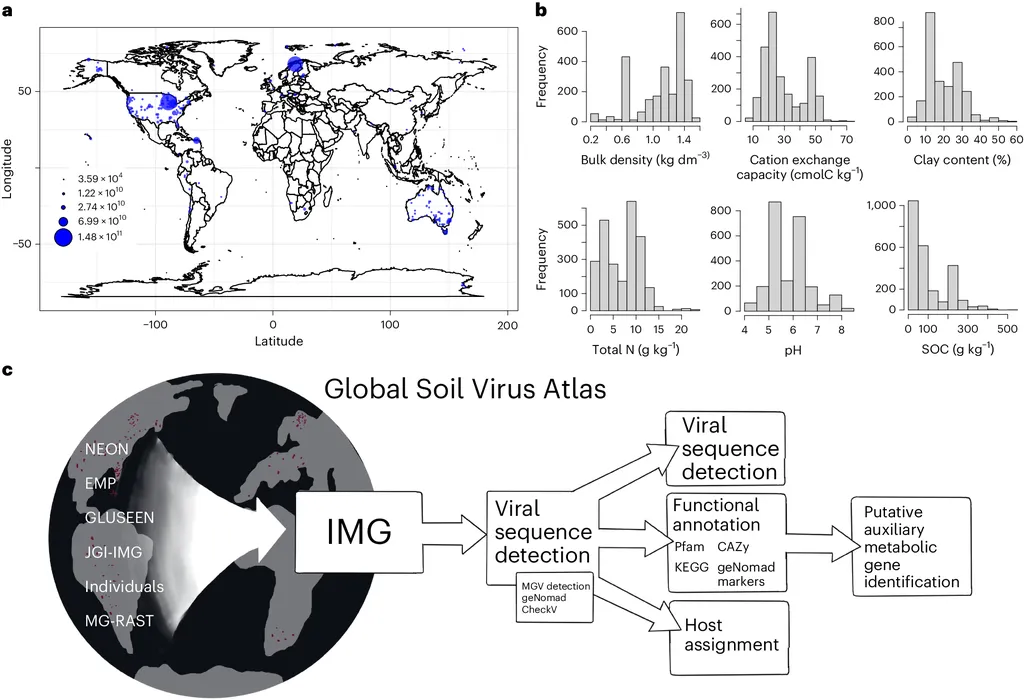
In the vast, unseen world of soil microbiomes, viruses play a pivotal role in regulating microbial dynamics and biogeochemical cycles. Among these, T4-like bacteriophages have long been a subject of intrigue, yet their distribution and the factors influencing their abundance have remained shrouded in mystery. A recent study published in *Environmental Microbiome* sheds light on these enigmatic viruses, revealing that temperature seasonality is a key driver of their abundance across diverse global ecosystems.
The research, led by Yachao Zhao from the Key Laboratory of Dryland Agriculture at the Chinese Academy of Agricultural Sciences, analyzed metagenomic data from 116 sites spanning 14 biomes across six continents. By examining two viral hallmark genes, gene 20 (g20) and gene 23 (g23), the team uncovered broad spatial patterns and identified dominant environmental factors influencing the distribution of T4-like bacteriophages.
“Our findings reveal that temperature seasonality constrains the abundance of soil T4-like bacteriophages,” Zhao explained. “This suggests that these viruses are sensitive indicators of climate-driven environmental shifts and play important ecological roles within soil microbial communities.”
The study found that the relative abundance of g20 and g23 was higher in tropical climates and lower in polar and dry regions, indicating a strong climatic influence. Temperature seasonality, in particular, showed a significant negative correlation with the relative abundance of both genes. Using an extreme gradient boosting (XGBoost) model, the researchers predicted global distribution patterns, revealing concordant global trends with lower relative abundances in regions with greater seasonal temperature variation.
The implications of this research extend beyond academic curiosity, offering valuable insights for the agriculture sector. Understanding the distribution and ecological roles of T4-like bacteriophages can help farmers and agronomists develop more effective soil management practices. For instance, the presence of these viruses can influence soil fertility and microbial dynamics, which are critical for crop health and productivity.
“By comprehending the factors that drive the abundance of these viruses, we can better predict how changes in climate will impact soil health and agricultural productivity,” Zhao noted. “This knowledge can guide the development of strategies to mitigate adverse effects and enhance soil resilience.”
The study also highlights the importance of further research into the ecological roles of T4-like bacteriophages and their interactions with soil microbial communities. As climate change continues to alter global temperature patterns, understanding these dynamics will be crucial for maintaining sustainable agricultural practices.
In an era where climate change is reshaping ecosystems worldwide, this research provides a foundation for exploring how soil microbiomes will adapt and evolve. The findings not only advance our understanding of viral ecology but also offer practical applications for the agriculture sector, paving the way for more resilient and productive farming practices in the face of a changing climate.