
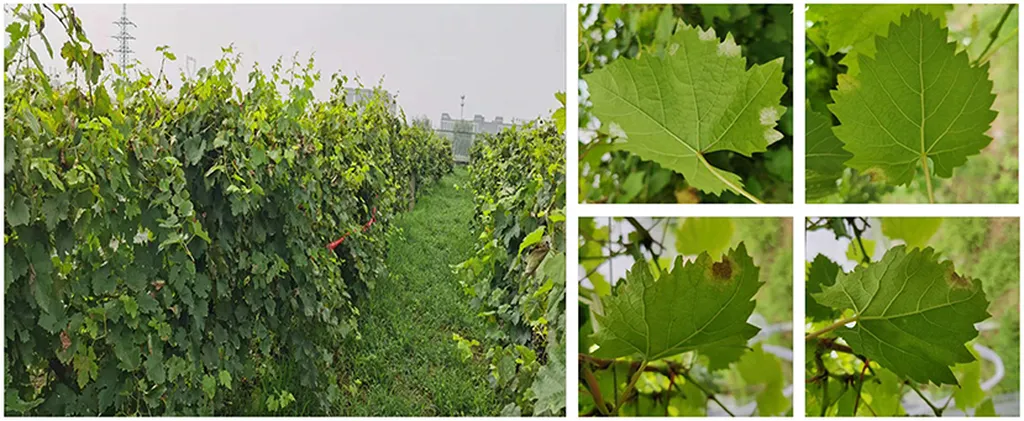
In the ever-evolving landscape of precision agriculture, a groundbreaking study published in *BMC Plant Biology* offers a promising solution for early detection of grapevine downy mildew (GDM) using unmanned aerial vehicles (UAVs). The research, led by Chunyang Li from the College of Information Science and Technology & Artificial Intelligence at Nanjing Forestry University, introduces a lightweight detection network (GDM-Net) that addresses several critical challenges in UAV-based imaging.
Grapevine downy mildew is a significant threat to vineyards worldwide, causing substantial economic losses. Early detection is crucial for effective disease management, but traditional methods often fall short due to limitations in imaging technology and computational power. The study highlights the difficulties posed by natural light overexposure, limited imaging resolution, and severe canopy occlusion, which obscure early lesions and hinder accurate detection.
To tackle these issues, the researchers developed a CLAHE–Unsharp Masking–Gamma Correction (CUG) image enhancement framework. This innovative approach expands the regional dynamic range, emphasizes high-frequency lesion details, and redistributes image brightness, significantly improving the visibility of early lesions. “Our CUG framework effectively alleviates the issue of weak and difficult-to-recognize early lesion features, making it easier to detect GDM at its earliest stages,” Li explained.
The study also introduces the YOLOv11n backbone, which integrates an Adaptive Instance-aware Feature Interaction (AIFI) mechanism. This mechanism achieves sparse and efficient feature interaction with minimal computational cost, enhancing feature extraction with high efficiency and accuracy. Additionally, the Adaptive Dual-Path Fusion Attention (ADFA) module in the neck architecture performs multiscale convolutional feature extraction, cross-attention interaction, and adaptive dynamic fusion between feature pathways. This improves the discriminative capacity under occlusion and clustering conditions, addressing a key bottleneck in UAV-based GDM detection.
The experimental results are promising. The CUG image enhancement framework significantly improves early lesion visibility and feature separability under complex illumination conditions. GDM-Net demonstrates superior onboard deployment feasibility compared with other mainstream models, achieving a 5.6% improvement in mAP@50 and a 6.5% improvement in mAP@50:95, while requiring only 7.5 GFLOPs of computational cost.
The implications for the agriculture sector are substantial. Early and accurate detection of GDM can lead to timely interventions, reducing crop losses and improving yield quality. This technology has the potential to revolutionize crop health management systems, making them more efficient and intelligent. As Li noted, “GDM-Net provides an efficient and practical solution for UAV-based crop disease monitoring, highlighting its potential for broader applications in precision agriculture.”
This research not only addresses current challenges but also paves the way for future developments in the field. The integration of image information enhancement and improved lightweight detection could inspire similar innovations for other crop diseases, enhancing the overall resilience of agricultural systems. As the agriculture sector continues to embrace technological advancements, studies like this one will play a pivotal role in shaping the future of crop health management.