
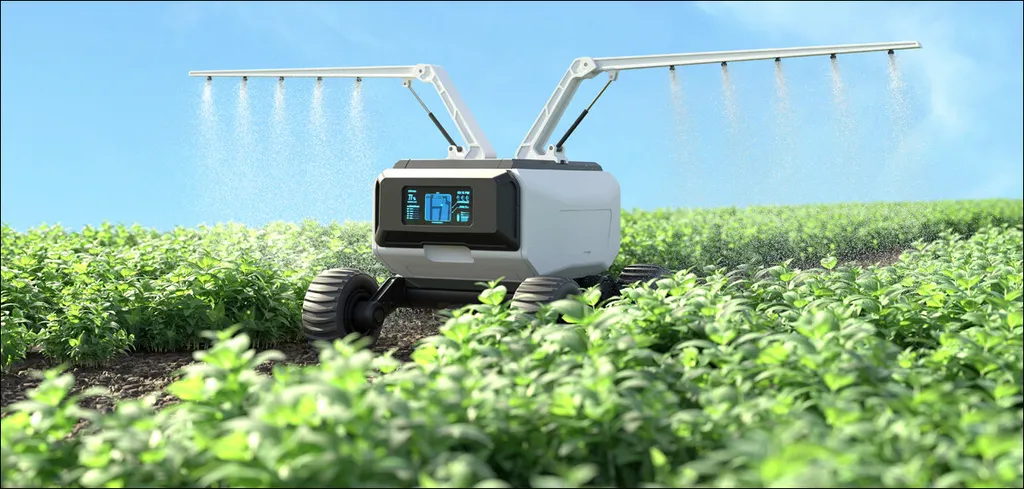
In the ever-evolving landscape of agricultural technology, a groundbreaking study published in *AIMS Mathematics* is set to revolutionize how we approach the selection of artificial intelligence-powered agricultural field robots. The research, led by Muhammad Bilal Khan, introduces a novel framework that combines interval intuitionistic fuzzy sets (IFSs) and circular intuitionistic fuzzy sets (C-IFSs) to create a more flexible and robust decision-making tool.
The study presents the concept of $ {\mathcal{L}}^{p} $-intuitionistic fuzzy sets ($ {\mathcal{L}}^{p} $-$ IFS $), which allows for a more nuanced representation of uncertain data. By using different shapes—diamonds, circles, stars, and squares—to depict degrees of membership and non-membership, this new framework enables decision-makers to evaluate options within a broader context. “The structure of a $ {\mathcal{L}}^{p} $-$ IFS $ facilitates the representation of information through points on different shapes with respect to $ pth $-norm with a designated center and norm $ ‘\aleph ‘ $, thereby enabling a more precise characterization of the fuzziness inherent in uncertain data,” explains Khan.
This innovation is particularly significant for the agriculture sector, where the selection of AI-powered field robots is a complex multi-attribute decision-making (MADM) problem. The proposed methodology not only outlines fundamental operations involving $ {\mathcal{L}}^{p} $-$ IFSs $ but also introduces a novel scoring function and an accuracy function that incorporates the decision-makers’ attitude ($ \lambda $). This flexibility allows for a more tailored approach to decision-making, depending on whether the decision-maker is optimistic or pessimistic.
The commercial impacts of this research are substantial. As the agriculture sector increasingly turns to AI-powered solutions to enhance efficiency and productivity, the ability to make more nuanced and informed decisions about the selection of field robots can lead to significant cost savings and improved outcomes. “The proposed methodology was applied to a problem concerning the selection of the optimal artificial intelligence (AI) agricultural field robots multi-attribute decision-making ($ MADM $) framework,” notes Khan. This application demonstrates the practical relevance of the research and its potential to shape future developments in the field.
Moreover, the study presents a framework for addressing MADM challenges within a $ {\mathcal{L}}^{p} $-intuitionistic fuzzy context, highlighting the versatility and applicability of the proposed method. The time complexity of the proposed method and a comparative analysis were also evaluated, ensuring that the framework is not only theoretically sound but also practically feasible.
As the agriculture sector continues to evolve, the integration of advanced decision-making tools like $ {\mathcal{L}}^{p} $-$ IFS $ can pave the way for more efficient and effective use of AI-powered technologies. This research, led by Muhammad Bilal Khan and published in *AIMS Mathematics*, is a testament to the potential of innovative mathematical frameworks to drive progress in the agriculture sector. The study’s findings are poised to shape future developments, offering a more flexible and robust approach to decision-making in the ever-changing landscape of agricultural technology.