
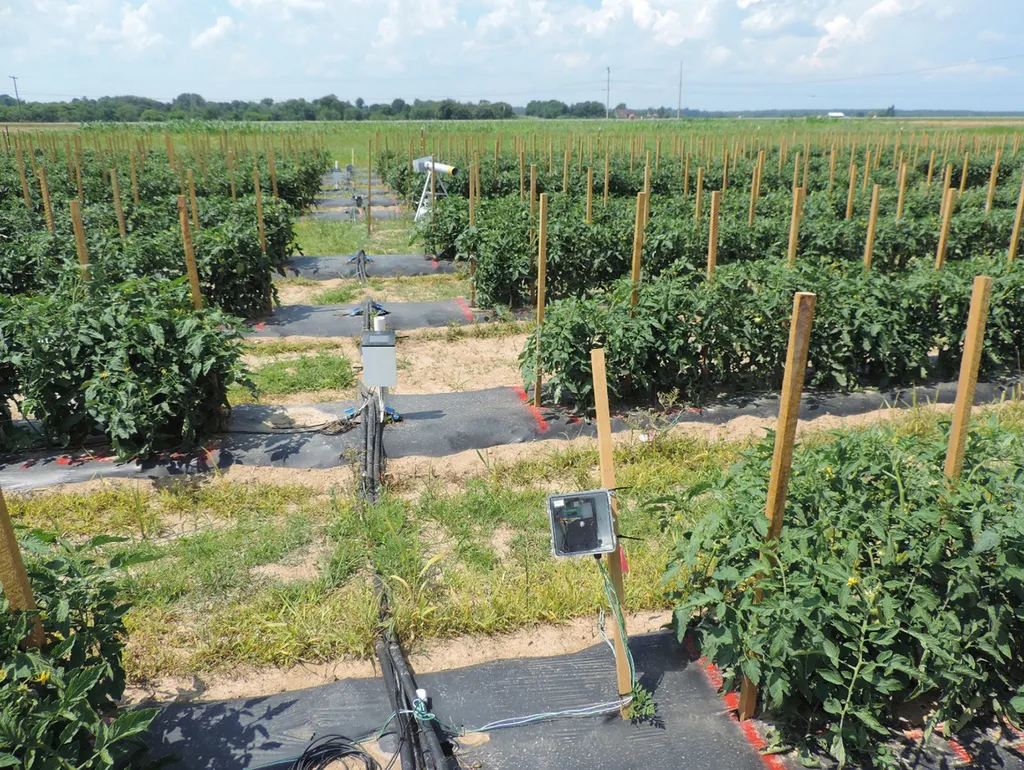
In the face of escalating global food security challenges and water scarcity, a groundbreaking study published in *Mathematical Biosciences and Engineering* offers a promising solution for the agriculture sector. Researchers have developed an Internet of Things (IoT)-driven predictive analytics framework designed to optimize irrigation in tomato cultivation, potentially revolutionizing how farmers manage water resources.
The study, led by Maung Maung Htwe, introduces a sophisticated model that estimates daily water requirements with remarkable precision. By leveraging data from multi-sensor IoT deployments, the framework monitors environmental conditions such as air temperature, humidity, CO2 levels, and pressure, alongside critical soil parameters like humidity, temperature, and electrical conductivity. This comprehensive dataset enables the model to extract temporal patterns, inter-variable relationships, and insights from agronomic indicators like Growing Degree Days (GDD).
The model employs a two-part eXtreme Gradient Boosting (XGBoost) regression approach, combining classification and regression techniques to predict the daily water volume needed per hectare. The innovation lies in its ability to transform complex historical IoT data into actionable intelligence for irrigation scheduling. “This framework not only minimizes water consumption but also ensures optimal soil health, which is crucial for sustainable agriculture,” said Maung Maung Htwe.
The implications for the agriculture sector are substantial. By achieving a high R2 value of 0.9476 and demonstrating a potential water saving of 50.84% in simulated dynamic optimization compared to raw predictions, the model offers a robust tool for precision irrigation. This intelligence empowers farmers to reduce water waste and prevent harmful over-irrigation, leading to more efficient and sustainable practices.
The study’s findings provide a foundation for data-driven insights that can inform highly effective precision irrigation strategies. As climate change continues to impact agricultural practices, such innovations are critical for enhancing crop resilience and resource efficiency. The research suggests that future developments in IoT-driven predictive analytics could further optimize irrigation systems, potentially extending to other crops and regions.
While the lead author’s affiliation remains unknown, the study’s impact on the agriculture sector is undeniable. By integrating advanced machine learning techniques with IoT technology, this research paves the way for smarter, more sustainable farming practices. As the agriculture industry continues to evolve, the adoption of such technologies could play a pivotal role in addressing global food security and water management challenges.