
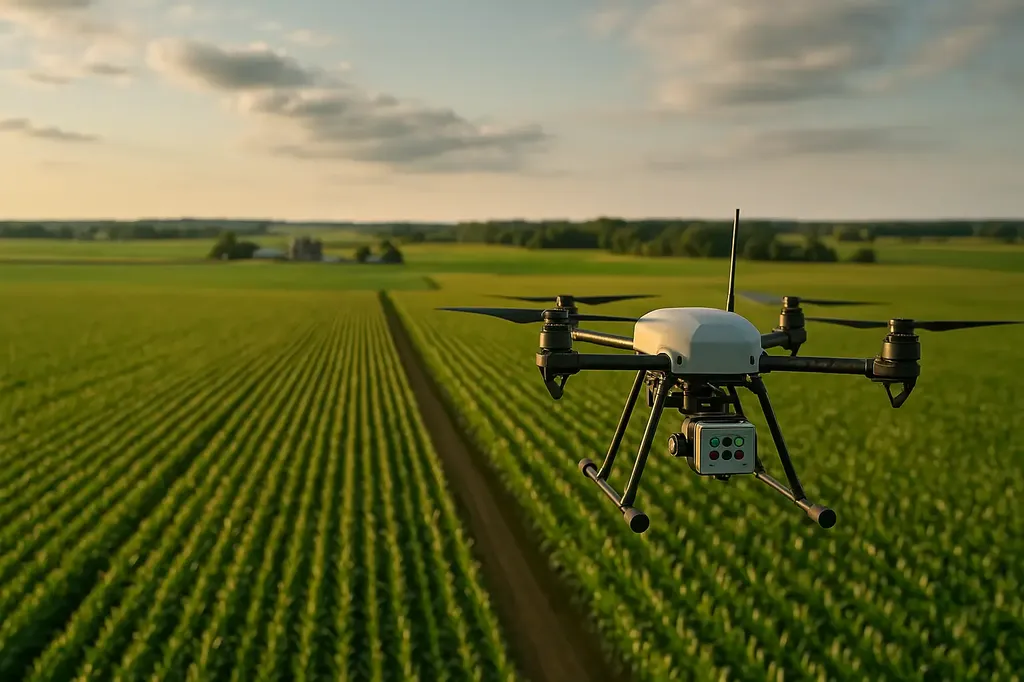
In the heart of Mexico’s Coahuila state, researchers have developed a cutting-edge system that could revolutionize pest detection in agriculture. The innovative approach, published in *Smart Agricultural Technology*, combines drones and artificial intelligence to spot early signs of the Hellula undalis pest in cabbage crops, offering a promising solution to combat crop losses and boost food security.
The system, developed by Rodolfo De Jesus Villalobos-Salazar and his team at Cinvestav Saltillo, uses a drone equipped with a camera to capture video footage of cabbage leaves. From this footage, the team created a dataset of 1981 images showing leaves with pest damage and an equal number without. They then trained a YOLOv8 deep learning model to distinguish between the two. The drone, navigated autonomously using Simultaneous Localization and Mapping (SLAM) techniques, can detect pest damage in real-time, with a precision of 60%.
“This system proves effective starting from the second week of cabbage growth,” said Villalobos-Salazar. “Early detection is crucial for preventing or reducing crop and financial losses.”
The implications for the agriculture sector are significant. With global crop losses due to pests and diseases ranging from 20% to 40%, according to the Food and Agriculture Organization (FAO), early detection systems like this could help farmers minimize losses and maximize yields. Moreover, the system’s real-time capabilities allow for prompt intervention, potentially saving crops before damage becomes severe.
The research also opens up new avenues for future developments. As Villalobos-Salazar explains, “Our work demonstrates the potential of combining drones, AI, and real-time detection for pest management. This approach could be adapted for other crops and pests, further enhancing food security.”
The commercial impact of this research could be substantial. By reducing crop losses, farmers could see increased profits, and the agricultural industry could become more sustainable. Additionally, the system’s real-time monitoring capabilities could lead to more efficient use of pesticides, reducing environmental impact.
As the global population continues to grow, reaching an estimated 9.8 billion by 2050, innovations like this will be crucial in meeting the rising demand for food. The work of Villalobos-Salazar and his team at Cinvestav Saltillo, published in *Smart Agricultural Technology*, marks a significant step forward in the fight against crop pests, offering a glimpse into the future of agricultural technology.