
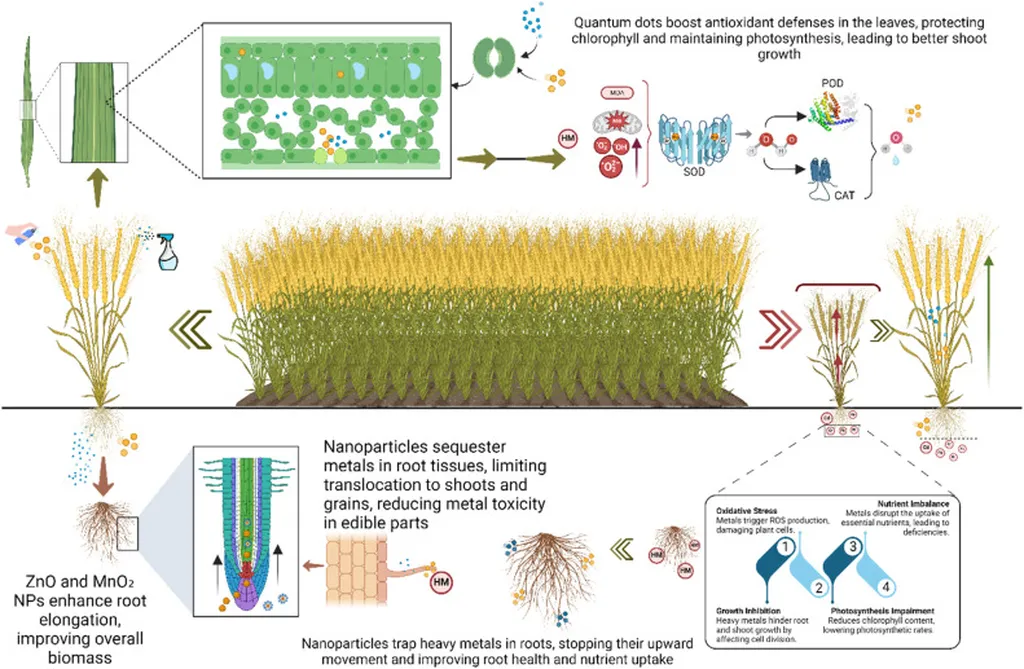
In the heart of Pakistan’s Punjab region, a groundbreaking review is stirring the pot in the world of agricultural science. Muhammad Hammad, a researcher from Thal University Bhakkar, has just published a comprehensive review in *Frontiers in Plant Science* that could reshape how we tackle heavy metal contamination in crops. The focus? Nanoparticles and their potential to induce tolerance in crops stressed by heavy metals, with a twist—genotypic modulation.
Heavy metal contamination is a global scourge, silently stealing from our soils and crops. It’s a problem that’s been around for ages, but solutions have been limited and often ineffective. Enter nanoparticles, tiny powerhouses with unique properties that could turn the tide. Hammad’s review delves into how these nanoparticles can modulate genotypic responses, offering a novel approach to mitigating heavy metal stress in crops.
The review highlights that nanoparticles outperform conventional methods in improving physiological traits, reducing metal uptake, and enhancing antioxidant defenses. “Nanoparticles have shown significant promise in enhancing crop resilience against heavy metal stress,” Hammad notes. “Their unique properties allow them to interact with plants at the genetic level, modulating responses in ways that conventional methods simply can’t.”
But the story doesn’t end there. Hammad’s review also underscores the importance of genotypic diversity. Different crop genotypes respond differently to nanoparticles, a factor that has been often overlooked in previous research. This genotypic modulation, mediated by differential gene expression and epigenetic regulation, opens up new avenues for tailored, crop-specific solutions.
The commercial implications for the agriculture sector are substantial. With heavy metal contamination costing the global economy billions annually, nanoparticles could offer a much-needed lifeline. They could enhance crop yields, improve soil health, and ensure food safety, all while being more effective than traditional methods.
However, the path forward isn’t without its challenges. Hammad points out that current research is hampered by methodological heterogeneity and insufficient data synthesis. Moreover, the long-term impacts and environmental safety of nanoparticles are still not fully understood.
Yet, the potential is undeniable. As Hammad puts it, “This review contributes to the development of novel nano-genomic strategies for sustainable crop resilience against heavy metal contamination.” By integrating omics tools and nanoparticles, we could be on the cusp of a new era in agricultural science, one that promises to be more sustainable, more resilient, and more productive.
In the meantime, researchers like Hammad are paving the way, one nanoparticle at a time. Their work is a testament to the power of innovation and the potential of science to transform our world. As we stand on the brink of this nano-genomic revolution, one thing is clear— the future of agriculture is looking brighter, one genotype at a time.