
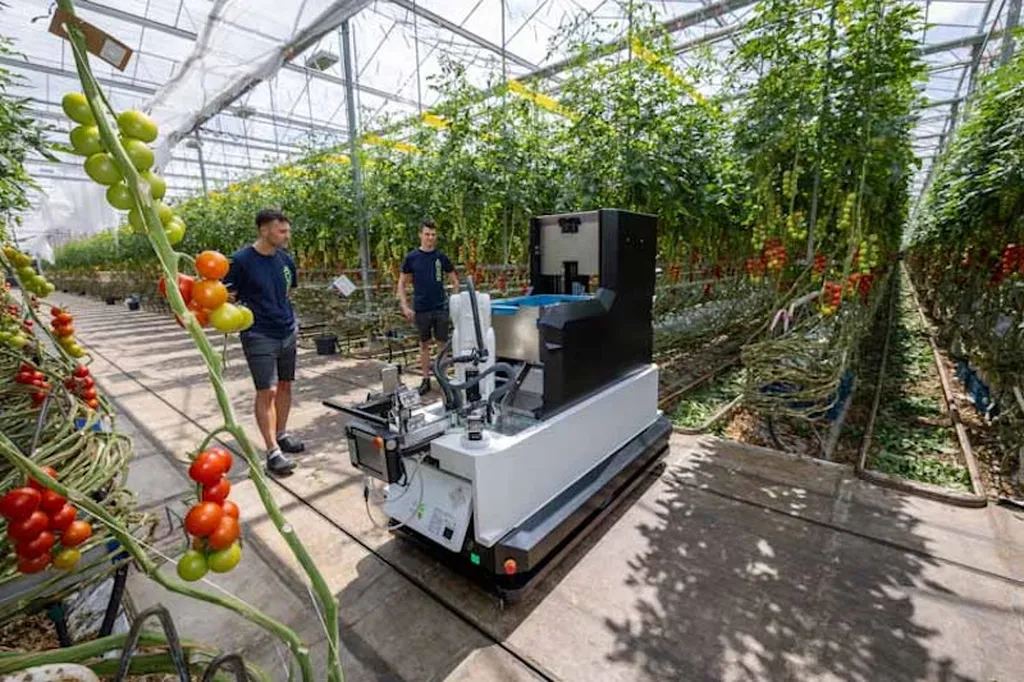
In the heart of the Netherlands, at the NPPL-R Horticulture annual event in Bunnik, two tomato harvesting robots were put to the test in cocktail tomato crops. The robots, GRoW from Ridder/Metomotion and Artemy from Certhon/Denso, showcased their unique approaches and points of attention, with overlapping issues and findings.
The GRoW robot, currently being tested in a greenhouse at growers Erwin van der Lans and Jan van Marrewijk in Dinteloord, has two robot arms working in parallel for the crop rows to the left and right of the robot. Its battery capacity is housed in an integrated trolley where the harvest crates are discharged. However, the robot automation is not yet aligned with the conveyor system and other logistics, requiring an operator to manually grant permission to move to the next row.
On the other hand, the Artemy robot operates on one side along the plant rows, moving fully autonomously to the next harvest row or to the trolley. It has a larger internal battery with a capacity of 5.5 hours. The cutting mechanism is designed to cut the truss stem as close as possible along the main stem, limiting the entry point for viruses and fungi.
Both robots require some additional time to manually prepare the rows of cocktail tomatoes in advance for robotic harvesting. This includes correcting trusses that hang over another stem or become entangled, removing (dry) leaves hanging on the truss, or stems and trusses hanging in front of each other. Messier trusses in a later cultivation phase with an older crop result in a lower success rate.
During the WUR validation tests, the GRoW robot managed to harvest half of the number of trusses that staff had classified as manually harvestable. Calculated against the total number of harvestable trusses according to pre-agreed specifications, performance amounted to 75%. To allow the GRoW robot to function optimally, a number of agreements were made with grower Lans regarding minimum values to be maintained for the distance between stem and heating pipe, truss density per m2 and the free fruit stem length.
Practical experiences with the GRoW robot revealed that missed harvesting attempts are caused by stems and trusses being struck and pushed aside by the gripper, and by clips on the plant that disrupt detection of the cutting point. Trusses hanging in front of each other also hinder successful operation by the robot. Harvest workers place 18 trusses in a crate, neatly all with the crowns facing upwards. The robot fills them to 80% (15 trusses), and when placing them onto a small conveyor belt to the harvest container they sometimes end up upside down.
At grower ACRES, tests were carried out with the Artemy harvesting robot. This test focused primarily on the reliability of the robot, meaning damage-free and fault-free operation, and not yet on speed or cooperation with other automation systems in the greenhouse. The target was to harvest 50% of the harvestable trusses. At a higher percentage, the efficiency of the robot decreases, as it then requires more time to detect and approach the more difficult trusses.
The implications of these findings are significant for the future of tomato harvesting. As the technology improves and becomes more reliable, it could revolutionize the way tomatoes are harvested, increasing efficiency and reducing labor costs. However, it is clear that there is still work to be done in terms of fine-tuning the robots and optimizing the growing conditions for robotic harvesting. The future of tomato harvesting is here, but it is not yet perfect.