
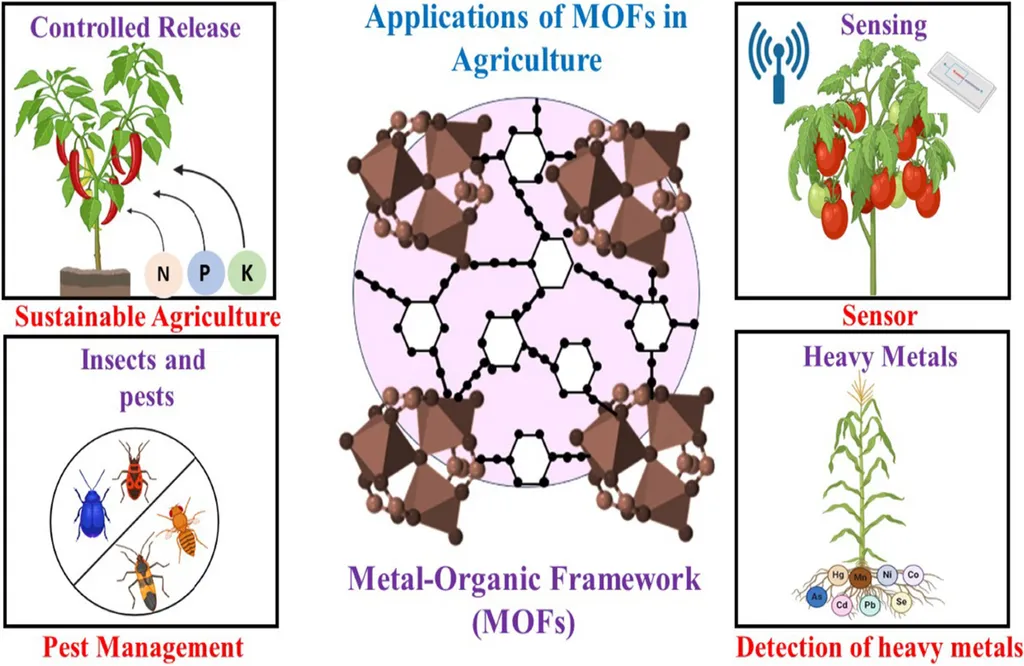
In the ever-evolving world of agricultural technology, a recent study published in *ACS Omega* is making waves with its innovative approach to nutrient delivery in soils. The research, led by Lianjie Wan from the State Key Laboratory of Soil and Sustainable Agriculture at the Chinese Academy of Sciences, delves into the fascinating realm of bimetallic metal-organic frameworks (MOFs) and their potential to revolutionize how nutrients are released into agricultural systems.
At the heart of this study is the exploration of Fe/Zn-tannic acid frameworks, a novel class of MOFs that leverage the competitive dynamics between iron and zinc ions to modulate their structure and nutrient release properties. This is not just a scientific curiosity; it’s a potential game-changer for sustainable agriculture. By fine-tuning the composition of these frameworks, researchers can control the rate at which nutrients are delivered to plants, ensuring a steady supply that maximizes growth and minimizes waste.
“Our findings suggest that by carefully balancing the ratio of iron to zinc in these frameworks, we can create a system that releases nutrients in a sustained manner,” explains Wan. “This could be a significant step forward in precision agriculture, allowing farmers to apply nutrients more efficiently and reduce the environmental impact of runoff.”
The implications for the agriculture sector are substantial. Traditional fertilizers often lead to nutrient leaching, where excess nutrients wash away before plants can absorb them, leading to environmental degradation and wasted resources. The bimetallic MOFs studied by Wan and his team offer a more controlled approach, potentially reducing the need for frequent fertilizer applications and mitigating the environmental footprint of modern farming practices.
Moreover, the versatility of these frameworks opens the door to a range of applications beyond just iron and zinc. The principles demonstrated in this research could be applied to other essential nutrients, creating a suite of tailored nutrient delivery systems that cater to the specific needs of different crops and soil conditions.
“This research is a testament to the power of interdisciplinary collaboration,” says Wan. “By combining insights from materials science, chemistry, and agronomy, we can develop solutions that address some of the most pressing challenges in agriculture today.”
As the agricultural industry continues to seek sustainable and efficient solutions, the work of Wan and his team provides a promising avenue for innovation. The study not only advances our understanding of bimetallic MOFs but also paves the way for future developments in nutrient management, potentially reshaping the landscape of modern farming.
In a field where precision and sustainability are increasingly critical, this research offers a glimpse into a future where technology and agriculture converge to create more resilient and productive systems. As the findings are further explored and developed, they could play a pivotal role in shaping the next generation of agricultural practices, benefiting both farmers and the environment alike.