
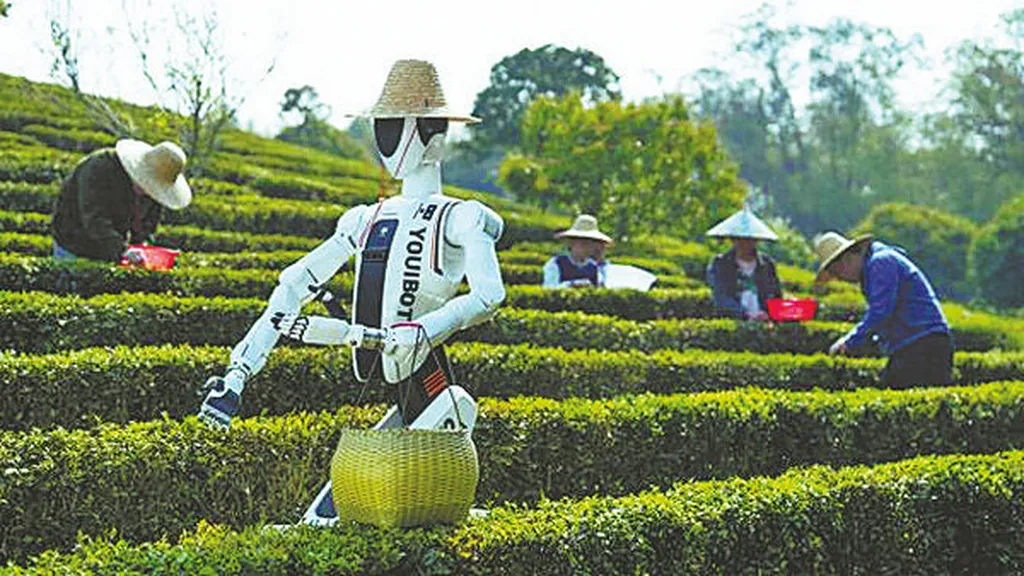
In the heart of China’s tea-growing regions, a technological revolution is brewing, one that promises to reshape the future of tea harvesting. A team of researchers, led by JIA Jiangming from Zhejiang Sci-Tech University, has developed a groundbreaking collaborative planning method for dual-arm tea-picking robots. Their work, published in the journal ‘Chaye kexue’, addresses critical challenges in the tea industry, including labor shortages and the need for high-precision picking.
The researchers’ innovative approach dynamically allocates picking points and optimizes the robotic arm’s path using an ant colony algorithm. This method significantly improves the operational efficiency of tea-picking robots. “Our simulation results show an average time of 1.41 seconds for one-shoot picking, with a 91.95% time ratio for dual-arm synchronous operation,” explains JIA. “This is a substantial improvement over existing methods.”
The implications for the agriculture sector are profound. Tea-picking robots equipped with this technology can operate more efficiently, reducing labor costs and addressing the chronic shortage of workers in the industry. Moreover, the robots achieve full coverage of the picking space, ensuring that no tea leaves are left behind. In field experiments, the robots demonstrated a 29.95% improvement in picking time compared to single-arm robots.
The researchers also overcame the limitations of depth cameras by proposing a dynamic addition of picking point planning. This innovation allows the depth camera and the robotic arm to operate in sync, further enhancing the robot’s efficiency. “This method not only significantly improves the operational efficiency of the tea-picking robot but also achieves full coverage of the space, ensuring efficient collaborative picking,” says JIA.
The commercial impact of this research could be substantial. As the global demand for high-quality tea continues to rise, the need for efficient and precise harvesting methods becomes ever more critical. Tea-picking robots equipped with this collaborative planning method could become a game-changer, helping tea producers meet market demands while reducing costs.
Looking ahead, this research could pave the way for further advancements in agricultural robotics. The dynamic allocation of picking points and the synchronization of depth cameras with robotic arms could be applied to other crops, revolutionizing the way we approach harvesting. As the agriculture sector continues to embrace technology, innovations like these will be crucial in shaping the future of farming.
The lead authors of this research, JIA Jiangming, WANG Xiang, ZHOU Yujie, WU Chuanyu, CHEN Jianneng, YU Rong, and LI Yujie, are affiliated with the School of Mechanical Engineering at Zhejiang Sci-Tech University, Zhejiang Ocean University, and the Key Laboratory of Agricultural Intelligent Perception and Robotics of Zhejiang Province. Their work represents a significant step forward in the field of agricultural robotics, with the potential to transform the tea industry and beyond.