
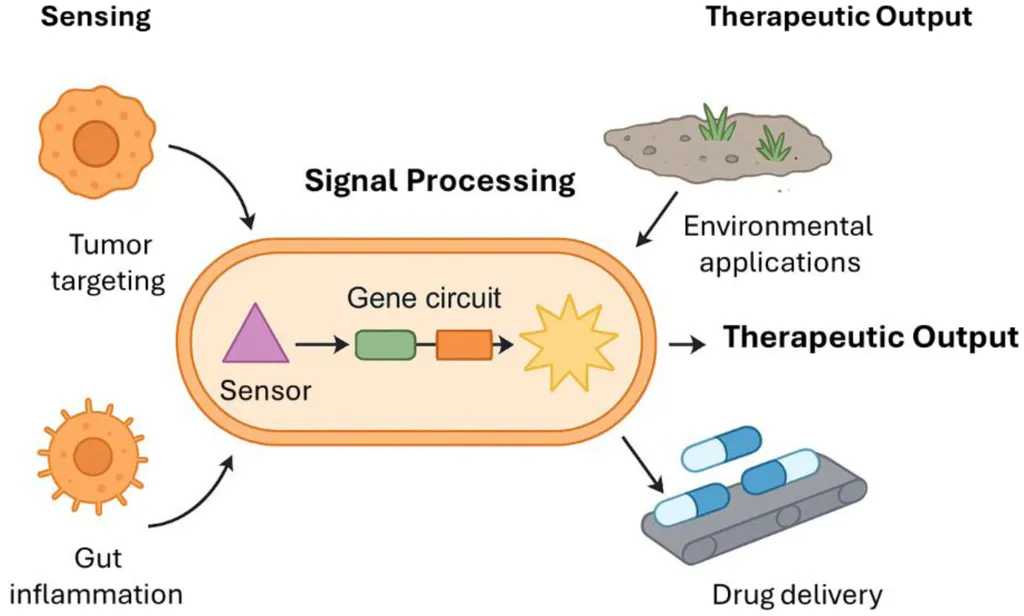
In a groundbreaking development, researchers have unveiled the potential of engineered bacteria as living therapeutics, offering a new frontier in precision medicine and beyond. This innovative approach, detailed in a recent review published in *AIMS Microbiology*, highlights how synthetic biology is transforming the way we tackle health, industrial, environmental, and agricultural challenges.
Engineered bacteria, designed to sense, respond to, and function within complex environments, are poised to revolutionize various sectors. “These microbial platforms provide unprecedented adaptability, allowing for real-time detection of disease signals and targeted therapeutic delivery,” explains lead author Imen Zalila-Kolsi from the College of Medical and Health Sciences at Liwa University in Abu Dhabi. This adaptability is not just limited to medical applications; it extends to agriculture, where these engineered microbes could play a pivotal role in sustainable farming practices.
The review underscores several key advancements in microbial engineering, including CRISPR-Cas systems, synthetic gene circuits, and modular plasmid architectures. These technologies enable fine-tuned control over microbial behavior and therapeutic output, making them highly versatile tools. “The integration of computational modeling and machine learning has further accelerated design, optimization, and scalability,” Zalila-Kolsi adds, highlighting the interdisciplinary nature of this research.
For the agriculture sector, the implications are profound. Engineered bacteria could be used to enhance crop resilience, improve soil health, and reduce the need for chemical fertilizers and pesticides. By precisely targeting pathogens or nutrient deficiencies, these living therapeutics could lead to more sustainable and efficient farming practices. This could not only boost yields but also reduce the environmental impact of agriculture, addressing some of the most pressing challenges in food security.
However, the path forward is not without its hurdles. Maintaining genetic stability, ensuring biosafety, and achieving reproducibility in clinical and industrial settings remain significant challenges. Ethical and regulatory frameworks are evolving to address these concerns, with a focus on dual-use considerations, public perception, and global policy disparities.
Looking ahead, the convergence of synthetic biology with nanotechnology, materials science, and personalized medicine is expected to pave the way for intelligent, responsive, and sustainable solutions. Engineered bacteria are poised to become transformative tools not only in disease treatment but also in diagnostics, biomanufacturing, pollution mitigation, and sustainable agriculture.
As this field continues to evolve, the potential for engineered bacteria to shape the future of agriculture and other sectors is immense. The research published in *AIMS Microbiology* by lead author Imen Zalila-Kolsi from the College of Medical and Health Sciences at Liwa University in Abu Dhabi offers a glimpse into a future where living therapeutics could redefine our approach to global health and environmental challenges.