
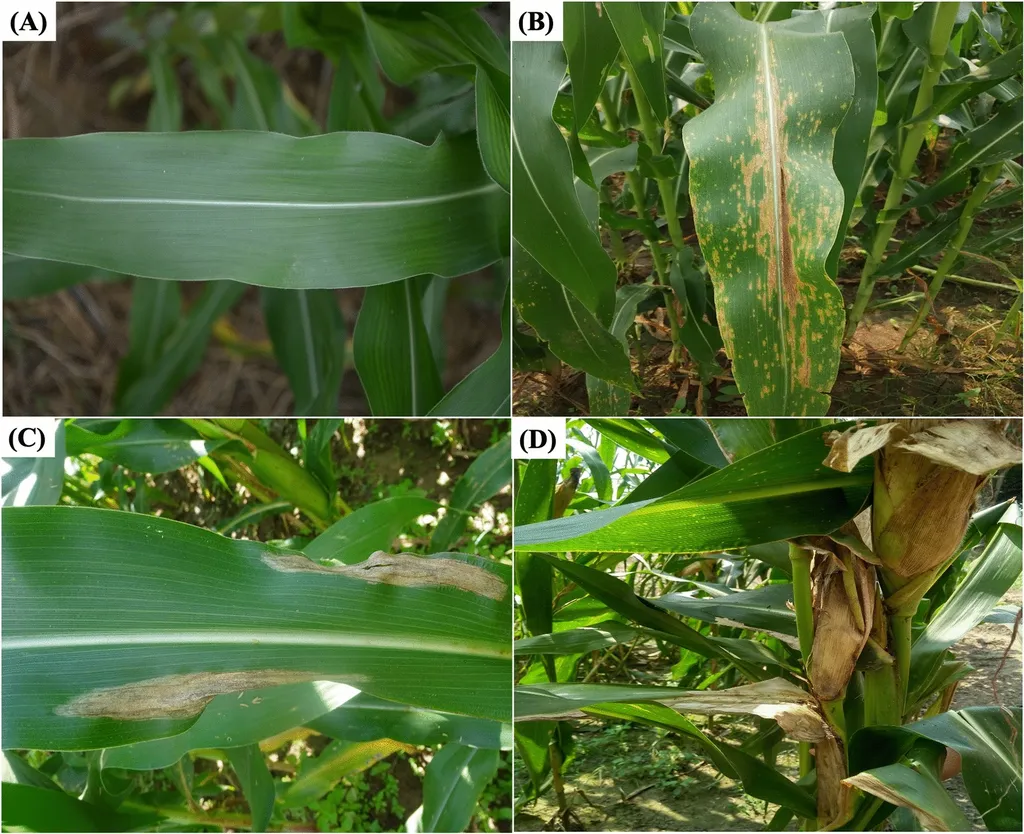
In the heart of Indonesia, a groundbreaking development is taking root, promising to revolutionize how farmers diagnose and combat corn diseases. Sukri Hanifudin, a researcher from the Department of Information System at Universitas Trunojoyo Madura, has led a study that could significantly enhance disease detection in corn, a staple crop vital to global agriculture. The research, published in EPJ Web of Conferences, introduces a deep learning-based expert system that interprets natural language descriptions of symptoms to identify diseases with remarkable accuracy.
The challenge of early disease detection in corn has long been hampered by the linguistic variability in describing symptoms. Farmers and agronomists often struggle with rigid, rule-based diagnostic systems that fail to account for the nuances of natural language. Hanifudin’s study addresses this issue head-on by developing a text classification model that can accurately interpret symptom descriptions, providing a more flexible and intuitive diagnostic tool.
The model employs Term Frequency-Inverse Document Frequency (TF-IDF) for feature extraction and a Multi-Layer Perceptron (MLP) architecture for classification. To ensure robustness and generalization, the researchers applied data augmentation and the Synthetic Minority Over-sampling Technique (SMOTE) to balance and expand the training dataset. The results are impressive: the model achieved an accuracy of 99.82%, with precision, recall, and F1-score values all equal to 1.00 across disease categories.
“This level of accuracy is a game-changer for the agriculture sector,” Hanifudin explains. “It means farmers can get real-time, reliable diagnoses based on simple descriptions of symptoms, enabling them to take swift action and prevent the spread of diseases.”
The trained model was successfully converted into TensorFlow Lite (tflite) format for mobile deployment, making it accessible to farmers in the field. The system was integrated into an Android-based mobile application named JagungKu, providing real-time diagnostic results and empowering farmers with the tools they need to protect their crops.
The commercial impacts of this research are substantial. Early disease detection can lead to significant cost savings by reducing crop losses and minimizing the need for extensive pesticide use. It also supports sustainable precision agriculture, allowing farmers to target treatments more effectively and reduce environmental impact.
Looking ahead, this research opens up exciting possibilities for the future of agricultural technology. As Hanifudin notes, “The potential of deep learning in agriculture is vast. This is just the beginning. We can expect to see more intelligent systems that interpret natural language and provide real-time, actionable insights for farmers.”
The integration of advanced technologies like deep learning into agricultural practices is not just about improving efficiency; it’s about creating a more sustainable and resilient food system. As the global population grows and climate change poses increasing challenges, innovations like Hanifudin’s expert system will be crucial in ensuring food security and supporting farmers worldwide.
In the coming years, we can anticipate further developments in text-based disease detection systems, as well as the expansion of these technologies to other crops and agricultural challenges. The work of Sukri Hanifudin and his team serves as a testament to the power of interdisciplinary research and the transformative potential of agritech. As the agriculture sector continues to evolve, the fusion of artificial intelligence and agricultural science will undoubtedly play a pivotal role in shaping its future.