
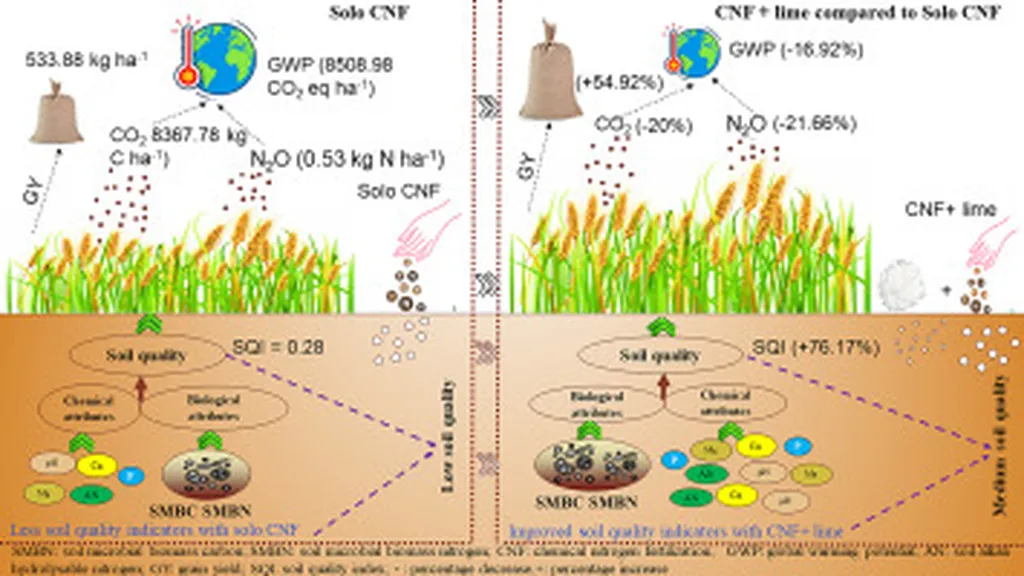
In a groundbreaking study published in *Geoderma*, researchers have uncovered critical insights into how nitrogen fertilization impacts soil health, particularly in acidic soils. The study, led by Shijie He from the State Key Lab for Conservation and Utilization of Subtropical Agri-Biological Resources at Guangxi University, analyzed data from 2,348 field trials across 157 sites worldwide. The findings reveal that nitrogen fertilization induces greater loss of base cations and accumulation of exchangeable acids in acidic soils compared to neutral soils, with significant implications for global agriculture.
The research highlights that under nitrogen fertilization, exchangeable potassium (K+), calcium (Ca2+), and magnesium (Mg2+) decreased significantly in acidic soils by 20.3%, 48.6%, and 43.3%, respectively. In contrast, neutral soils experienced much lower decreases of 17.9%, 14.5%, and 6.3%. Additionally, the exchangeable acid content in acidic soils increased by 116.5%, far surpassing the 35.7% increase observed in neutral soils.
“Acidic soils are more sensitive to nitrogen fertilization than neutral soils and more susceptible to soil acidification,” said Shijie He, the lead author of the study. This sensitivity underscores the urgent need for targeted soil management practices to mitigate the adverse effects of nitrogen fertilization.
The study also found that the accumulation of exchangeable acids could be effectively inhibited when soil organic matter content exceeded 25.0 g/kg. Furthermore, the addition of calcium was found to be crucial for retaining soil organic matter, offering a potential strategy for alleviating soil acidification.
The commercial impacts of these findings are substantial. Soil acidification affects 40–70% of croplands worldwide, and the intensifying use of nitrogen fertilizers is exacerbating the problem. Understanding the dynamics of base cations and exchangeable acids in different soil pH levels can help farmers and agronomists develop more effective soil management strategies. This, in turn, can enhance crop productivity and sustainability, ultimately benefiting the global agriculture sector.
The research also provides scientific evidence for quantifying the threshold of organic matter content for acidification relief. This knowledge is invaluable for developing targeted interventions that can mitigate soil acidification and improve soil health.
As the agriculture sector continues to grapple with the challenges of soil degradation and climate change, this study offers a crucial stepping stone towards more sustainable and resilient farming practices. By understanding the intricate relationships between nitrogen fertilization, soil pH, and soil chemistry, researchers and practitioners can work together to develop innovative solutions that safeguard soil health and ensure food security for future generations.
The findings of this study, published in *Geoderma*, underscore the importance of ongoing research in soil science and highlight the need for collaborative efforts to address the pressing issue of soil acidification. As Shijie He and his team continue to explore these dynamics, their work will undoubtedly shape the future of agriculture and contribute to a more sustainable food system.