
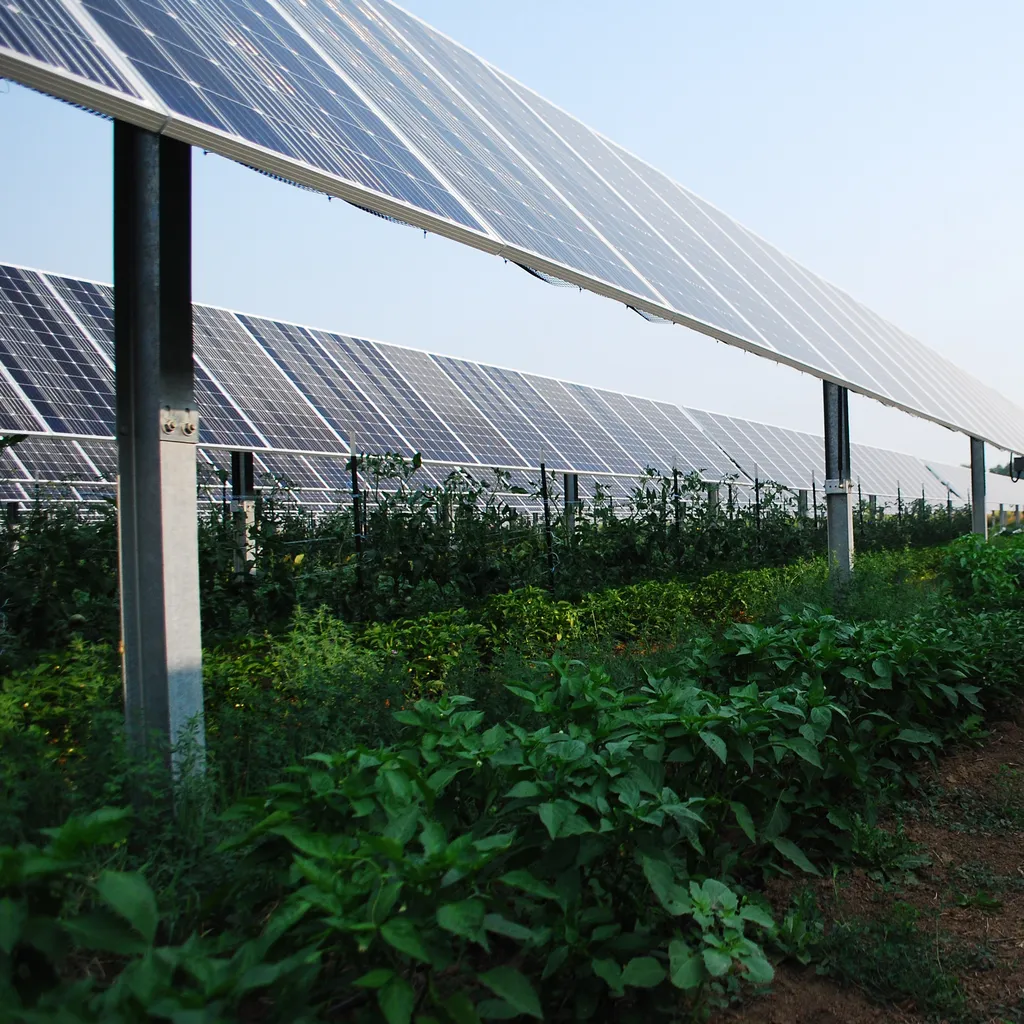
In the sun-drenched landscapes of West Sumbawa, a pioneering project is redefining the boundaries of land productivity and sustainability. PT Medco Energi, through its subsidiary PT MPSoS, has embarked on an innovative journey by integrating solar energy generation with agricultural activities. This agrovoltaic approach, as detailed in a recent study published in *Advances in Food Science, Sustainable Agriculture, and Agroindustrial Engineering*, is not just a scientific endeavor but a potential game-changer for the agriculture sector.
The project, led by Nurul Amri Komarudin from Universitas Singaperbangsa Karawang, involves the cultivation of seedless watermelons beneath solar panels installed on a 27-hectare site. The site, capable of generating 26.8 MWp of energy, is a testament to the region’s abundant sunlight and its potential for renewable energy development. “The idea is to maximize land use efficiency,” explains Komarudin. “By growing crops under solar panels, we can simultaneously produce energy and food, addressing two critical needs with one solution.”
The study’s field experiment involved growing watermelons across 11 panel arrays, with varying plot sizes. The results were promising, with a crop establishment success rate exceeding 80%. This success underscores the potential of agrovoltaic systems to contribute to both energy generation and food sustainability. “The preliminary results are encouraging,” says Komarudin. “They suggest that agrovoltaic systems can be a viable strategy for enhancing land-use efficiency and promoting sustainable agriculture.”
The commercial implications for the agriculture sector are significant. Agrovoltaic systems could allow farmers to diversify their income streams by generating solar energy alongside their traditional crops. This could be particularly beneficial in regions with abundant sunlight, where the potential for solar energy generation is high. Moreover, the integration of solar panels with agriculture could help mitigate the impacts of climate change by reducing greenhouse gas emissions and promoting sustainable land use practices.
The study’s findings also open up new avenues for research and development in the field of agrovoltaics. Future studies could explore the feasibility of integrating different types of crops with solar panels, as well as the long-term impacts of agrovoltaic systems on soil health and biodiversity. Additionally, the economic viability of agrovoltaic systems could be further investigated, with a focus on the potential for scaling up these systems in different agricultural contexts.
In conclusion, the agrovoltaic project in West Sumbawa is a promising development in the field of sustainable agriculture. By integrating solar energy generation with agricultural activities, the project offers a innovative solution to the challenges of land use efficiency and food sustainability. As the world grapples with the impacts of climate change, such initiatives could pave the way for a more sustainable and resilient future for the agriculture sector.