
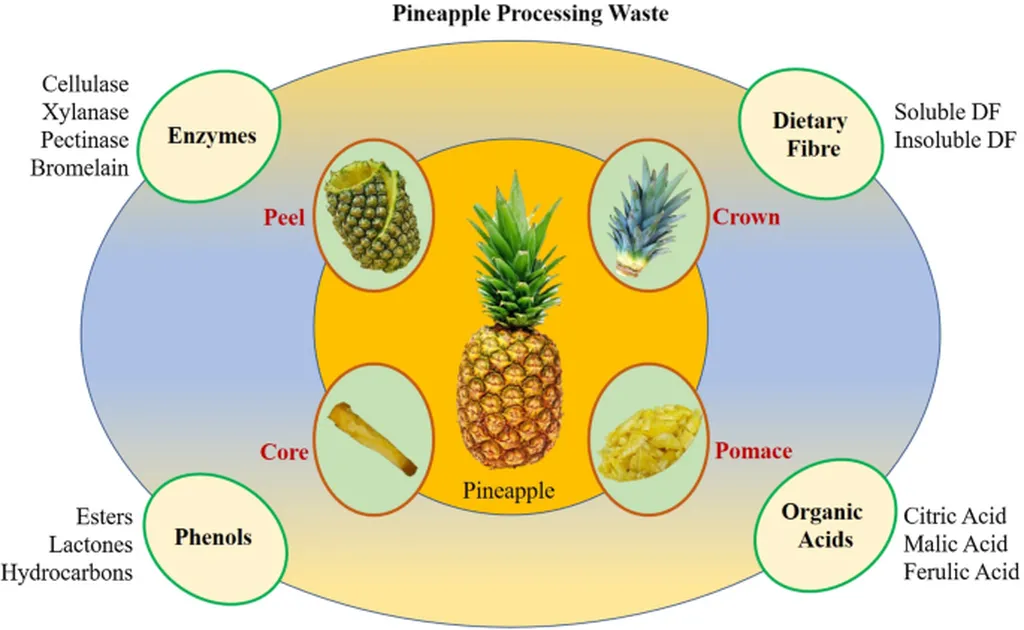
In the quest for sustainable and efficient methods to extract valuable compounds from agricultural waste, a recent study has unveiled a promising technique that could revolutionize the way we process pineapple peels. Published in *Advances in Food Science, Sustainable Agriculture, and Agroindustrial Engineering*, the research, led by Amalia Nur Kumalaningrum from Institut Teknologi Kalimantan, focuses on optimizing the ultrasonic-cellulase extraction (UCE) method to recover polyphenolic compounds with high antioxidant activity from pineapple peel waste.
Pineapple peels, often discarded as agricultural waste, are rich in phenolic compounds that have potential applications in functional foods and nutraceuticals. The study aimed to maximize the extraction of these compounds by fine-tuning various parameters, including solvent-to-sample ratio, enzyme concentration, pH, temperature, ultrasonic amplitude, and extraction time. The optimal conditions were found to be a solvent-to-sample ratio of 50 mL/g, an enzyme concentration of 15%, a pH of 6, a temperature of 50°C, an ultrasonic amplitude of 70%, and an extraction time of 120 minutes. These conditions yielded the highest total phenolic content of 37.80 ± 4.21 mg GAE/g.
Comparative analysis revealed that the UCE method outperformed both enzyme-assisted extraction (EAE) and ultrasonic-assisted extraction (UAE) alone. The UCE method produced a polyphenolic content of 28.04 ± 1.08 mg GAE/g and exhibited stronger antioxidant activity with an IC₅₀ value of 9.27 µg/mL. “The synergistic effect of ultrasonic cavitation and enzymatic hydrolysis significantly enhances the release of bioactive compounds,” explained Kumalaningrum. This finding underscores the potential of UCE as a green and energy-efficient technology for transforming agricultural waste into valuable natural antioxidants.
The commercial implications of this research are substantial. Pineapple is a widely cultivated crop, and the peels represent a significant portion of the fruit’s weight, often ending up as waste. By implementing the UCE method, agricultural processors can add value to this waste stream, creating new revenue opportunities. The extracted polyphenolic compounds can be used in the food and beverage industry to develop functional foods with enhanced health benefits, such as antioxidant-rich juices, supplements, and fortified products.
Moreover, the adoption of UCE technology aligns with the growing global emphasis on sustainability and circular economy practices. By converting agricultural waste into high-value products, the method contributes to environmental conservation and reduces the carbon footprint of the food industry. “This technology not only addresses the issue of waste management but also promotes the sustainable use of resources,” noted Kumalaningrum.
The study’s findings could pave the way for further research into the extraction of bioactive compounds from other agricultural byproducts. The UCE method’s efficiency and eco-friendliness make it a viable option for various applications in the agritech sector. As the demand for natural antioxidants continues to rise, the UCE method offers a scalable and sustainable solution for meeting this demand while minimizing environmental impact.
In conclusion, the research led by Amalia Nur Kumalaningrum from Institut Teknologi Kalimantan highlights the potential of the ultrasonic-cellulase extraction method as a game-changer in the field of sustainable agriculture and food processing. By optimizing the extraction of polyphenolic compounds from pineapple peel waste, this study opens new avenues for commercializing natural antioxidants and promoting a circular economy in the agricultural sector. The findings not only contribute to scientific knowledge but also offer practical solutions for a more sustainable and profitable future in agritech.