
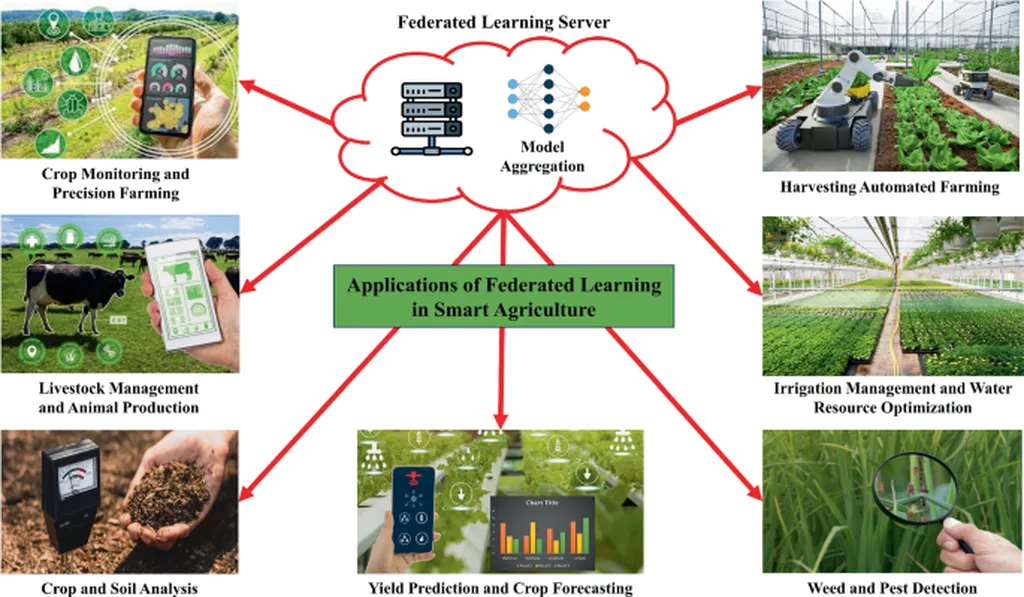
In the quest for smarter and more sustainable farming practices, a groundbreaking study published in *Frontiers in Plant Science* has introduced a novel framework that combines Agentic Artificial Intelligence (AAI), Precision Agriculture (PA), and Federated Learning (FL) to revolutionize the agricultural sector. Led by Parvathaneni Naga Srinivasu from the Amrita School of Computing at Amrita Vishwa Vidyapeetham in Amaravati, Andhra Pradesh, India, this research offers a promising pathway to optimize resource utilization and reduce environmental impact through intelligent, real-time decision-making.
The study proposes an AAI-based framework that integrates distributed sensing devices, intelligent agents, and federated learning to enable real-time monitoring and decision support at the farm level. This innovative approach allows for localized intelligence and inter-device communication, creating a robust system for precision agriculture. “The integration of AAI with federated learning not only enhances the accuracy of our models but also ensures that data privacy and security are maintained,” explained Srinivasu. This is particularly crucial in an era where data-driven decision-making is becoming increasingly vital for agricultural productivity and sustainability.
The research evaluated the proposed model across two distinct datasets: tomato disease classification and weed detection. The federated global model achieved an impressive accuracy of 96.4%, significantly outperforming individual client models. For instance, DenseNet121 and MobileNetV2 attained accuracies of 95.0% and 93.9%, respectively. In weed species detection, EfficientDet-D0 demonstrated superior performance with an [email protected] of 0.978, average precision of 0.865, and an F1-score of 0.961, compared to YOLOv8 with an [email protected] of 0.956 and an F1-score of 0.935.
The commercial implications of this research are substantial. By enabling real-time monitoring and intelligent decision-making, farmers can optimize the use of resources such as water, fertilizers, and pesticides, leading to increased crop yields and reduced environmental impact. “This technology has the potential to transform precision agriculture by making it more accessible and effective for farmers worldwide,” said Srinivasu. The study’s findings highlight the feasibility and effectiveness of integrating AAI with federated learning, paving the way for sustainable and intelligent farming systems.
The research also includes a SWOT analysis, which identifies the strengths, weaknesses, opportunities, and threats associated with the proposed approach. This comprehensive evaluation provides a roadmap for future research and deployment, emphasizing the need for sustainable intelligent farming systems.
As the agricultural sector continues to evolve, the integration of advanced technologies like AAI and federated learning will play a pivotal role in shaping the future of farming. This study not only demonstrates the potential of these technologies but also sets the stage for further innovation and development in the field of precision agriculture. With the growing demand for sustainable and efficient farming practices, the insights gained from this research could have far-reaching commercial impacts, benefiting farmers, consumers, and the environment alike.