
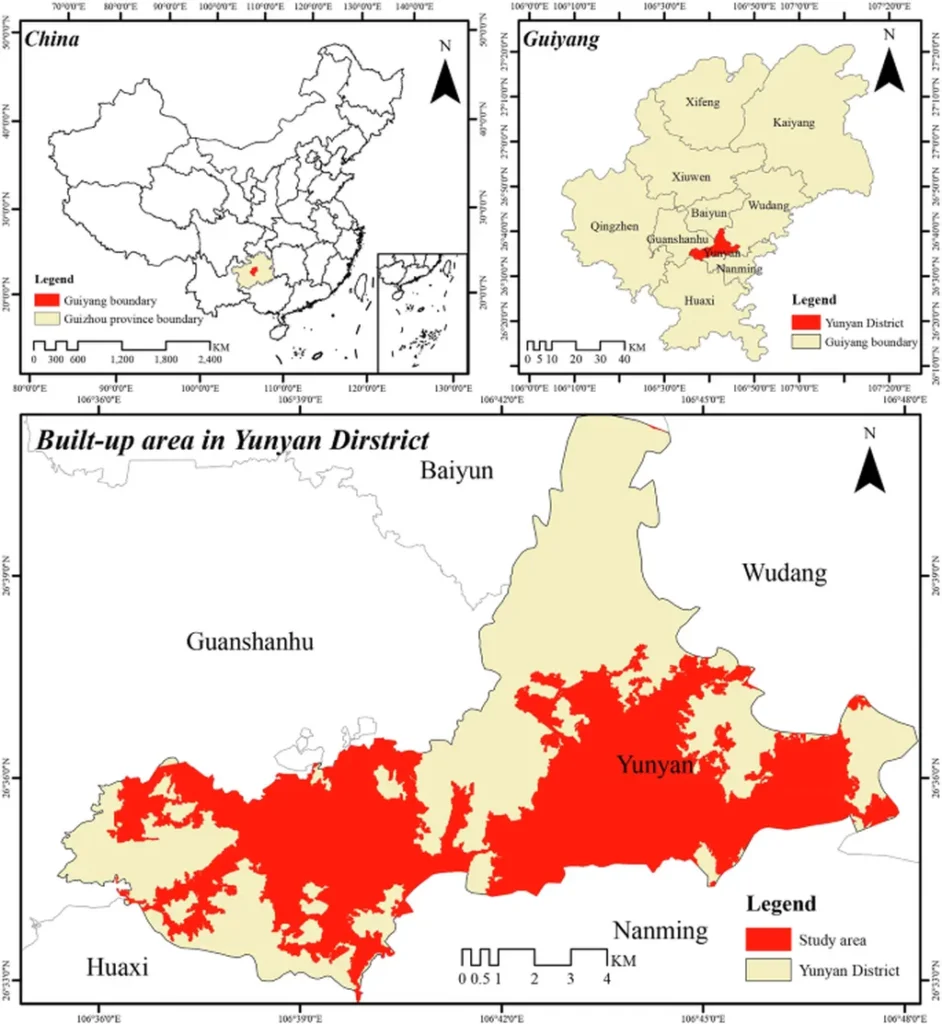
In the heart of China, Guiyang City is grappling with a challenge that echoes across the globe: how to balance economic growth with the preservation of vital ecosystem services. A recent study published in *Ecological Indicators* offers a compelling new approach to this dilemma, with significant implications for the agriculture sector and land use planning.
The research, led by Ren-Jie Cao of Guizhou University, introduces a multi-scale optimization framework that integrates advanced algorithms and land use planning models. The goal? To find the sweet spot between economic development and ecological preservation. The team employed the NSGA-II and SLSQP algorithms alongside the PLUS model to simulate various scenarios, each offering a different balance between economic and ecological priorities.
One of the most striking findings is the optimal spatial pattern that emerged under the Ecological-Economic Balance (EEB) scenario. This scenario proposes a forest coverage of 66.3% and an arable land proportion of 25.1%, creating a spatial layout described as “centralized construction in the south, eco-agriculture in the center, and eco-conservation in the north.” This balanced approach could serve as a blueprint for other regions grappling with similar challenges.
“Our study reveals the optimal spatial pattern of regional land use and the underlying driving mechanism,” says Ren-Jie Cao. “By constructing a multi-scale coupling framework that integrates ‘total optimization’ with ‘spatial allocation,’ we offer a novel methodology for synergizing economic development and forest ecosystem services.”
The research also identifies key drivers of land use change, with GDP and population density emerging as the primary forces behind the expansion of construction land. Sensitivity analysis further highlights the critical role of forest coverage rate and population carrying capacity in regulating land use patterns.
For the agriculture sector, these findings could be transformative. By optimizing the allocation of arable land, the framework could enhance agricultural productivity while minimizing environmental impact. This could lead to more sustainable farming practices and improved economic outcomes for farmers.
The study’s methodology offers a robust tool for policymakers and planners. By simulating different scenarios, they can make informed decisions that balance economic growth with ecological preservation. This could pave the way for more sustainable urban development and agricultural practices.
As the world grapples with the challenges of climate change and environmental degradation, this research offers a beacon of hope. By providing a clear, data-driven approach to land use optimization, it could shape the future of sustainable development, not just in Guiyang, but across the globe.
The study, published in *Ecological Indicators*, was led by Ren-Jie Cao from the School of Management at Guizhou University and the Guizhou University Laboratory for Collaborative Innovation in Digital Transformation and Governance. This innovative approach to land use optimization could well become a cornerstone of sustainable development strategies worldwide.