
In the face of escalating climate challenges, scientists are turning to the intricate world of plant biology to bolster crop resilience and productivity. A recent study published in *Plant Stress* reveals groundbreaking insights into how genetic engineering of phytochrome B (PHYB) and its interacting factors (PIFs) could revolutionize agriculture by enhancing stress resilience in crops.
Plants, much like humans, are deeply affected by their environment. Drought, salinity, and extreme temperatures can disrupt their metabolism and growth, threatening global food security. However, plants have evolved sophisticated mechanisms to adapt to these stresses, with phytochromes playing a pivotal role. These photoreceptors act as master regulators, integrating light and temperature signals to orchestrate stress responses and influence plant growth and metabolism.
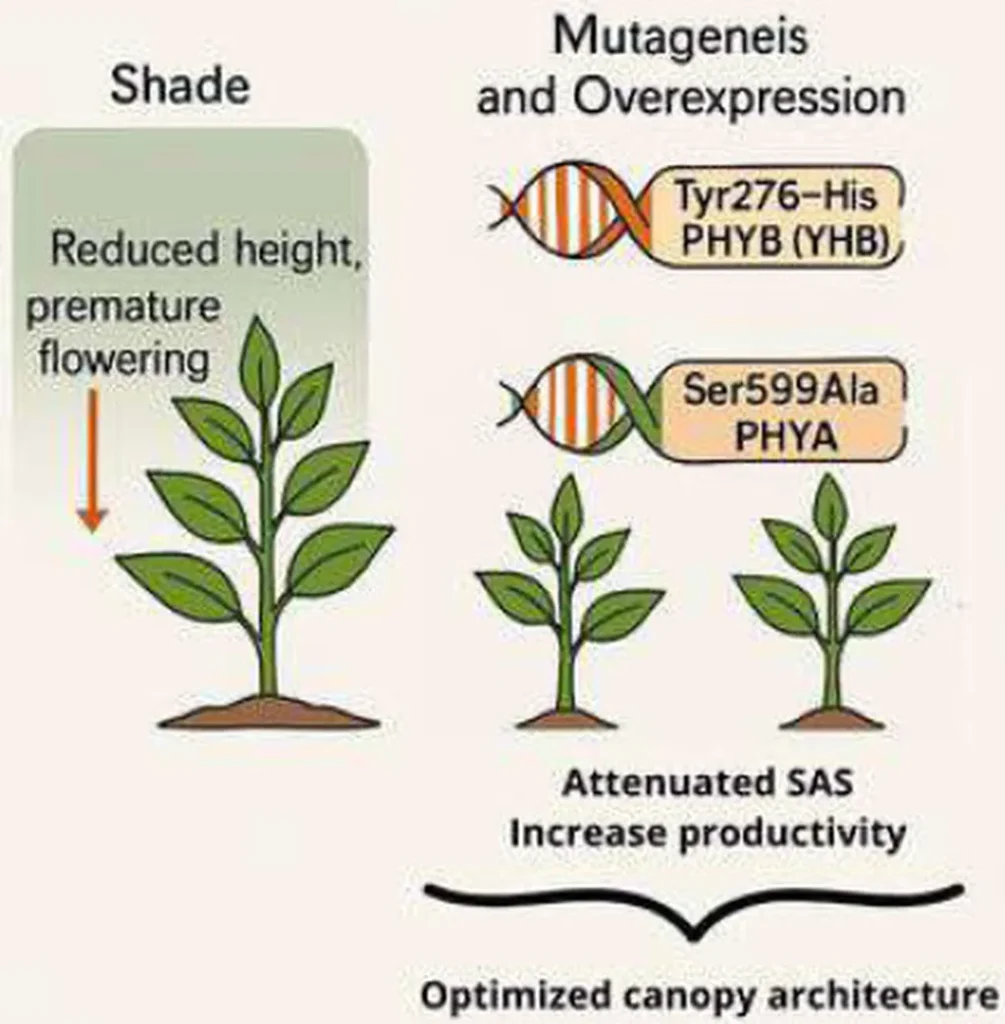
The study, led by Ricardo Bianchetti from the Instituto de Biociências at the Universidade de São Paulo, Brazil, explores how recent advancements in genetic engineering can be harnessed to modulate PHYB and PIF activities. By employing techniques such as genome editing, targeted mutagenesis, RNAi-mediated silencing, and tissue-specific overexpression, researchers can precisely manipulate PHYB-mediated signaling pathways. This precise manipulation can enhance crop performance under challenging conditions, including osmotic stress, extreme temperatures, and light competition in densely planted systems.
“By fine-tuning these pathways, we can develop crop varieties that are not only more resilient to environmental stresses but also more productive,” Bianchetti explains. This could be a game-changer for farmers worldwide, particularly in regions prone to climate variability.
The commercial implications of this research are substantial. As climate change intensifies, the demand for stress-resilient crops is expected to surge. By leveraging genetic engineering to enhance PHYB and PIF activities, agricultural companies can develop high-performing crop varieties that thrive in adverse conditions. This could lead to increased yields, reduced crop losses, and improved food security.
Moreover, the combination of different genetic engineering approaches offers a promising strategy to boost agricultural productivity. “The synergy between biotechnological advancements and the critical role of PHYB in plant stress responses presents a unique opportunity to advance food security and promote sustainable agriculture,” Bianchetti adds.
This research not only highlights the potential of genetic engineering in enhancing crop resilience but also underscores the importance of understanding and manipulating plant signaling pathways. As we grapple with the realities of climate change, such innovations could pave the way for a more resilient and productive agricultural future.
The study, published in *Plant Stress* and led by Ricardo Bianchetti from the Instituto de Biociências at the Universidade de São Paulo, Brazil, offers a beacon of hope for the agriculture sector, demonstrating how cutting-edge biotechnology can be harnessed to address global food security challenges.