
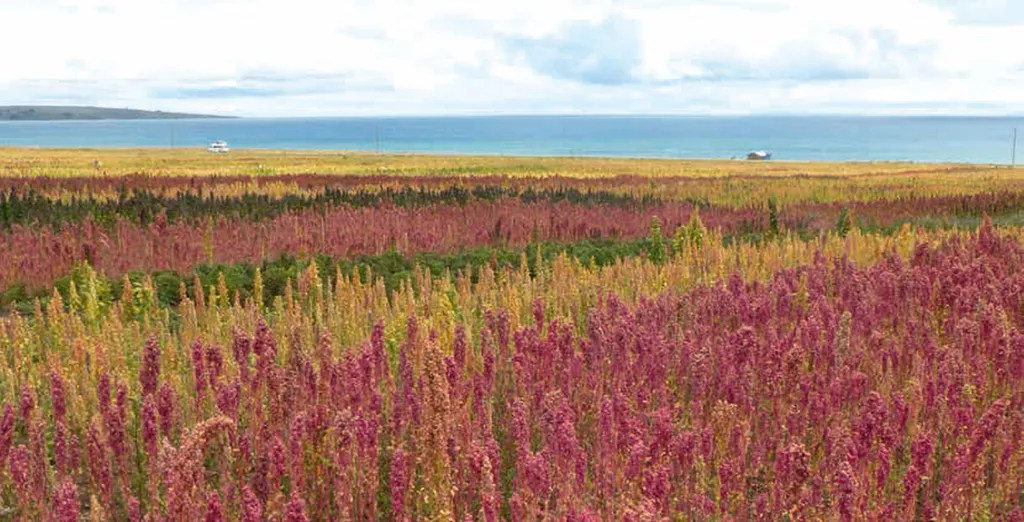
In the arid expanses of Shanxi Province, China, a humble crop is making waves in the world of sustainable agriculture. Quinoa, a grain long celebrated for its nutritional prowess, is now gaining attention for its adaptability and efficiency in water and nitrogen use. A recent study published in *Agricultural Water Management* has unveiled promising insights into optimizing quinoa cultivation, potentially revolutionizing farming practices in semi-arid regions.
The research, led by Yan Deng from the College of Agriculture at Shanxi Agricultural University, delves into the intricate interplay between row spacing and nitrogen fertilization. The findings suggest that strategic adjustments in these factors can significantly enhance quinoa yield and water productivity. “Wider row spacings notably boosted quinoa yield,” Deng explains, highlighting that the widest spacing (60 cm) outperformed narrower configurations by up to 87.17% in 2023 and 113.68% in 2024. This discovery could be a game-changer for farmers grappling with water scarcity and soil nutrient management.
The study’s two-year field experiment evaluated three nitrogen fertilizer levels and three row spacing configurations. The results revealed that medium row spacing (40 cm) and a moderate nitrogen level (120 kg/ha) struck the optimal balance, significantly improving plant dry matter, nitrogen accumulation, and water use efficiency. “The medium row spacing (R2) and nitrogen level (N2) had the most significant effect on increasing plant dry matter and nitrogen accumulation,” Deng notes, underscoring the importance of precision in agricultural practices.
The implications for the agriculture sector are profound. As water resources become increasingly scarce and the demand for sustainable farming practices grows, the findings offer a blueprint for high-efficiency, water-saving cultivation. Farmers in semi-arid regions could potentially boost their yields while minimizing water and nitrogen waste, thereby enhancing their economic viability and environmental stewardship.
The study also sheds light on the regulatory mechanism of row spacing and nitrogen coupling on soil water-nitrogen dynamics. This understanding could pave the way for more sophisticated agricultural technologies and practices, tailored to the specific needs of different crops and regions. As the world grapples with the challenges of climate change and food security, such innovations are more critical than ever.
In the words of Yan Deng, “This study provides a scientific basis for high-efficiency and water-saving quinoa cultivation in semi-arid regions.” The research not only advances our understanding of quinoa cultivation but also sets a precedent for future studies in sustainable agriculture. As the agricultural sector continues to evolve, the insights gleaned from this study could shape the development of new technologies and practices, ensuring a more resilient and productive future for farmers worldwide.