
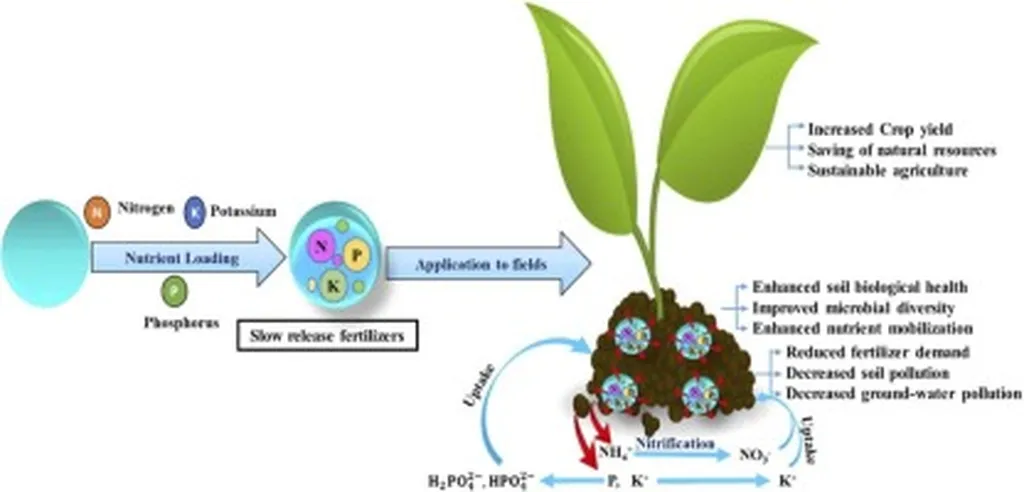
In a significant stride towards sustainable agriculture, researchers have developed a novel slow-release fertilizer that could revolutionize how farmers manage nutrient delivery to crops. Published in the journal *Polymer Testing*, the study introduces sodium alginate (SA)-based microspheres loaded with nitrogen (N), phosphorus (P), and potassium (K) fertilizers, offering a promising solution to enhance fertilizer utilization and mitigate environmental pollution.
The research, led by Xiaolin Liu from the Key Laboratory of Urban Agriculture in North China at Beijing University of Agriculture, demonstrates that these microspheres can encapsulate essential nutrients within a porous network structure. This encapsulation not only protects the nutrients from premature release but also ensures a controlled and sustained delivery system. “The composite fertilizer is embedded in the porous network structure of the SA microspheres in the form of crystals,” Liu explained, highlighting the innovative approach to nutrient encapsulation.
One of the standout features of these microspheres is their responsiveness to environmental conditions. The study found that the swelling behavior of the SA-NPK microspheres is highly sensitive to pH levels and sodium ion concentrations. In acidic environments and elevated NaCl concentrations, the microspheres release the encapsulated nutrients more effectively. This responsiveness is crucial for optimizing nutrient delivery based on soil conditions, ensuring that crops receive the necessary nutrients precisely when they need them.
The practical implications for the agriculture sector are substantial. Traditional fertilizers often lead to nutrient runoff, which not only wastes resources but also contributes to environmental degradation. The slow-release nature of these microspheres can significantly reduce nutrient loss, thereby enhancing fertilizer efficiency and minimizing environmental impact. “After 72 hours, the cumulative release amounts of N, P, and K reached impressive levels,” noted Liu, underscoring the effectiveness of the microspheres in nutrient delivery.
Moreover, the microspheres exhibited favorable biodegradability, confirming their potential to minimize environmental impact. This eco-friendly characteristic aligns with the growing demand for sustainable agricultural practices. The soil leaching experiments further demonstrated the sustained-release performance of the microspheres, with cumulative nutrient release rates of 82% for N, 62% for P, and 86% for K after 15 days. These results highlight the potential of SA-NPK microspheres to provide a low-cost, eco-friendly, and biodegradable slow-release fertilizer system.
The commercial impact of this research could be profound. Farmers could benefit from reduced fertilizer costs and improved crop yields, while also contributing to environmental sustainability. The technology could be particularly beneficial in regions with poor soil quality or where nutrient runoff is a significant issue. As the agriculture sector continues to seek innovative solutions to enhance productivity and sustainability, the SA-NPK microspheres offer a promising avenue for future developments.
This research not only advances our understanding of slow-release fertilizers but also paves the way for more efficient and environmentally friendly agricultural practices. As the global population grows and the demand for food increases, the need for sustainable and efficient farming practices becomes ever more critical. The SA-NPK microspheres developed by Liu and his team represent a significant step forward in meeting these challenges.