
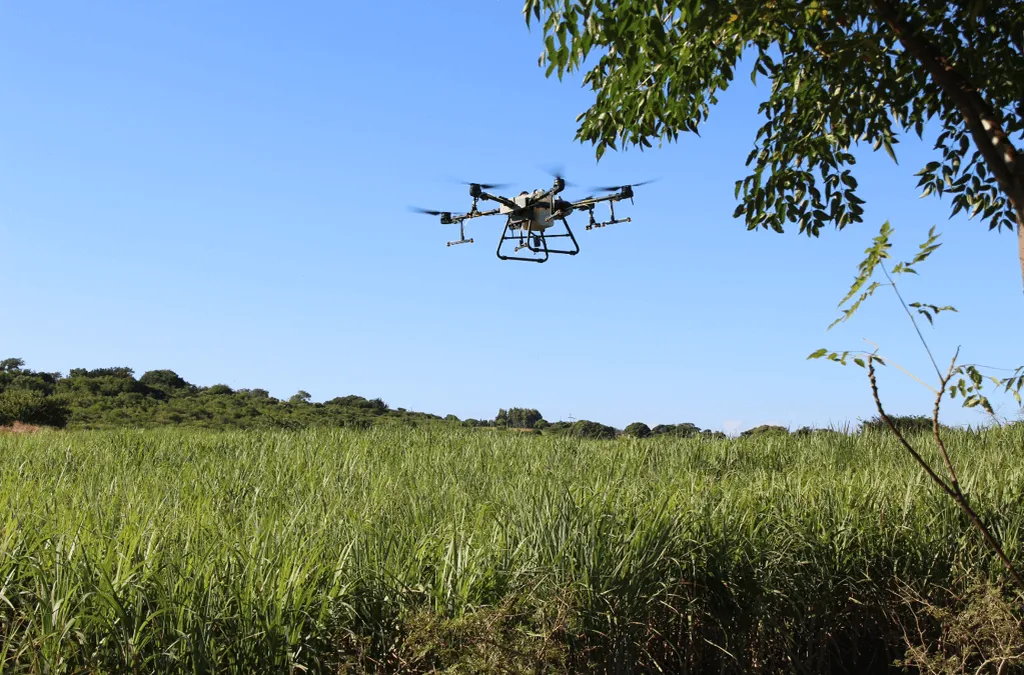
In the heart of South Africa’s sugarcane fields, a technological revolution is brewing, one that promises to transform how smallholder farmers manage water—a resource that is increasingly under threat. Researchers have developed a machine learning (ML) model that can predict the Normalised Difference Water Index (NDWI), a key indicator of vegetation water content, using unmanned aerial vehicle (UAV) multispectral imagery. This innovation, detailed in a study published in *Agricultural Water Management*, could redefine precision farming and water management in smallholder agriculture.
The study, led by Ameera Yacoob from the Centre for Water Resources Research at the University of KwaZulu-Natal, addresses a critical gap in spatially explicit assessments of crop water stress. By integrating Sentinel-2 satellite data with UAV-acquired imagery, the researchers trained an ML model to predict NDWI using structural vegetation indices (SVIs). The model’s high predictive accuracy (R² = 0.95) and low error rates (RMSE = 0.03, MAE = 0.02) demonstrate its potential to capture the complex, non-linear relationships between vegetation indices and water stress.
“This approach allows us to monitor crop water status in real-time and with high precision,” Yacoob explained. “It’s a game-changer for smallholder farmers who often lack the resources for extensive ground-based monitoring.”
The model’s ability to track temporal variations in sugarcane water status—such as post-rainfall stress recovery and increased water retention during early maturation—aligns with changes in leaf area index (LAI), chlorophyll content (CC), and Total Soil Water Profile (TSWP). This alignment suggests that NDWI can serve as a reliable proxy for crop water dynamics. Furthermore, NDWI showed a positive correlation with actual evapotranspiration (ETa; R² = 0.60) and a negative correlation with the Water Deficit Index (WDI; R² = 0.62), reinforcing its utility in assessing crop water status.
The commercial implications of this research are profound. By enabling site-specific irrigation scheduling, the ML-driven NDWI estimation can enhance resource use efficiency and promote sustainable sugarcane cultivation. This is particularly crucial in water-scarce regions where smallholder farmers are most vulnerable to water stress.
“Precision farming is not just about increasing yields; it’s about sustainability and resilience,” Yacoob noted. “This technology empowers farmers to make data-driven decisions that conserve water and improve crop health.”
The study’s findings contribute to climate-resilient water management practices tailored to the needs of smallholder systems. As climate change intensifies water scarcity, such innovations will be vital in ensuring food security and economic stability for smallholder farmers.
Looking ahead, this research could pave the way for broader applications of ML and UAV technology in agriculture. From optimizing irrigation strategies to monitoring crop health, the integration of these technologies holds immense potential for transforming the agricultural sector. As Yacoob and her team continue to refine their model, the future of precision farming looks increasingly promising, offering hope for a more sustainable and resilient agricultural landscape.