
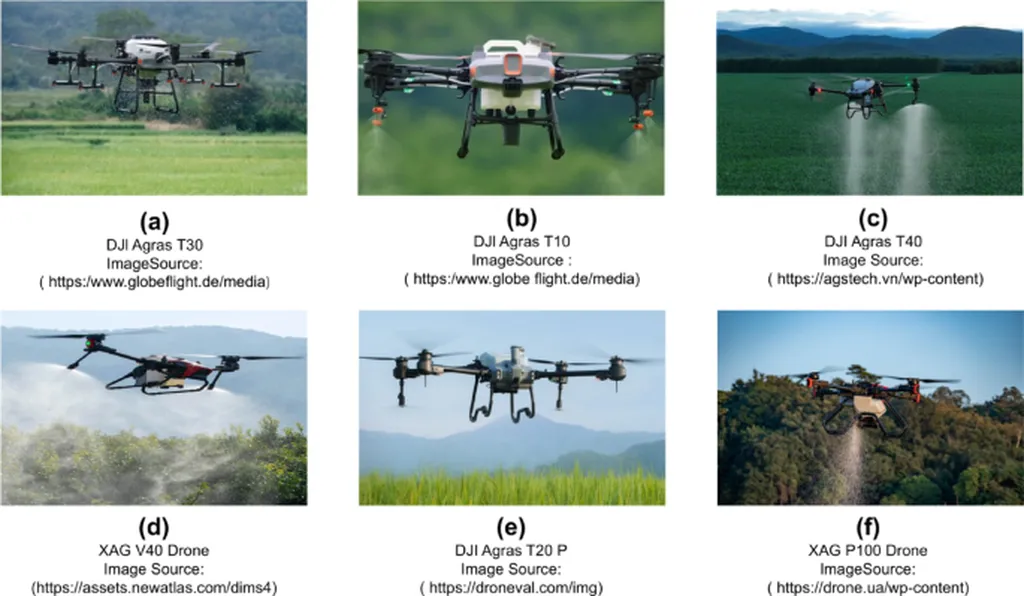
In the rapidly evolving world of agricultural technology, a groundbreaking study has emerged that could revolutionize the way we approach aerial pesticide application. Published in *Smart Agricultural Technology*, the research, led by Kun Chang of the School of Automobile and Transportation Engineering at Guangdong Polytechnic Normal University, delves into the intricate dynamics between the downwash airflow generated by agricultural unmanned aerial vehicles (UAVs) and the movement of droplets. This study not only enhances our understanding of the physical processes involved but also paves the way for more efficient and precise pesticide application, a critical need in modern agriculture.
The downwash airflow created by UAV rotors plays a pivotal role in determining how droplets disperse once they leave the nozzle. This dispersion directly impacts the effectiveness of pesticide application and the potential for drift, which can lead to environmental contamination and reduced efficiency. However, until now, the coupled dynamics between rotor-induced airflow and droplet motion have remained poorly understood. Chang’s research aims to bridge this knowledge gap.
By developing a two-phase computational fluid dynamics (CFD) model that incorporates various rotor speeds, Chang and his team were able to simulate the entire pesticide spraying process of agricultural UAVs. This model was validated through particle image velocimetry (PIV) experiments, ensuring the accuracy of their findings. “The integration of CFD and PIV methods provides a reliable framework for studying the interaction between UAV rotor downwash and droplet dynamics,” Chang explained. This integration allowed the researchers to establish a functional relationship between rotor speed and droplet velocity distribution, offering valuable insights into the behavior of droplets under different conditions.
The study revealed that the maximum droplet velocity occurs near the nozzle, reaching up to 20 meters per second. As the rotor speed increases, both droplet velocity and concentration rise significantly, while the velocity attenuation rate decreases. Within 1 meter below the nozzle, all velocity attenuation rates remained below 50%, indicating a strong influence of rotor speed on droplet behavior. The PIV measurements closely matched the CFD simulation results, with a minimum relative error of just 1%, underscoring the robustness of the model.
The implications of this research for the agriculture sector are substantial. By optimizing UAV spraying parameters based on these findings, farmers and agricultural operators can enhance the precision of their pesticide application, reducing waste and minimizing environmental impact. “The findings offer theoretical support for optimizing UAV spraying parameters and improving pesticide application efficiency,” Chang noted. This could lead to more sustainable agricultural practices and improved crop yields, addressing some of the most pressing challenges in modern farming.
Looking ahead, this research sets the stage for future developments in the field of agricultural UAV technology. As the demand for precision agriculture grows, the ability to fine-tune spraying parameters will become increasingly important. The insights gained from this study could inform the design of new UAV models and spraying systems, as well as the development of advanced control algorithms that adapt to varying environmental conditions. Moreover, the integration of CFD and PIV methods could become a standard approach for studying and optimizing aerial application techniques, further advancing the field of agricultural technology.
In conclusion, Kun Chang’s research represents a significant step forward in our understanding of the complex interplay between UAV downwash and droplet dynamics. By providing a reliable framework for studying these interactions, the study offers valuable insights that could shape the future of aerial plant protection operations. As the agriculture sector continues to embrace technological innovation, this research serves as a testament to the power of interdisciplinary collaboration and the potential for technology to drive sustainable and efficient agricultural practices.