
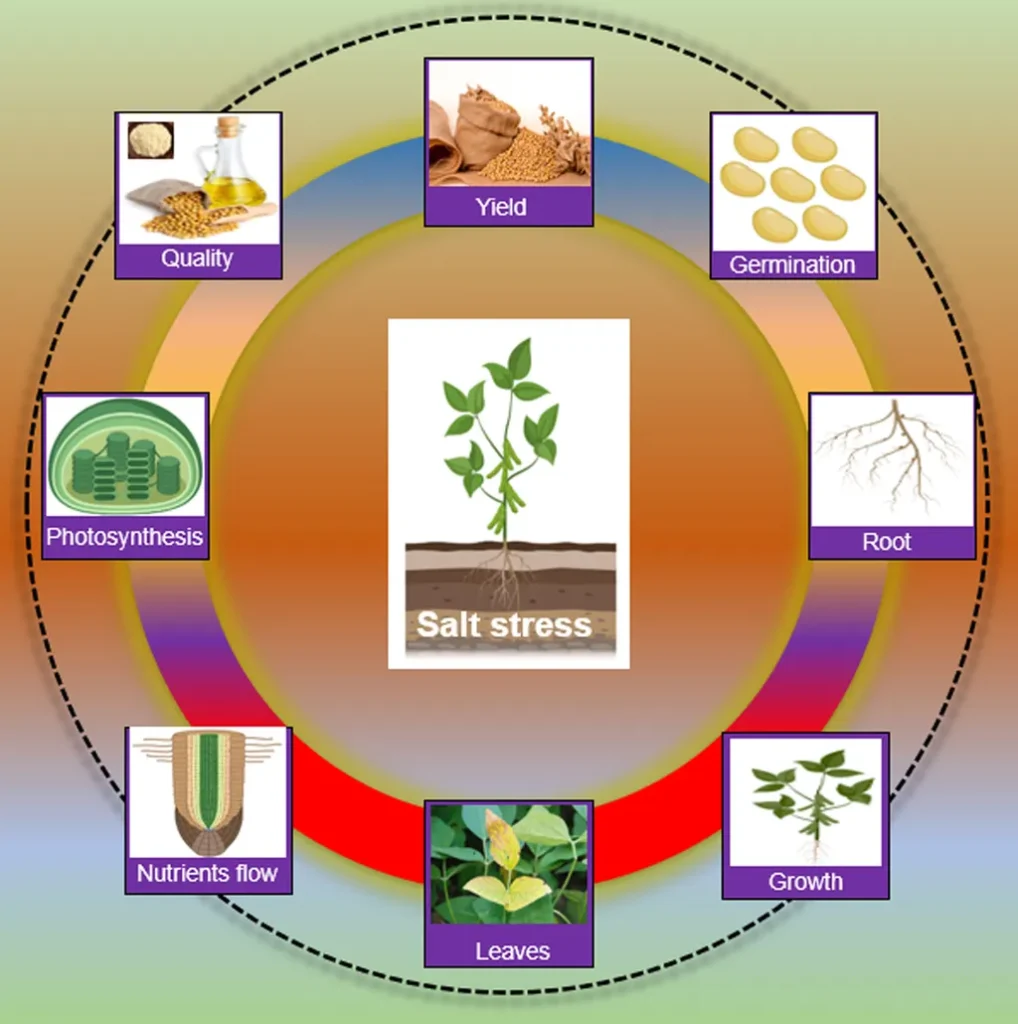
In the heart of China’s Heilongjiang Province, a team of researchers led by Shuangzhe Li from Northeast Agricultural University has made a significant breakthrough in understanding how soybeans respond to salt stress. Their study, published in the journal *Plant Stress*, could pave the way for developing salt-tolerant soybean varieties, a critical need for the agriculture sector as saline soils continue to threaten crop yields worldwide.
Soybean, a vital crop for food and biofuel production, is particularly sensitive to salt stress, which can severely limit its yield and cultivation area. To tackle this challenge, Li and his team employed transcriptome profiling to compare the responses of salt-sensitive and salt-tolerant soybean varieties under salt stress. Their findings reveal a complex interplay of molecular mechanisms that could inform future breeding strategies.
The researchers identified thousands of differentially expressed genes (DEGs) in both the leaves and roots of the salt-tolerant variety, with even more DEGs detected in the salt-sensitive variety. “The regulatory pathways activated under salt stress exhibited significant differences between genotypes and tissues,” Li explained. This discovery underscores the complexity of soybean’s response to salinity and the need for targeted approaches in breeding programs.
One of the most striking findings was the strong activation of the plant hormone signal transduction pathway in both tissues of both cultivars. Key genes in multiple hormone pathways demonstrated substantially higher transcriptional upregulation in the salt-tolerant variety, suggesting that hormone signaling plays a crucial role in salt tolerance.
Moreover, the researchers found that the activation level of the plant-pathogen interaction pathway differed greatly between varieties, with the GmCML gene family accounting for a major proportion of this pathway. Comparative analysis identified GmCML48 as the gene most strongly induced by various stress treatments, including salt, ABA, and BR. Transgenic overexpression lines displayed significant improvements in growth traits and antioxidant enzyme activities under salt stress, establishing GmCML48 as a key contributor to soybean salt tolerance.
The identification of GmCML48 as a key gene in salt tolerance opens up new avenues for developing salt-tolerant soybean varieties. “These findings could advance the understanding of soybean molecular adaptations to saline environments and provide a theoretical basis for targeted breeding of salt-tolerant cultivars,” Li said.
The commercial implications of this research are substantial. As saline soils continue to expand due to climate change and poor agricultural practices, the development of salt-tolerant crops is becoming increasingly important. Soybean, being a major crop, stands to benefit significantly from this research, potentially leading to higher yields and more stable production in saline areas.
Furthermore, the identification of the Hap_A haplotype associated with superior salt tolerance could facilitate marker-assisted selection in breeding programs, accelerating the development of salt-tolerant varieties. This research not only enhances our understanding of soybean’s molecular responses to salt stress but also provides practical tools for breeders to improve soybean cultivation in challenging environments.
As the global population continues to grow, the demand for sustainable and resilient agricultural practices is more pressing than ever. This study by Li and his team represents a significant step forward in addressing these challenges, offering hope for a more food-secure future.