
In the ever-evolving landscape of precision agriculture, a groundbreaking study published in *Industrial Crops and Products* is set to revolutionize how we assess the nutritional content of legumes. Led by Muhammed İkbal Çatal from the Department of Field Crops at Recep Tayyip Erdoğan University in Türkiye, the research delves into the efficacy of advanced data mining algorithms for predicting Crude Protein (CP) content in legumes, offering a non-destructive, rapid, and cost-effective alternative to traditional methods.
The study, which evaluated four data mining algorithms—Multivariate Adaptive Regression Splines (MARS), Support Vector Regression (SVR), k-Nearest Neighbors (KNN), and Artificial Neural Networks (ANN)—aims to bridge the gap left by conventional methods like the Kjeldahl process. These traditional techniques, while accurate, are often destructive, time-consuming, and expensive, posing significant challenges for modern crop breeding programs and industrial quality control.
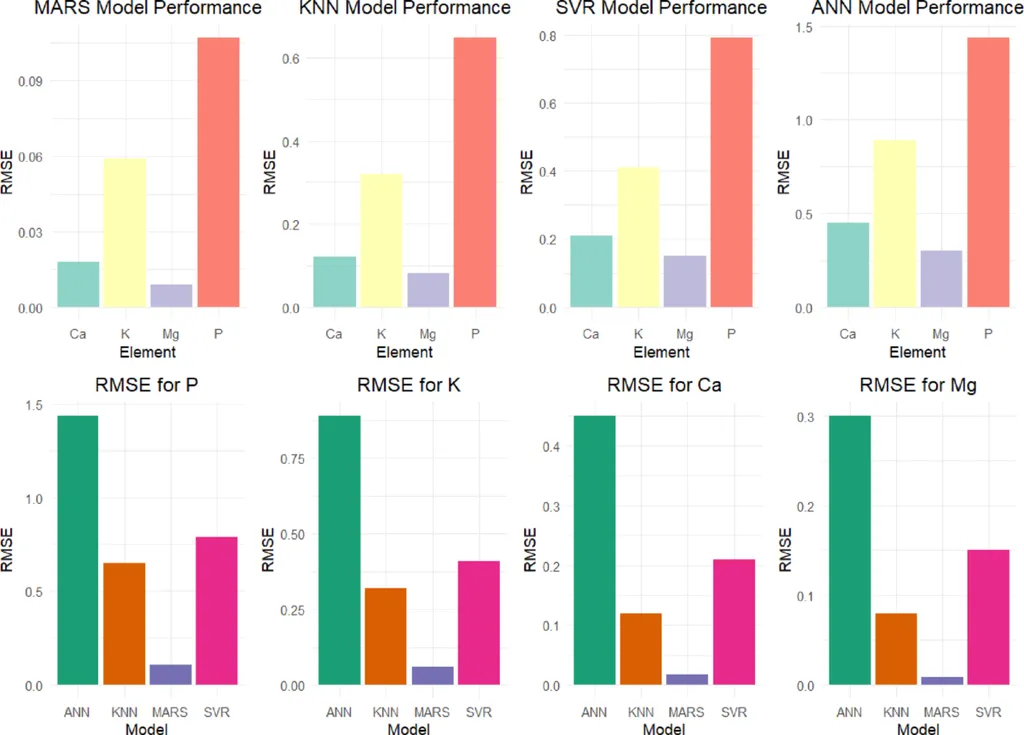
The findings are nothing short of transformative. MARS emerged as the standout performer, demonstrating superior predictive accuracy with the lowest Root Mean Squared Error (RMSE) of 0.62 and a Relative Root Mean Squared Error (RRMSE) of 3.38. It also achieved the highest coefficient of determination (R²) of 0.93 and an Akaike Information Criterion (AIC) of −5.51, indicating a robust fit for modeling complex non-linear relationships and variable interactions in agricultural datasets.
“MARS not only provides high accuracy but also offers interpretability, which is crucial for translating complex nutrient interactions into actionable, biologically relevant insights,” said Çatal. This interpretability is a game-changer, allowing researchers and industry professionals to understand and utilize the predictions effectively.
Support Vector Regression (SVR) showed moderate accuracy, particularly efficient with smaller datasets, while Artificial Neural Networks (ANN) struggled with generalization, likely due to overfitting or dataset size incompatibility. KNN, although interpretable, lagged in accuracy with an RMSE of 1.92.
The implications for the agriculture sector are profound. The integration of MARS into crop improvement programs can accelerate the development of high-protein cultivars through rapid, non-destructive screening. This advancement holds significant potential for enhancing precision agriculture and industrial legume production, ultimately contributing to more sustainable and efficient crop management practices.
As the agriculture industry continues to embrace technological innovations, this research paves the way for more sophisticated and efficient methods of nutritional assessment. By leveraging the power of data mining algorithms, farmers and breeders can make more informed decisions, leading to improved crop yields and quality.
In the words of Çatal, “This study establishes a robust, multi-species, non-linear prediction framework that can translate complex nutrient interactions into actionable insights, thereby accelerating the development of high-protein legume cultivars.”
The study, published in *Industrial Crops and Products* and led by Muhammed İkbal Çatal from the Department of Field Crops at Recep Tayyip Erdoğan University, marks a significant milestone in the application of machine learning in agriculture. It offers a glimpse into a future where data-driven decisions can transform the way we cultivate and utilize legumes, ultimately benefiting the entire agricultural ecosystem.