
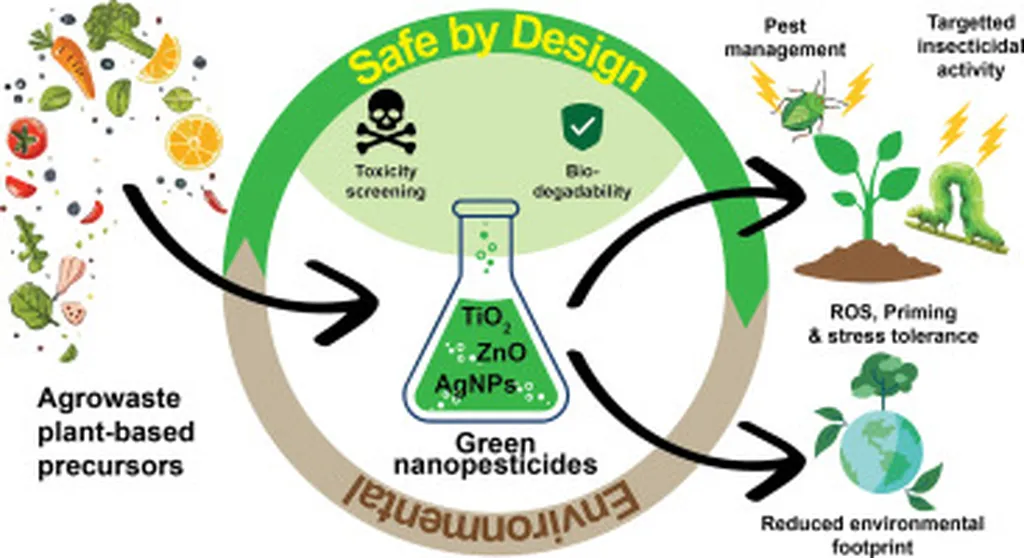
In the quest for sustainable pest control solutions, a team of researchers has made a significant stride by harnessing the power of green chemistry. Published in the journal *Next Materials*, the study led by Senthilkumar Pavithra from the Department of Botany at Bharathidasan University, Tiruchirappalli, India, explores the eco-friendly synthesis of copper nanoparticles (CuNPs) using an aqueous extract from the medicinal plant *Platostoma menthoides*. The findings could revolutionize pest management in agriculture, offering a greener alternative to conventional chemical pesticides.
The research focuses on the larvicidal properties of these bio-synthesized CuNPs, specifically targeting *Spodoptera frugiperda*, a notorious pest known for its devastating impact on crops. The study employed a range of analytical techniques to characterize the nanoparticles, including UV–Vis spectroscopy, FT–IR, XRD, SEM, EDAX, particle size analysis, zeta potential, and HR-TEM. The results confirmed the successful synthesis of CuNPs, with an average size of 152.3 nm and a zeta potential of −34.6 mV, indicating their stability.
One of the most compelling aspects of this research is its potential commercial impact on the agriculture sector. Traditional chemical pesticides often come with environmental and health concerns, making the development of eco-friendly alternatives a priority. “The use of plant-derived nanoparticles offers a sustainable approach to pest control, reducing the reliance on harmful chemicals,” said Pavithra. The study demonstrated potent larvicidal activity against *Spodoptera frugiperda*, with a dosage of 100 µg/mL resulting in LC₅₀ and LC₉₀ values of 55.64 and 122.79 µg/mL, respectively, within 24 hours post-treatment.
Histopathological analysis revealed extensive tissue damage and structural disruption in the larvae treated with the nanoparticles, underscoring their efficacy. Additionally, a lethality bioassay using *Artemia salina* nauplii showed a dose-dependent toxic response, with the CuNPs exhibiting moderate toxicity. These findings highlight the potential of *P. menthoides*-derived CuNPs as an eco-friendly pest control agent, paving the way for innovative applications in sustainable agriculture and pest management.
The implications of this research extend beyond immediate pest control. The green synthesis of nanoparticles using plant extracts represents a paradigm shift in the field of agritech, offering a scalable and environmentally friendly solution. As the global push for sustainable practices intensifies, such innovations could become a cornerstone of modern agriculture. “This study opens up new avenues for exploring the use of medicinal plants in nanotechnology for agricultural applications,” Pavithra added.
The research published in *Next Materials* not only advances our understanding of green synthesis and its applications but also sets the stage for future developments in sustainable pest management. By leveraging the natural properties of *Platostoma menthoides*, scientists have unlocked a powerful tool that could transform the way we approach crop protection, ensuring a healthier and more sustainable future for agriculture.