
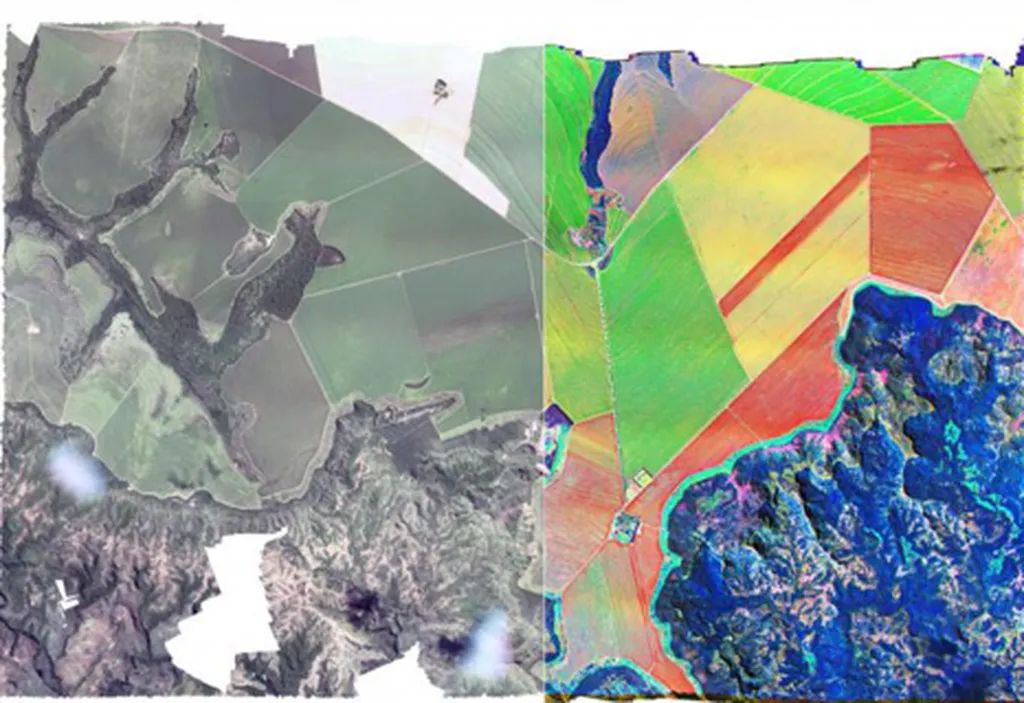
In the quest to enhance agricultural monitoring and food security, researchers have been exploring innovative ways to improve crop type mapping. A recent study published in *The International Archives of the Photogrammetry, Remote Sensing and Spatial Information Sciences* sheds light on the effectiveness of various machine learning and deep learning models, including geospatial foundation models (GFMs), for crop type mapping using hyperspectral imaging (HSI). The research, led by M. Bourriz from the Center for Remote Sensing Applications (CRSA) at Mohammed VI Polytechnic University (UM6P) in Morocco, offers promising insights for the agriculture sector.
Traditional methods of crop type mapping often rely on multi-spectral imagery (MSI) and machine learning (ML) or deep learning (DL) algorithms. However, these methods can struggle to differentiate between crops with similar spectral signatures and require extensive labeled ground truth data. Hyperspectral imaging, with its high spectral resolution, provides a more precise means of discrimination. The study evaluates the performance of traditional ML algorithms like Support Vector Machines (SVM) and Random Forests (RF), deep learning models such as Convolutional Neural Networks (CNN) and HybridSN, and GFMs, specifically HyperSIGMA and Prithvi-EO-1.0, using the Indian Pines benchmark dataset.
One of the key findings of the study is that HybridSN achieved the highest accuracy in most scenarios, with Overall Accuracy (OA) reaching up to 99.8%. This demonstrates its ability to capture spatial-spectral relationships effectively. “HybridSN’s performance is particularly noteworthy because it highlights the importance of integrating both spatial and spectral information for accurate crop type mapping,” said M. Bourriz.
Moreover, HyperSIGMA, a vision transformer-based foundation model for HSI analysis, outperformed all models when trained on only 1% of the labeled data. This underscores the advantage of self-supervised learning in low-label environments. “The success of HyperSIGMA in low-label scenarios is a significant breakthrough, as it addresses one of the major challenges in agricultural applications—limited labeled data,” Bourriz added.
The study also explored the adaptation of Prithvi-EO-1.0, a multi-spectral foundation model, to hyperspectral data. Despite being originally designed for multi-spectral imagery, Prithvi-EO-1.0 achieved an OA of up to 97% when fine-tuned for hyperspectral data. This demonstrates the potential for multi-spectral foundation models to be successfully adopted for hyperspectral data with appropriate optimization techniques.
The commercial implications of this research are substantial. Accurate and precise crop type mapping is essential for food security, crop yield prediction, and yield gap analysis. The findings suggest that GFMs can significantly enhance the accuracy and efficiency of crop type mapping, even in data-scarce scenarios. This could lead to more informed decision-making for farmers, agronomists, and policymakers, ultimately improving agricultural productivity and sustainability.
As the agriculture sector continues to embrace technological advancements, the integration of GFMs and HSI holds promise for revolutionizing crop monitoring and management. The research by M. Bourriz and colleagues not only advances our understanding of the capabilities of different models but also paves the way for future developments in large-scale crop-type mapping using HSI. By leveraging the strengths of GFMs, the agriculture sector can look forward to more accurate, efficient, and scalable solutions for crop type mapping, ultimately contributing to global food security and sustainable agriculture practices.