
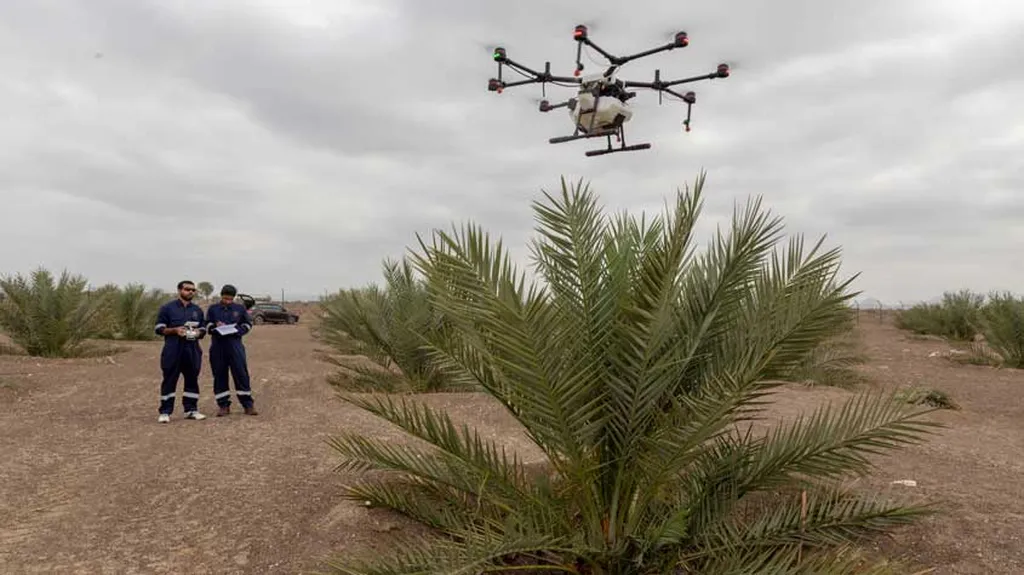
In the sun-scorched oases of Morocco’s Figuig region, a silent revolution is taking root, one that could reshape how farmers monitor and manage their date palm crops. Researchers, led by A. Hammadi from the Geosciences Laboratory at Hassan II University of Casablanca, have harnessed the power of deep learning and Unmanned Aerial Vehicles (UAVs) to assess palm tree health with unprecedented precision. Their work, published in ‘The International Archives of the Photogrammetry, Remote Sensing and Spatial Information Sciences,’ offers a glimpse into the future of precision agriculture.
The challenge is clear: traditional ground surveys are labor-intensive, costly, and subjective, while satellite imagery often lacks the resolution to accurately assess individual tree health. “Our UAV-based deep learning approach aims to overcome these limitations by providing improved scalability, objectivity, and spatial precision,” Hammadi explains. The team’s innovative method involves capturing high-resolution RGB orthomosaics using UAVs, processing these into tiles, and then manually annotating them to create a dataset that distinguishes between healthy palms, unhealthy palms, and background.
The dataset, comprising 296 tiles, was used to train and evaluate two deep learning models: U-Net and DeepLabV3+. The results were promising, with the DeepLabV3+ model achieving a Macro Average F1-score of 82.06%, slightly outperforming U-Net’s 81.28%. “Both models showed strong capability in identifying background and healthy palms,” Hammadi notes. However, accurately segmenting the diverse ‘unhealthy’ class remained a significant challenge, highlighting the inherent difficulties in differentiating subtle or varied stress symptoms from aerial RGB data alone.
The commercial implications of this research are substantial. Date palms are a vital crop in many regions, and their health directly impacts yield and profitability. By providing a scalable, objective, and precise method for assessing palm health, this technology could enable farmers to make timely, data-driven decisions. This could lead to more efficient use of resources, reduced costs, and ultimately, improved crop yields.
Moreover, this research lays the groundwork for future developments in the field. As Hammadi suggests, future work may focus on enhancing model robustness, incorporating complementary data sources like thermal or multispectral imagery, and investigating model architectures better suited for subtle feature extraction. These advancements could further refine the accuracy and utility of AI-driven tools in precision agriculture.
In the broader context, this research underscores the potential of integrating UAV technology with custom deep learning models for practical, large-scale crop health assessment. It offers a marked improvement over less scalable or lower-resolution traditional techniques, paving the way for more sustainable and productive agricultural practices. As the technology evolves, it could become an indispensable tool for farmers worldwide, helping them to navigate the challenges of a changing climate and an increasingly competitive market.
In the meantime, the date palm growers of Figuig and beyond have a powerful new ally in their quest for healthier crops and better yields. And as the technology continues to evolve, the future of precision agriculture looks brighter than ever.