
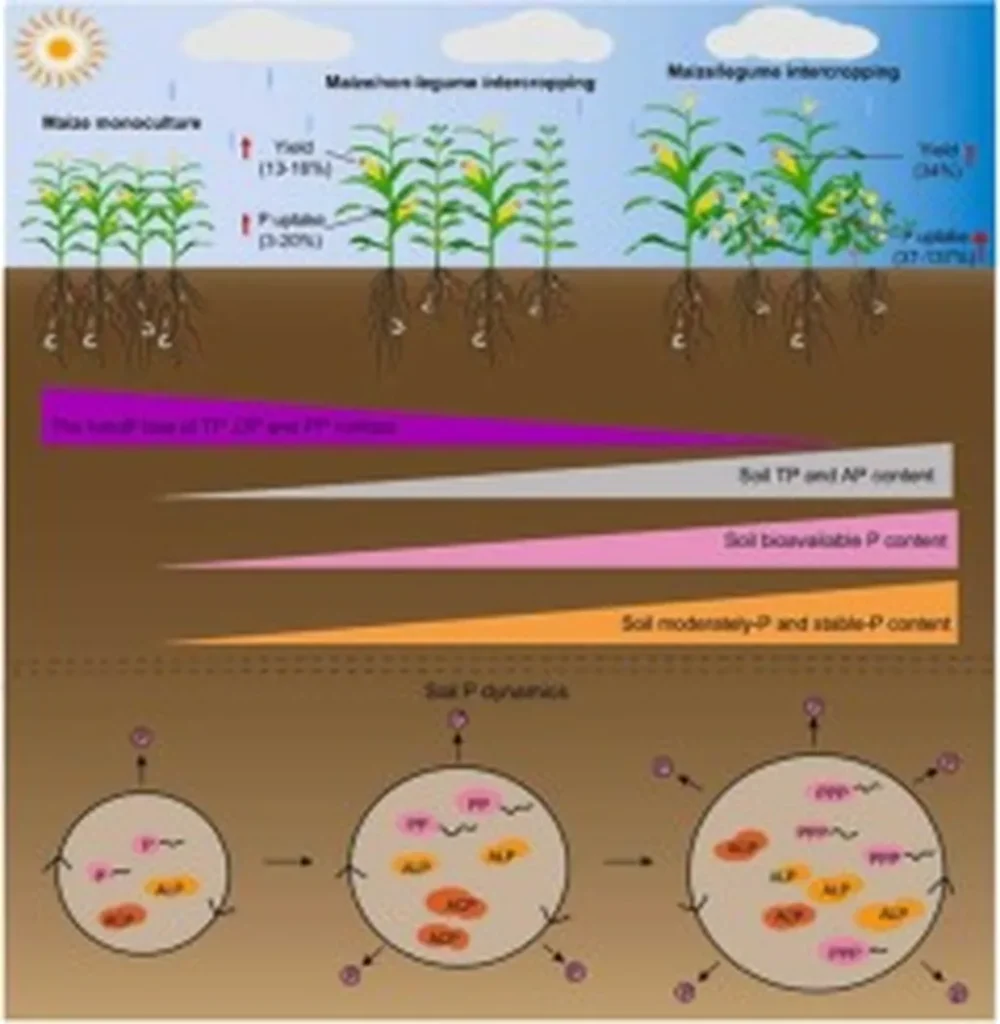
In the quest for sustainable agriculture, farmers and researchers are constantly seeking innovative strategies to optimize crop yields while minimizing environmental impact. A recent study published in *Frontiers in Microbiology* offers promising insights into how phosphorus fertilization and intercropping can synergistically enhance crop productivity by reshaping the rhizosphere microbiome. The research, led by Yan Zheng from the College of Agronomy at Henan University of Science and Technology, provides a mechanistic framework for developing integrated, microbiome-informed management strategies.
The study focused on a long-term field experiment involving maize and peanut intercropping under phosphorus (P) fertilization. The results were striking: phosphorus fertilization significantly increased the yields of both maize (by 52.12%) and peanut (by 43.60%), while also enhancing the intercropping yield advantage (IYA) by 60.77% and the land equivalent ratio (LER) by 2.54%. These findings suggest that the combination of P fertilization and intercropping can lead to substantial productivity gains, offering a practical solution for farmers looking to maximize their yields.
One of the most intriguing aspects of the study was the role of soil phosphorus availability as the dominant environmental driver, explaining 73.46% and 84.39% of the variance in bacterial and fungal community structure, respectively. “Phosphorus addition and intercropping selectively enriched keystone functional taxa, such as the nitrifying bacterium Nitrospirae and the saprophytic fungus Mortierellomycota,” explained Yan Zheng. These taxa are crucial for improving soil nutrient availability and enhancing crop performance.
The research also highlighted how intercropping suppressed the pathogen-rich phylum Ascomycota, which can negatively impact crop health. This suppression further underscores the potential of intercropping to create a more favorable microbial environment for crop growth. The study’s findings demonstrate that the synergy between P fertilization and intercropping enhances crop productivity through a microbiome-mediated mechanism, restructuring the rhizosphere community into a functionally beneficial state.
For the agriculture sector, these findings could have significant commercial impacts. By optimizing nutrient cycling and enhancing microbial communities, farmers can achieve higher yields with fewer inputs, leading to increased profitability and sustainability. The study provides a roadmap for developing integrated management strategies that leverage the power of microbiomes to support sustainable agricultural intensification.
As we look to the future, this research opens up new avenues for exploring the interplay between nutrient management and microbial communities. It also underscores the importance of adopting a holistic approach to agriculture that considers the complex interactions between plants, microbes, and soil. By doing so, we can pave the way for more resilient and productive farming systems that meet the challenges of a growing global population.
In the words of Yan Zheng, “Our findings provide a mechanistic framework for developing integrated, microbiome-informed management strategies to support sustainable agricultural intensification.” This research not only advances our understanding of the rhizosphere microbiome but also offers practical solutions for farmers seeking to enhance their crop yields while minimizing environmental impact. As the agriculture sector continues to evolve, the insights gained from this study will undoubtedly shape future developments in the field.