
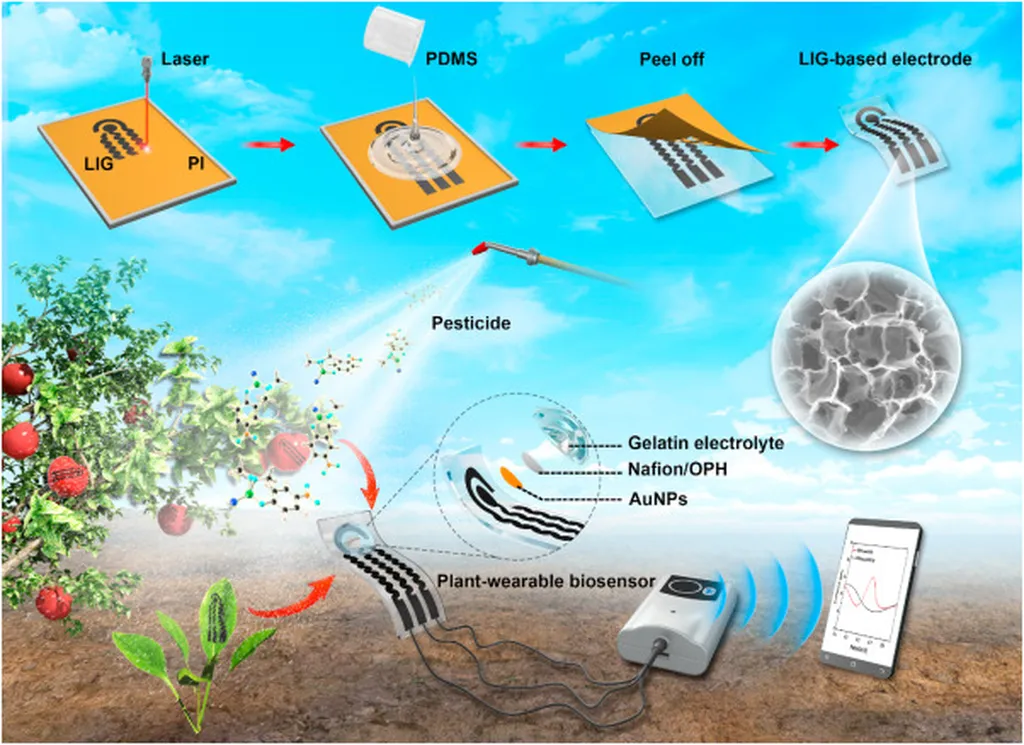
In the ever-evolving landscape of agricultural technology, a groundbreaking study published in *Advanced Science* introduces a novel approach to pesticide detection that could revolutionize food safety and precision farming. Researchers, led by Hongxia Li from the Department of Food Quality and Safety at Jilin University in China, have developed plant-wearable sensors (PWS) capable of real-time, on-site monitoring of pesticide residues on crops. This innovation promises to enhance the precision and sustainability of agricultural practices, offering significant commercial benefits to the sector.
The core of this technology lies in the immobilization of acetylcholinesterase (AChE) enzymes within hydrogen-bonded organic frameworks (HOFs). These frameworks, constructed through electronic interactions and hydrogen bonding, exhibit high catalytic activity and stability. By embedding AChE@PAH-HOFs into a glycerol-sodium alginate hydrogel matrix, the researchers created a sensor that can withstand high temperatures and maintain high water-retaining capacity, essential for prolonged operation in diverse agricultural environments.
“Our goal was to develop a sensor that could provide accurate, real-time data on pesticide levels without compromising the plant’s health,” said Li. “The integration of enzyme immobilization with hydrogel technology has allowed us to achieve this, offering a non-invasive and cost-effective solution for farmers and agricultural professionals.”
The plant-wearable sensors were tested on tomato plants, demonstrating exceptional accuracy and sensitivity in detecting chlorpyrifos, a common organophosphorus pesticide. With a detection limit of just 1 ng mL⁻¹, the sensors outperformed traditional methods, providing precise data that can inform targeted pesticide application and ensure food safety.
The commercial implications of this research are vast. Farmers can now monitor pesticide levels in real-time, reducing the risk of over-application and minimizing environmental impact. This precision not only supports sustainable farming practices but also enhances crop yield and quality, ultimately benefiting both producers and consumers.
Moreover, the integration of image processing algorithms with the PWS enables continuous, long-term monitoring. This capability is crucial for tracking pesticide degradation and ensuring that plant-based foods meet safety criteria for consumption. As the agricultural sector increasingly embraces technology-driven solutions, this innovation could set a new standard for pesticide detection and management.
The research led by Li and her team at Jilin University represents a significant step forward in agritech. By combining enzyme immobilization with advanced sensor technology, they have created a tool that could reshape the future of precision agriculture. As the technology is further refined and commercialized, it has the potential to drive widespread adoption of sustainable and data-driven farming practices, ultimately contributing to a safer and more efficient agricultural ecosystem.