
In the realm of analytical chemistry, precision and speed are paramount, especially when it comes to measuring the concentration of substances in solutions. A recent study published in the journal *Heliyon* introduces a novel approach that could revolutionize how we quantify ethanol in water solutions, with significant implications for industries ranging from agriculture to healthcare. The research, led by Zhenghao Guo from the College of Physics and Optoelectronic Engineering at Ocean University of China, presents a linear fractional model that leverages polarized Raman spectroscopy to achieve unprecedented accuracy in ethanol detection.
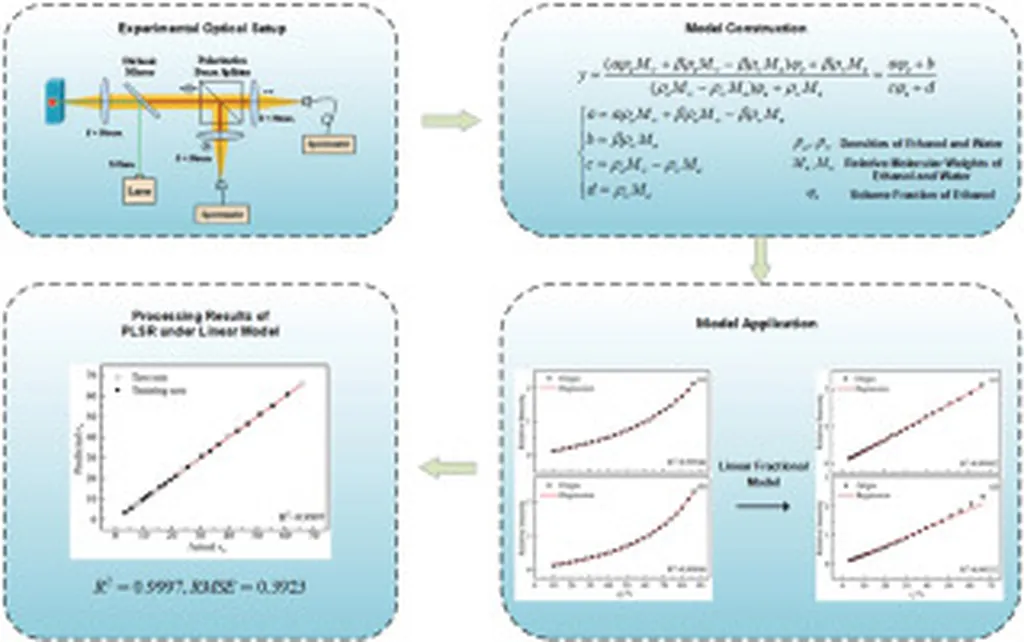
Raman spectroscopy is a well-established technique that provides insights into the molecular composition of substances by analyzing their vibrational modes. However, quantifying ethanol in water solutions has always been a challenge due to the overlapping -OH bonds present in both ethanol and water. Traditional methods often rely on these bonds as an internal standard, but this approach falls short when dealing with ethanol solutions. Guo and his team have addressed this limitation by developing a model that uses the molar ratio as an independent variable and combines the Raman spectra of two polarization directions to establish a Partial Least Squares Regression (PLSR) model.
The results of this study are impressive. The model achieved an R² value of 0.9997, indicating an exceptionally high correlation between the measured and actual concentration values. The Root Mean Square Error (RMSE) was a mere 0.3923, which is a significant improvement over existing methods. “This level of precision is crucial for industries that require accurate and rapid ethanol quantification,” says Guo. “Our model not only enhances the accuracy but also simplifies the process, making it more accessible and efficient.”
The agricultural sector stands to benefit greatly from this advancement. Ethanol is widely used as a fuel additive and a key component in various agricultural chemicals. Accurate and rapid quantification of ethanol in water solutions can lead to better quality control, improved efficiency, and cost savings. For instance, in the production of biofuels, precise ethanol measurement can ensure optimal blending ratios, leading to more efficient and environmentally friendly fuel solutions. Additionally, in the agricultural chemical industry, accurate ethanol quantification can enhance the formulation of pesticides, herbicides, and fertilizers, ensuring their effectiveness and safety.
Beyond agriculture, the healthcare industry can also reap the benefits of this innovative approach. Ethanol is a common ingredient in many pharmaceutical formulations, and accurate quantification is essential for ensuring the safety and efficacy of these drugs. The model developed by Guo and his team can provide a rapid and non-invasive method for ethanol detection, which can streamline the manufacturing process and improve product quality.
The implications of this research extend beyond immediate applications. The linear fractional model and the use of polarized Raman spectroscopy open up new avenues for exploring other complex mixtures and solutions. “This method can be adapted and optimized for a wide range of substances,” explains Guo. “It has the potential to revolutionize the field of analytical chemistry and pave the way for more advanced and precise measurement techniques.”
In conclusion, the study published in *Heliyon* by Zhenghao Guo and his team represents a significant step forward in the field of analytical chemistry. The linear fractional model for quantifying ethanol in water solutions using polarized Raman spectroscopy offers a highly accurate, rapid, and non-invasive method that can benefit various industries, including agriculture and healthcare. As the research continues to evolve, it is likely to shape future developments in the field, leading to more efficient and precise measurement techniques that can drive innovation and progress.