
In the heart of Punjab, India, a team of researchers led by Apoorva Arora at Chitkara University Institute of Engineering and Technology has developed a groundbreaking approach to plant disease detection that could revolutionize the agriculture sector. Their work, published in the journal ‘Systems and Soft Computing’, combines the power of Convolutional Neural Networks (CNNs) and Vision Transformers (ViT) to create a robust model for identifying and classifying plant leaf diseases with remarkable accuracy.
The challenge of detecting plant diseases is a complex one, with a vast array of plant species and diseases affecting crop productivity worldwide. Traditional methods of disease detection often rely on manual inspection, which can be time-consuming and prone to human error. The team’s innovative solution automates this process, using a multi-scale feature fusion network to analyze images of plant leaves and identify diseases with an impressive accuracy rate of 99.85%.
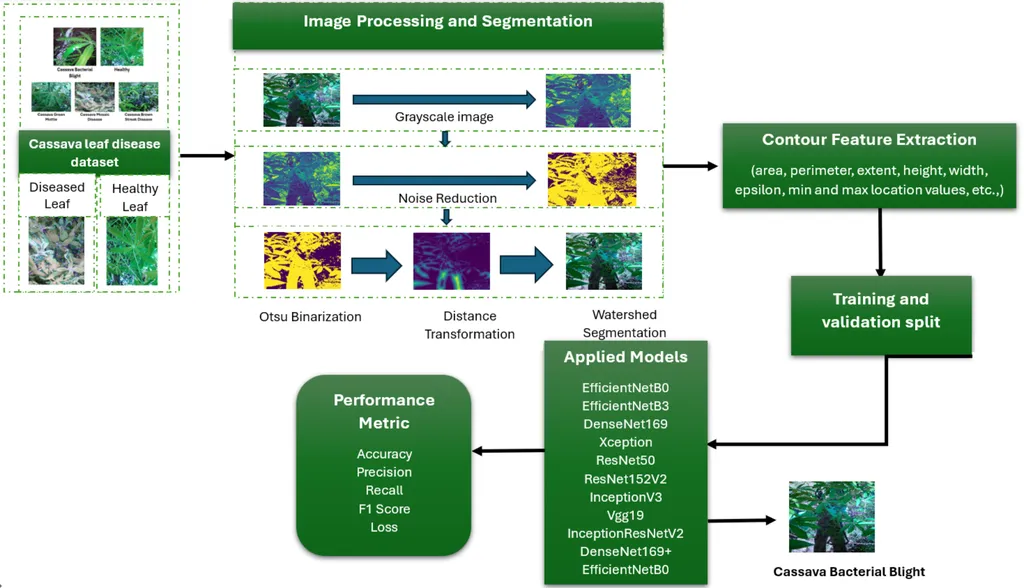
The process begins with pre-processing the plant image to reduce background noise using a Rank Order Fuzzy (ROF) filter approach. The image is then resized and data augmentation is performed to enhance the dataset. Next, disease spots are identified using histogram-based methods based on the L*a*b* color model. This preliminary identification aids in accurate segmentation, which is the division of the leaf images into uniform areas. The segmented patches are then fed into a fusion model for data categorization.
The fusion model leverages the strengths of both CNNs and ViT. “We integrate CNN designs such as VGG16, InceptionV3, AlexNet, and Google Net to extract powerful early features fusion,” explains Arora. “Then, local characteristics are captured using a ViT model to accurately detect plant illnesses.” This combination of technologies allows the model to outperform similar previously published methods in the detection and categorization of various plant leaf diseases.
The commercial implications of this research are significant. Early and accurate detection of plant diseases can lead to timely intervention, reducing crop loss and increasing agricultural productivity. This technology can be integrated into existing farming practices, providing farmers with a powerful tool to monitor and manage their crops more effectively. Furthermore, the model’s high accuracy rate suggests that it could be deployed in various agricultural settings, from large-scale farms to smallholder plots, potentially benefiting farmers worldwide.
Looking ahead, this research could shape the future of plant disease detection and precision agriculture. As Arora notes, “Our work opens up new possibilities for the application of AI in agriculture.” The integration of advanced machine learning techniques with agricultural practices could lead to more sustainable and efficient farming methods, ultimately contributing to global food security.
In the rapidly evolving field of agritech, this research stands out as a testament to the potential of AI to transform traditional industries. As we continue to witness the intersection of technology and agriculture, innovations like this one will play a pivotal role in shaping the future of farming.