
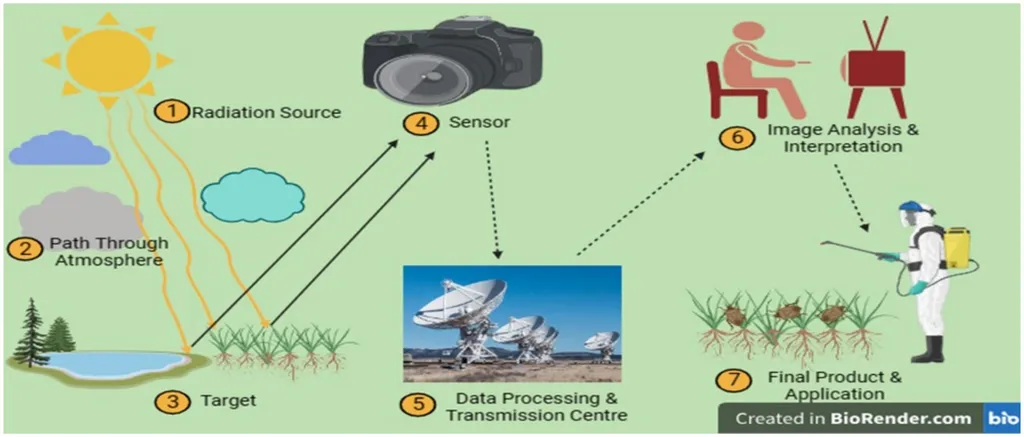
In the realm of smart agriculture, precision is key, and a new breakthrough in paddy pest image segmentation (PPIS) is set to revolutionize how farmers detect and manage pests in real-time. Researchers have developed a novel model called multiscale attention fusion VM-UNet (MSAF-VMUNet), which significantly improves the accuracy of pest detection in paddy fields. This advancement could have profound implications for the agriculture sector, enhancing pest control strategies and ultimately boosting crop yields.
The challenge of precise pest detection in natural environments has long plagued the agriculture industry. Traditional methods often fall short due to limitations in modeling global dependencies and high computational complexity. However, the MSAF-VMUNet model, developed by a team led by Yunlong Zhang from the Henan Agricultural Information Data Intelligent Engineering Research Center at SIAS University in Zhengzhou, China, integrates the strengths of Convolutional Neural Networks (CNNs) and Transformers to overcome these hurdles.
The MSAF-VMUNet model leverages the long-range dependencies modeling ability of the Visual State Space Model (VSS) and the precise positioning capability of U-Net. “Our model captures long-range contextual information through the multiscale VSS (MSVSS) block and employs an improved attention fusion (IAF) module for multi-level feature learning between the Encoder and Decoder,” explains Zhang. This innovative approach enables the model to adaptively emphasize key features and suppress redundant information, resulting in a more accurate and efficient detection process.
One of the standout features of the MSAF-VMUNet is its ability to handle various pests of different sizes and shapes without increasing computational complexity. This is a game-changer for farmers who rely on real-time data to make informed decisions about pest control. The model’s attention VSS module in the bottleneck layer ensures that the most critical features are highlighted, improving detection performance significantly.
The experimental results on the paddy pest subset of the public IP102 dataset are promising. The MSAF-VMUNet achieved a PPIS precision of 79.17%, which is 15.51% higher than traditional U-Net and 3.39% higher than the recent VM-UNet. These results validate the model’s effectiveness in addressing key challenges in field PPIS, including small pest detection, occlusion and noise handling, and preprocessing requirements.
The commercial impact of this research is substantial. Accurate and real-time pest detection can lead to more targeted and efficient use of pesticides, reducing costs and environmental impact. Farmers can implement preventive measures more effectively, minimizing crop damage and increasing yields. This technology can be integrated into existing smart agriculture systems, providing a reliable solution for pest control detection.
Looking ahead, this research opens up new avenues for future developments in the field. The MSAF-VMUNet model’s success in paddy pest detection could be extended to other crops and agricultural environments. As the technology evolves, it may become an integral part of precision agriculture, contributing to sustainable and efficient farming practices.
In conclusion, the development of the MSAF-VMUNet model represents a significant step forward in the field of smart agriculture. Its ability to improve pest detection accuracy and efficiency has the potential to transform pest control strategies, benefiting farmers and the agriculture sector as a whole. As the technology continues to advance, we can expect even greater innovations that will shape the future of agriculture.
The research was recently published in the journal ‘Frontiers in Plant Science’, highlighting its importance and relevance to the scientific community.