
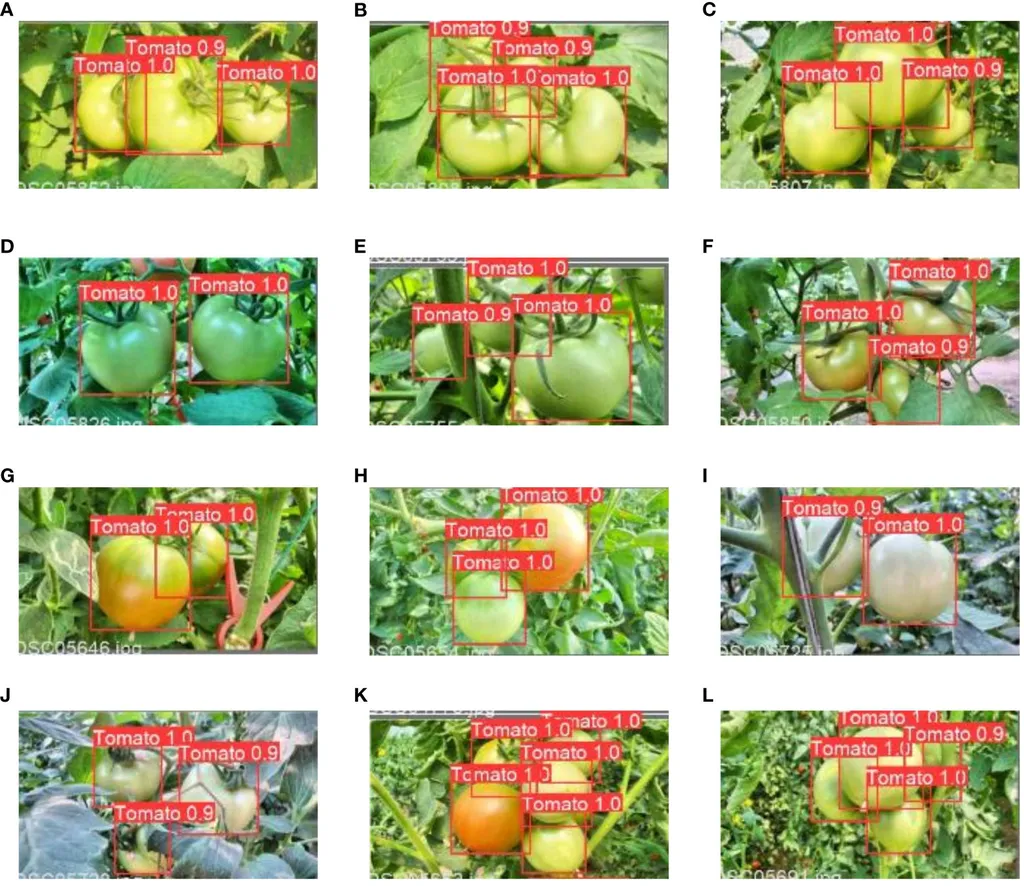
In the ever-evolving landscape of modern agriculture, the humble tomato stands as a key economic crop, yet its harvesting process is fraught with challenges. Complex growth environments, leaf occlusion, and uneven illumination often hinder traditional object detection technologies, leading to inaccuracies in identifying ripe and small-target tomatoes. However, a recent study published in *Frontiers in Plant Science* offers a promising solution to these persistent problems.
Led by Qiang Li, the research focuses on enhancing the YOLOv8n architecture to optimize tomato picking detection. The study identifies inherent bottlenecks in feature extraction and small-target recognition, proposing targeted improvements to address these issues. “We introduced a Space-to-Depth convolution module (SPD) to boost feature extraction and added a dedicated small-target detection layer integrated with the Parallelized Patch-Aware Attention mechanism (PPA),” explains Li. These modifications aim to enhance the model’s ability to detect small tomatoes accurately, even in complex environments.
To balance performance and efficiency, the researchers adopted a lightweight Slim-Neck structure and a self-developed Detect_CBAM detection head. Additionally, the Distance-Intersection over Union loss function (DIoU) was employed to optimize gradient distribution during training. The experiments were conducted on a self-built “tomato_dataset” comprising 7,160 images, divided into training, validation, and testing sets.
The results are impressive. The improved model achieved 89.6% precision, 87.3% recall, and 93.5% [email protected], significantly outperforming the baseline YOLOv8n and most comparative models. “Our model not only improves detection accuracy but also enhances robustness, providing reliable technical support for automated harvesting,” Li notes.
The commercial implications for the agriculture sector are substantial. Accurate and efficient tomato detection can streamline harvesting processes, reduce labor costs, and increase yield. This technology could be a game-changer for farmers, enabling them to leverage automation and intelligent systems to optimize their operations.
Looking ahead, this research could shape future developments in the field of agricultural technology. The enhanced YOLOv8n architecture demonstrates the potential for deep learning models to tackle complex challenges in agriculture. As the sector continues to embrace technological advancements, such innovations will play a crucial role in driving efficiency and sustainability.
The study, published in *Frontiers in Plant Science*, represents a significant step forward in the quest for intelligent agricultural solutions. With the lead author, Qiang Li, and his team paving the way, the future of tomato harvesting looks promising. As the agriculture industry continues to evolve, the integration of advanced detection technologies will undoubtedly be a key factor in its success.