
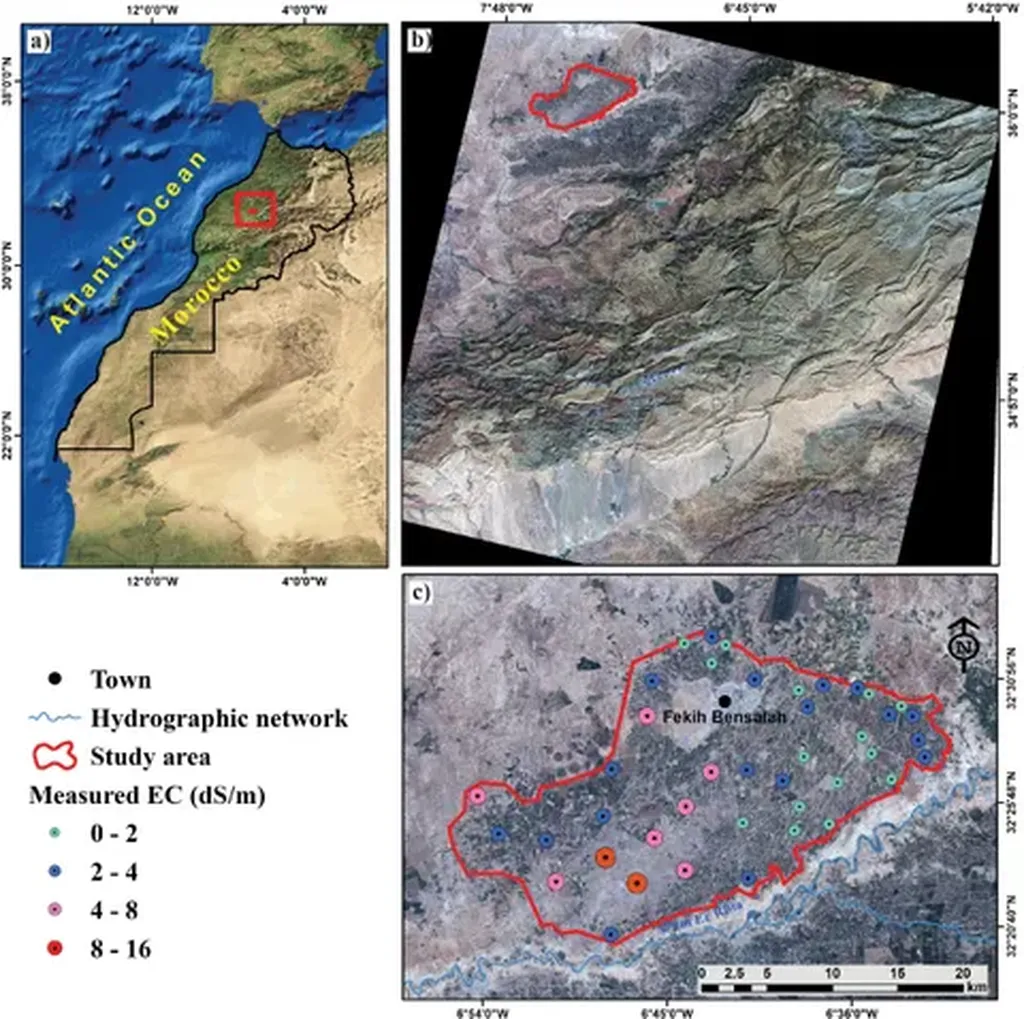
In the vast, sun-scorched landscapes of arid and semi-arid regions, an invisible menace lurks beneath the surface—saline soils. These salt-laden soils, often a result of human activity or natural processes, pose a significant threat to agriculture, infrastructure, and the environment. Traditional methods of mapping these saline soils have relied heavily on passive remote sensing data, but a new study published in ‘The International Archives of the Photogrammetry, Remote Sensing and Spatial Information Sciences’ is exploring a different avenue: active remote sensing, specifically Synthetic Aperture Radar (SAR).
The lead author, A. Abuelgasim from the Rabdan Academy in Abu Dhabi, United Arab Emirates, is at the forefront of this research. The study aims to bridge a significant gap in the current understanding of saline soil mapping by employing C-band Sentinel-1 data enhanced by polarimetric analysis. This approach offers a novel way to identify and map saline soils, potentially revolutionizing how we manage and mitigate the impacts of soil salinity.
“Most previous studies have focused on broad-band passive remote sensing data,” Abuelgasim explains. “But we believed that active radar remote sensing data, particularly SAR, could provide a more comprehensive understanding of saline soil distribution and its dynamics.”
The preliminary results of this research highlight the challenges of using active remote sensing in mapping saline soils. The study found that relying on the correlations between electric conductivity measurements and scattering entropy resulted in accuracies of only 17% and 15% using polarimetric anisotropy. These modest accuracies underscore the complexity of the task and the need for further refinement of the methodology.
However, the incorporation of polarimetric SAR (PolSAR) techniques offers a new avenue for improving soil salinity mapping. By leveraging the unique scattering mechanisms and dielectric properties of saline soils, PolSAR can provide more detailed and accurate information. This could be a game-changer for the agriculture sector, which is particularly vulnerable to the adverse effects of saline soils.
“Other soil parameters such as soil electric properties and perhaps soil moisture would improve the detection of saline soils using SAR data,” Abuelgasim notes. This suggests that a multi-faceted approach, incorporating various soil parameters, could enhance the accuracy of saline soil mapping.
The commercial impacts of this research for the agriculture sector are substantial. Accurate mapping of saline soils can help farmers make informed decisions about crop selection, irrigation, and soil management practices. It can also aid in the development of targeted remediation strategies, ultimately improving crop yields and ensuring food security in arid and semi-arid regions.
Moreover, this research could shape future developments in the field of remote sensing and soil science. By exploring the potential of active remote sensing and PolSAR techniques, it opens up new possibilities for monitoring and managing soil salinity. It also highlights the need for continued innovation and collaboration in addressing the challenges posed by saline soils.
As we look to the future, the work of Abuelgasim and their team serves as a reminder of the power of scientific inquiry and the potential of technology to transform our understanding of the world around us. In the fight against saline soils, active remote sensing may well be a key weapon in our arsenal.