
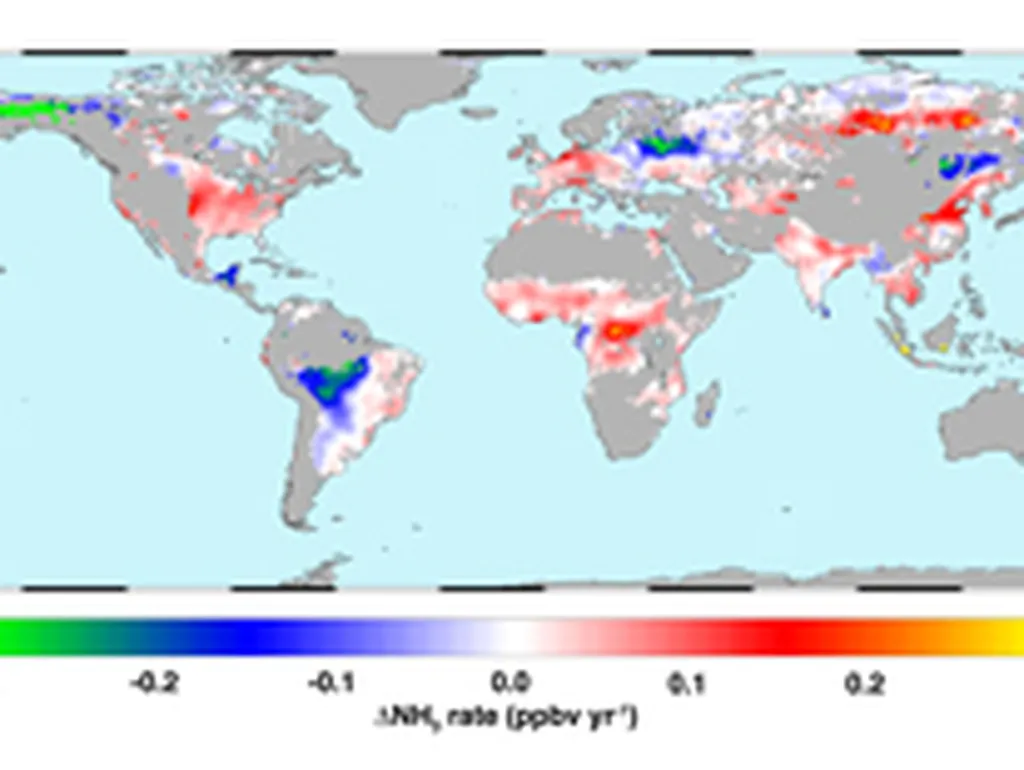
In a groundbreaking study published in *Atmospheric Chemistry and Physics*, researchers have harnessed satellite technology to map ammonia emissions and depositions across the contiguous United States, offering critical insights for the agriculture sector. The research, led by Z. Li from the Agroecosystem Sustainability Center at the University of Illinois Urbana-Champaign, leverages data from the Infrared Atmospheric Sounding Interferometer (IASI) and the Cross-track Infrared Sounder (CrIS) to provide a detailed picture of ammonia dynamics, which are predominantly driven by agricultural activities.
Ammonia (NH₃) is a significant environmental concern, contributing to nitrogen deposition and the formation of secondary aerosols that impact ecosystems, climate, and human health. Despite its importance, estimating NH₃ fluxes has been challenging due to limited direct observations and the complexity of emission and deposition processes. This study employs a directional derivative approach to estimate NH₃ fluxes, revealing major agricultural emission hotspots such as the San Joaquin Valley in California, the Snake River Valley in Idaho, the Texas panhandle, the Great Plains, Southeastern Pennsylvania, and Eastern North Carolina.
The findings highlight that NH₃ removal is primarily driven by deposition near source areas rather than chemical transformation, with strong sinks in vegetation-dense regions like forests, grasslands, shrublands, and wetlands. Seasonal variations show peaks in warm months and lower values in winter, influenced by temperature-dependent volatilization from livestock production and fertilizer application.
“Our study provides a comprehensive view of ammonia emissions and depositions, which is crucial for understanding the environmental impact of agricultural practices,” said Z. Li, the lead author of the study. “By combining satellite observations from IASI and CrIS, we can better capture the diurnal dynamics of NH₃ fluxes, offering valuable insights for nitrogen management and environmental policy.”
The research also reveals that CrIS consistently reports higher fluxes than IASI, particularly in spring, reflecting differences in their overpass times. This discrepancy underscores the importance of integrating multiple data sources to gain a more accurate understanding of NH₃ dynamics.
For the agriculture sector, these findings have significant commercial implications. Accurate mapping of ammonia emissions can inform better nitrogen management practices, reducing environmental impact while optimizing fertilizer use. This is particularly relevant in regions with limited ground-based monitoring, where satellite data can fill critical gaps in our understanding of NH₃ dynamics.
As the agriculture industry continues to face increasing scrutiny over its environmental footprint, this research provides a powerful tool for policymakers and farmers alike. By leveraging advanced satellite technology, the study offers a pathway to more sustainable agricultural practices, ultimately benefiting both the environment and the bottom line.
The integration of IASI and CrIS observations not only enhances our understanding of NH₃ fluxes but also sets a precedent for future research in this field. As satellite technology continues to evolve, the potential for even more precise and comprehensive monitoring of atmospheric pollutants grows, paving the way for innovative solutions to environmental challenges.
In summary, this study represents a significant step forward in our ability to monitor and manage ammonia emissions, offering valuable insights that can shape future developments in agriculture and environmental policy.