
In the ever-evolving landscape of agriculture, the quest for optimizing crop yield and quality remains a top priority. A recent study published in the *Journal of Agriculture and Food Research* sheds light on a promising approach to tobacco cultivation that could reshape the industry’s future. Led by Wei Yang from the Yunnan Academy of Tobacco Agricultural Sciences and affiliated with the Hubei Key Laboratory of Waterlogging Disaster and Agricultural Use of Wetland, the research explores the synergistic effects of integrating various fertilizers to enhance tobacco growth, nutrient efficiency, and economic returns.
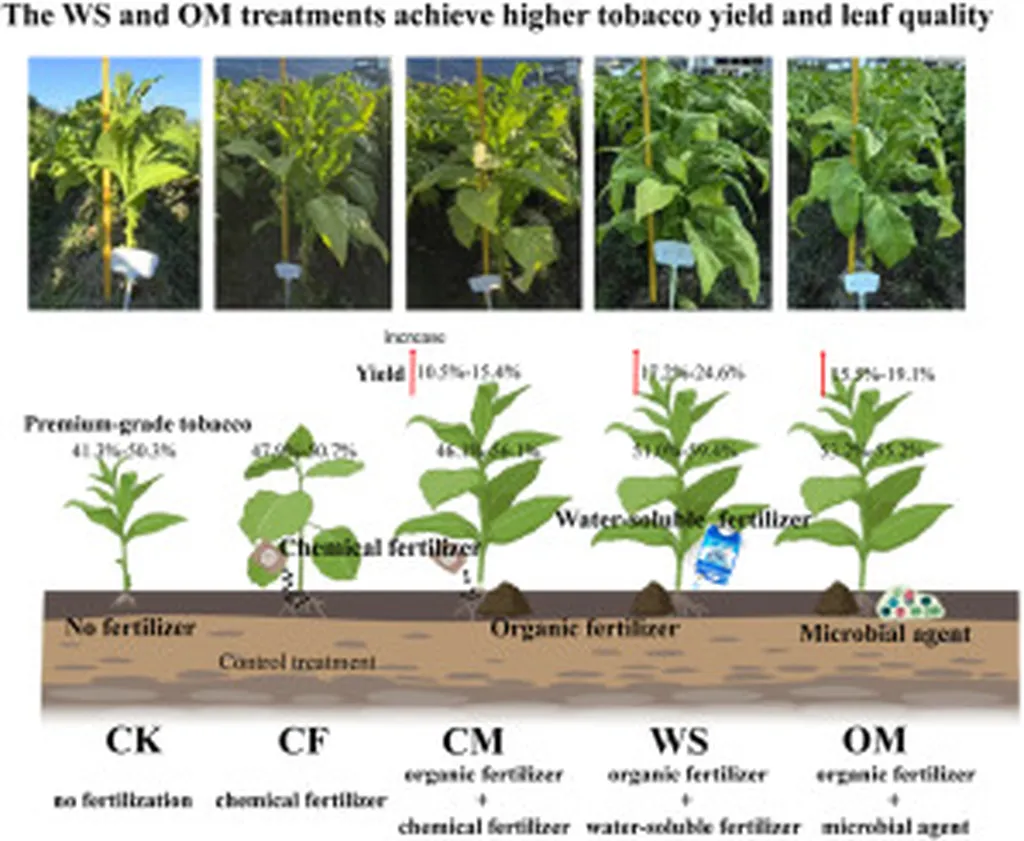
The study, conducted over two years, evaluated five distinct nutrient management strategies: no fertilization (CK), conventional chemical fertilizer (CF), organic fertilizer combined with conventional chemical fertilizer (CM), organic fertilizer combined with water-soluble fertilizer (WS), and organic fertilizer combined with a compound microbial agent (OM). The results were striking, particularly for the WS and OM treatments, which demonstrated significant improvements in tobacco yield and quality.
“We found that the WS and OM treatments increased tobacco yield by 14.9% to 24.6% and improved the proportion of premium and medium-grade tobacco leaves by 1.6% to 6.3% compared to the conventional chemical fertilizer treatment,” said Wei Yang. These enhancements were driven by increased plant height, stem girth, number of leaves, leaf area index, biomass, nutrient use efficiency, and higher contents of total sugar and potassium.
The economic implications of these findings are substantial. The WS treatment, in particular, showed the best comprehensive performance, increasing nitrogen use efficiency by 106.0% to 130.9%, phosphorus use efficiency by 62.7% to 149.6%, and potassium use efficiency by 473.1% to 551.4%. This translated to a significant boost in tobacco revenue, with increases ranging from 26.8% to 29.0% for WS and 22.8% to 31.5% for OM treatments.
The study’s findings suggest that integrating organic fertilizers with water-soluble fertilizers or microbial agents could be a game-changer for the tobacco industry. “This approach not only enhances nutrient use efficiency but also improves the overall quality and economic value of the crop,” Yang explained. “It’s a win-win scenario for both farmers and the industry.”
The research highlights the potential for sustainable agricultural practices that balance yield, quality, and economic returns. As the agriculture sector continues to seek innovative solutions to meet global demands, this study offers a compelling case for the adoption of integrated nutrient management strategies. The findings could pave the way for similar approaches in other crops, fostering a more sustainable and profitable future for agriculture.
For stakeholders in the tobacco industry and beyond, the message is clear: embracing a more holistic approach to nutrient management could unlock new levels of productivity and profitability. As Wei Yang and his team continue to explore these synergies, the agricultural community watches with keen interest, ready to adapt and implement these groundbreaking strategies.