
In the ever-evolving landscape of agricultural technology, a groundbreaking study published in *Current Plant Biology* is set to revolutionize how we estimate the harvest index (HI) in wheat fields. The research, led by Nisar Ali from the University of Regina, introduces a high-throughput phenotyping framework that leverages UAV-based multispectral imaging and ensemble machine learning to provide non-destructive, plot-level HI estimation. This innovation promises to significantly enhance the efficiency and accuracy of crop productivity evaluations, a critical aspect of modern wheat breeding programs.
Traditionally, estimating the harvest index—a ratio of grain yield to total aboveground biomass (AGB)—has been a labor-intensive process involving destructive field sampling. This method, while accurate, is impractical for large-scale breeding trials due to its time-consuming nature and the physical strain it places on resources. The new framework, however, offers a non-destructive alternative that can deliver high-throughput, plot-level HI estimation, thereby addressing these longstanding challenges.
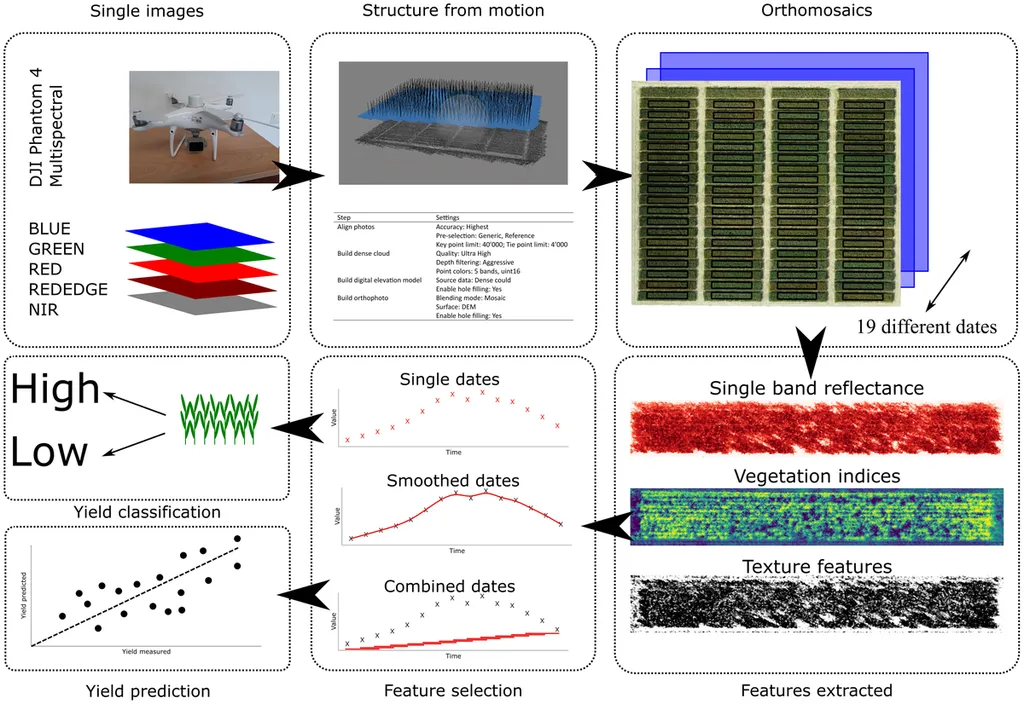
The study utilized a DJI M300 RTK drone equipped with a RedEdge-P sensor to collect multispectral data at two key growth stages: anthesis and maturity. Vegetation indices (VIs), including the normalized difference vegetation index (NDVI), normalized difference red edge index (NDRE), and green NDVI (G-NDVI), were extracted from the data and used as predictors to estimate grain yield and AGB. An ensemble learning model, based on a stacking architecture comprising five regressors and a ridge regression meta-learner, was employed to enhance prediction accuracy.
The results were impressive. Strong correlations were observed between UAV-derived and ground-truth VIs, with R2 values exceeding 0.94 and RMSE values below 0.023. The ensemble model demonstrated high accuracy and strong generalization for HI estimation across both experimental sites and growing seasons. At the anthesis stage, the NDVI-based ensemble model achieved a testing R2 of 0.87 and an RMSE of 4.18 g/p at the Indian Head site, and a testing R2 of 0.84 with an RMSE of 8.67 g/p at the Swift Current site. Similarly, at the maturity stage, the NDRE-based ensemble model recorded a testing R2 of 0.86 and an RMSE of 7.10 g/p at Indian Head, and a testing R2 of 0.83 with an RMSE of 8.06 g/p at Swift Current.
“The proposed UAV machine learning framework demonstrates a reliable and non-destructive approach for field-level HI estimation, thereby improving germplasm selection efficiency for yield improvement,” said lead author Nisar Ali. This innovation offers a valuable tool for accelerating trait-based wheat breeding and precision agriculture applications, ultimately shaping the future of the agriculture sector.
The commercial impacts of this research are profound. By providing a more efficient and accurate method for estimating the harvest index, this technology can significantly enhance the productivity and resource-use efficiency of wheat breeding programs. This, in turn, can lead to the development of higher-yielding and more resilient wheat varieties, benefiting farmers and the agriculture industry as a whole.
As we look to the future, the integration of UAV-based remote sensing and machine learning in agricultural practices is poised to become increasingly prevalent. This research not only highlights the potential of these technologies but also paves the way for further advancements in the field. By continuing to explore and refine these methods, we can unlock new possibilities for improving crop productivity and sustainability, ultimately contributing to a more secure and prosperous future for agriculture.
Published in *Current Plant Biology* and led by Nisar Ali from the University of Regina, this study represents a significant step forward in the quest for more efficient and accurate agricultural practices. As the agriculture sector continues to evolve, the insights and innovations presented in this research will undoubtedly play a crucial role in shaping its future.