
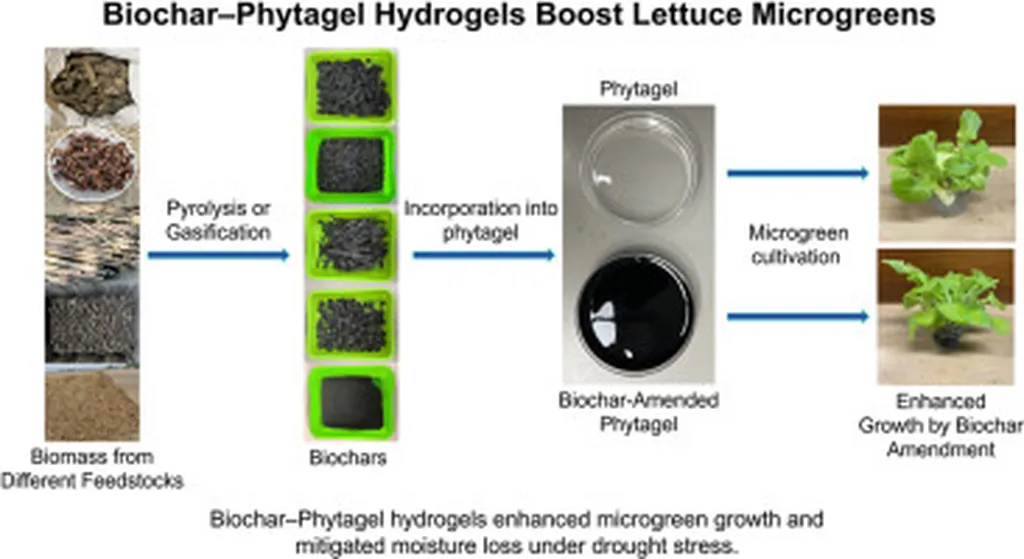
In the ever-evolving world of agriculture, researchers are continually seeking innovative solutions to enhance crop growth, nutrient uptake, and resilience, particularly in soil-free cultivation systems. A recent study published in the *Journal of Agriculture and Food Research* has uncovered promising results that could revolutionize hydroponic farming and controlled environment agriculture. The research, led by Ruogu Tang from the Department of Animal and Food Sciences at the University of Delaware, explores the potential of biochar-phytagel hydrogel composites to boost the growth and drought resilience of lettuce microgreens.
Biochar, a carbon-rich product derived from the pyrolysis of biomass, has long been recognized for its ability to improve soil water retention and nutrient availability. However, its role in hydrogel-based substrates has remained largely unexplored until now. Tang and her team incorporated various types of biochar—including corn, cocoa husk, nutshell, bamboo, and poultry litter—into phytagel hydrogels to cultivate lettuce microgreens. The findings are nothing short of intriguing.
The study revealed that biochar amendments significantly enhanced shoot elongation, root growth, and fresh biomass of lettuce microgreens, particularly under conditions of water stress. “At 70% relative humidity, biochar amendments enhanced shoot elongation up to 12.2 cm compared to 9.8 cm in the control,” Tang explained. “Under reduced humidity, biochar-phytagel substrates buffered moisture loss, preserved chlorophyll contents, and maintained leaf water above 90%, whereas the control fell below 88%.” This suggests that biochar-hydrogel composites could be a game-changer for farmers looking to optimize water usage and crop yields in hydroponic systems.
One of the most compelling aspects of this research is its potential to address the challenges posed by climate change and water scarcity. As droughts become more frequent and severe, the ability to cultivate crops with minimal water resources is increasingly valuable. The study’s findings indicate that biochar-hydrogel composites could offer a sustainable solution, enabling farmers to maintain high crop yields even under adverse conditions.
Moreover, the research highlights the nutritional benefits of biochar amendments. Nutrient profiling revealed significant increases in phosphorus, potassium, calcium, magnesium, and micronutrients such as iron, zinc, copper, and manganese. “These results demonstrate that biochar-hydrogel composites enhance both the resilience and nutritional quality of microgreens under moisture limitation,” Tang noted. This could have significant implications for the agricultural sector, as consumers increasingly demand nutrient-dense, sustainably grown produce.
The commercial impacts of this research are substantial. Hydroponic farming is already a rapidly growing sector, with a global market size projected to reach $2.1 billion by 2025. The integration of biochar-hydrogel composites into hydroponic systems could further drive this growth, offering farmers a cost-effective and environmentally friendly way to enhance crop productivity and resilience. As the agricultural industry continues to seek innovative solutions to the challenges of climate change and resource scarcity, this research provides a promising avenue for exploration.
In the words of Ruogu Tang, “Our findings open up new possibilities for sustainable controlled environment agriculture.” As the agricultural sector continues to evolve, the integration of biochar-hydrogel composites into hydroponic systems could pave the way for a more resilient and nutrient-rich future.