
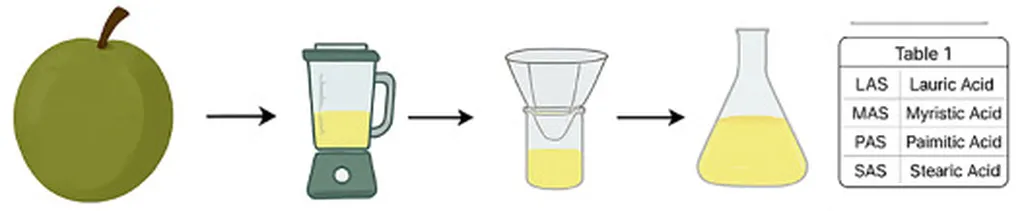
In the ever-evolving landscape of agricultural technology, a groundbreaking study has emerged that could revolutionize how we approach pesticide application. Researchers have successfully modified breadfruit starch through an esterification reaction with fatty acids, creating a hydrophobic material that could be a game-changer for controlled-release pesticide formulations. This innovation, published in the *South African Journal of Chemical Engineering*, opens new avenues for sustainable and efficient farming practices.
The study, led by Cut Fatimah Zuhra from the Department of Chemistry at Universitas Sumatera Utara in Indonesia, focuses on the modification of breadfruit starch. By substituting the hydroxyl (OH) groups in starch with fatty acids, the researchers were able to alter the starch’s properties, making it more hydrophobic. This modification is crucial for reducing the release rate of pesticides, addressing a longstanding environmental concern.
“Starch properties can be modified according to needs by substituting the OH group with fatty acids through esterification reactions,” Zuhra explained. The modified starch was synthesized using a urea/NaOH solvent, and its success was confirmed through various analyses, including FTIR, 1H NMR, TGA, and SEM. The results were promising, with starch modified with stearic acid achieving the best solubility value of 17.04% and the lowest swelling power of 3.25%.
The implications of this research for the agriculture sector are significant. Controlled-release pesticides can enhance the efficiency of pest management by ensuring a steady release of the active ingredient over an extended period. This not only reduces the frequency of application but also minimizes environmental impact, as less pesticide is needed overall.
“The method used was found to be optimal,” Zuhra noted, highlighting the potential for scalability and commercial application. The hydrophobic nature of the modified starch can slow down the release of pesticides, making them more effective and reducing the risk of environmental contamination. This innovation could be particularly beneficial in regions where pesticide runoff is a major concern, offering a more sustainable approach to pest control.
Looking ahead, this research could shape future developments in the field of agritech. The successful modification of breadfruit starch through esterification reactions opens the door to exploring other natural polymers that could be similarly enhanced for agricultural applications. This could lead to a new generation of eco-friendly, controlled-release formulations that are both effective and sustainable.
As the agriculture sector continues to embrace smart agrarian practices, innovations like this one will play a crucial role in shaping the future of farming. By reducing the environmental footprint of pesticide use, we can move towards a more sustainable and efficient agricultural system, benefiting both farmers and the planet.