
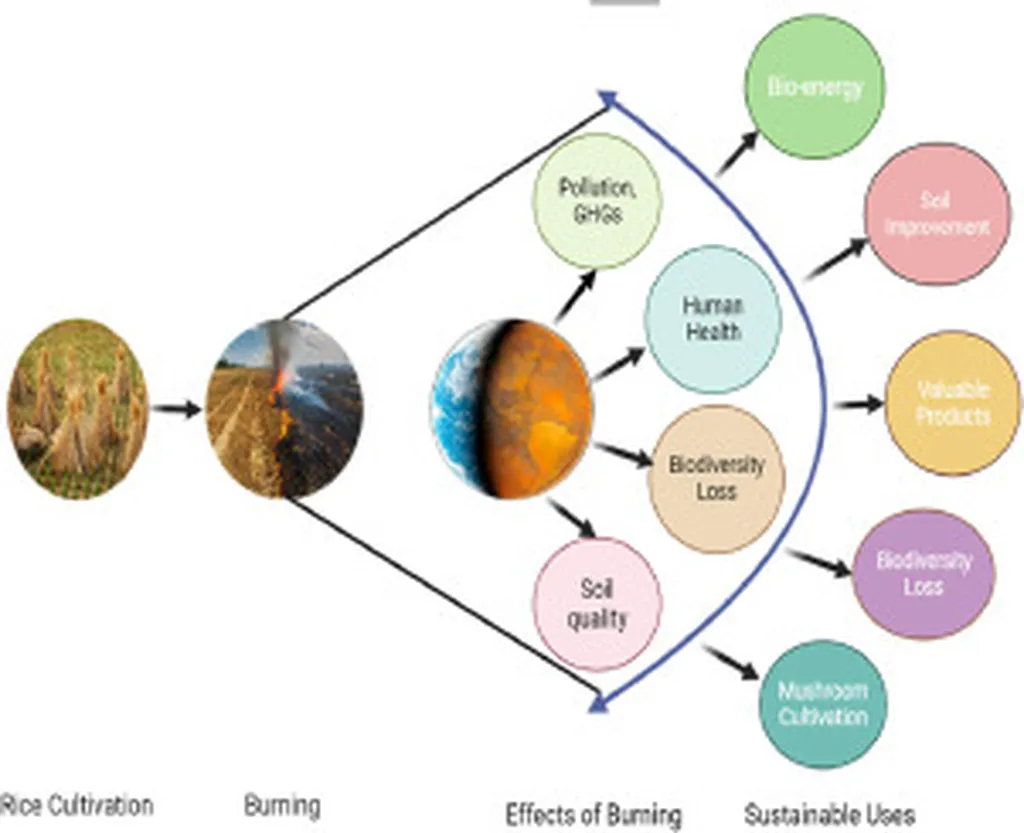
In the heart of India’s agricultural landscape, a pressing issue has long been the burning of paddy straw, a practice that not only chokes the skies with smoke but also depletes the soil of its vital nutrients. This age-old problem has sparked a novel solution, one that could potentially revolutionize the way we think about agricultural waste and energy security. A recent study published in *Frontiers in Sustainable Food Systems* proposes an innovative circular economy approach that transforms paddy straw into both compressed bio-gas (CBG) and fermented organic manure (FOM), offering a dual solution for energy and soil health.
The research, led by Sanjay Singh Rathore from the Division of Agronomy at the Indian Council of Agricultural Research (ICAR)-Indian Agricultural Research Institute in New Delhi, highlights the critical need to address the environmental and health consequences of crop residue burning. “This practice is a double-edged sword,” Rathore explains. “It not only contributes to air pollution and greenhouse gas emissions but also strips the soil of its essential nutrients and microbial activity, which are crucial for sustainable agriculture.”
The proposed solution is a two-pronged approach. First, paddy straw is converted into CBG, a renewable energy source that can significantly reduce India’s dependence on fossil fuels. The second prong involves the conversion of the nutrient-rich digestate, a by-product of the CBG production process, into FOM. This organic manure can enhance soil health, reducing the need for chemical fertilizers and promoting sustainable farming practices.
The commercial implications of this research are substantial. For the agriculture sector, the adoption of this circular economy model could lead to significant cost savings. By converting paddy straw into CBG, farmers can generate an additional revenue stream while also reducing their energy costs. Simultaneously, the use of FOM can improve soil fertility, leading to higher crop yields and further enhancing profitability.
Moreover, this approach aligns with the principles of climate-smart agriculture, offering a sustainable solution that addresses both energy security and environmental concerns. “This integrated dual-valorization model is a game-changer,” Rathore asserts. “It not only provides a renewable energy alternative but also ensures nutrient recycling, making it a win-win for both the environment and the agricultural sector.”
The study also offers a comprehensive circular bio-economy assessment tailored to India, evaluating emission reductions and demonstrating how the CBG–FOM system can enable sustainable, low-carbon agricultural development. This holistic approach could serve as a blueprint for other countries grappling with similar challenges, paving the way for a more sustainable and resilient agricultural future.
As the world continues to seek innovative solutions to the pressing issues of climate change and energy security, this research offers a beacon of hope. By valorizing paddy straw through the production of CBG and FOM, we can transform agricultural waste into a valuable resource, fostering a more sustainable and prosperous future for all.