
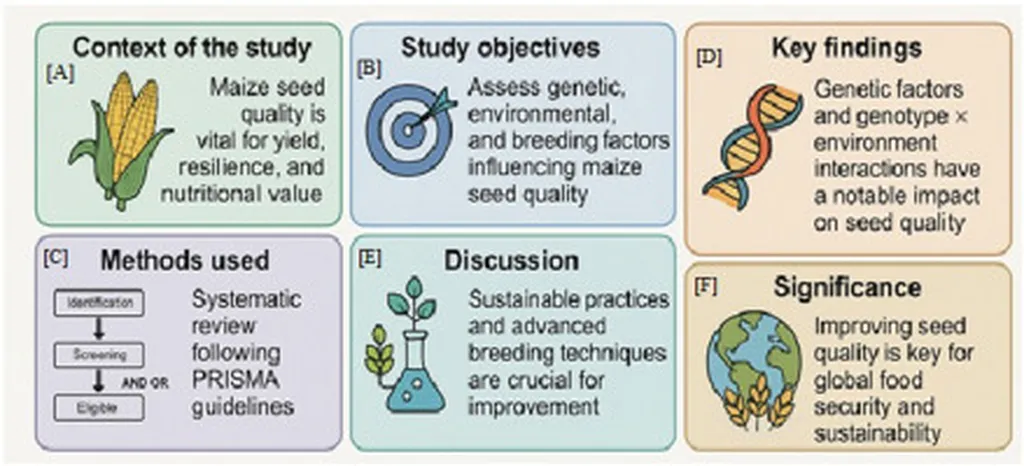
In the quest to bolster global food security and agricultural sustainability, a recent systematic review published in the *Journal of Agriculture and Food Research* has shed light on the critical factors influencing maize seed quality. Led by Fester Shadrach Tiah from the Sokoine University of Agriculture in Tanzania, the research synthesizes insights from multiple regions, offering a roadmap for enhancing maize production in the face of environmental challenges.
Maize, a staple crop for millions, is vulnerable to environmental stressors like drought and soil nutrient depletion. The review highlights that genetic interventions, such as hybridization and genetic modifications, play a pivotal role in improving seedling vigour, yield stability, and nutritional content. “Genetic modifications and hybridization are not just about increasing yield; they are about creating resilient seeds that can thrive in diverse and often harsh environments,” Tiah explained.
The study underscores the significance of genotype × environment × management interactions, revealing that factors like soil fertility and climate variability profoundly impact seed composition and germination performance. Breeding programs focused on stress tolerance and nutrient efficiency are crucial for enhancing seed quality, the review suggests. “By targeting specific traits like drought resistance and nutrient efficiency, we can develop seeds that are not only high-yielding but also nutritionally superior,” Tiah added.
Sustainable agricultural practices, including precision agriculture, conservation tillage, and seed treatments, are identified as key strategies to enhance seed viability and performance under varying environmental conditions. These practices not only improve seed quality but also contribute to long-term agricultural sustainability.
The findings suggest that integrating advanced breeding techniques, participatory approaches, and region-specific management strategies can significantly strengthen maize seed quality. This holistic approach is essential for building resilient production systems that can withstand the challenges posed by climate change and resource depletion.
For the agriculture sector, the implications are profound. Improved seed quality translates to higher yields, better nutritional value, and greater resilience to environmental stressors. This, in turn, can enhance food security and support the livelihoods of millions of farmers worldwide. “Investing in breeding programs, farmer education, and supportive policies is not just an option; it’s a necessity for the future of agriculture,” Tiah emphasized.
As the global population continues to grow, the demand for sustainable and nutritious food sources will only increase. This research provides a crucial foundation for future developments in maize breeding and agricultural practices, paving the way for a more secure and sustainable food future. The study, led by Fester Shadrach Tiah from the Sokoine University of Agriculture, offers a comprehensive overview of the genetic, agronomic, and environmental factors that influence maize seed quality, published in the *Journal of Agriculture and Food Research*.