
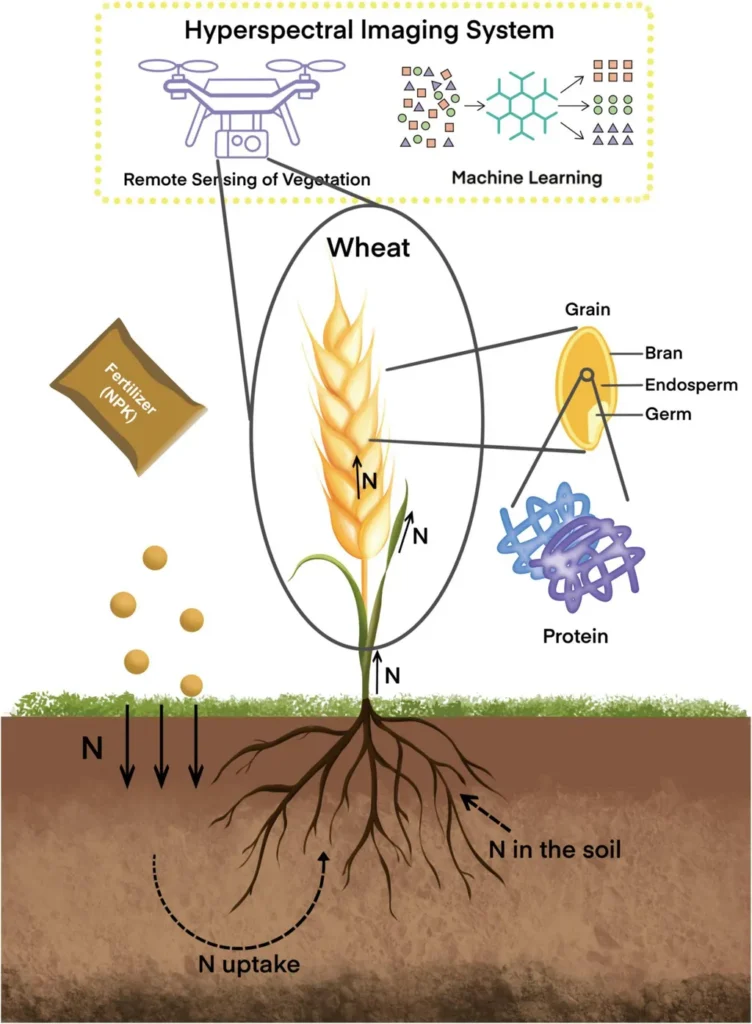
In the ever-evolving landscape of precision agriculture, a groundbreaking study published in *Smart Agricultural Technology* is set to revolutionize how we understand and monitor the intricate interactions within the soil-plant-atmosphere continuum (SPAC). Led by M.V. Chiozza from the Universidad de Sevilla, this research integrates multisensor data and advanced statistical modeling to capture dynamic photosynthetic traits in wheat, offering a glimpse into the future of crop breeding and management.
The study addresses a critical gap in agricultural technology: the lack of real-time, high-resolution data on key physiological traits such as net photosynthetic rate (A) and stomatal conductance (Gs). These traits are pivotal for assessing plant health, stress resilience, and overall productivity. By leveraging a multi-sensor high-throughput phenotyping platform (HTPP) equipped with a novel soil moisture system, the researchers achieved unprecedented monitoring capabilities. “This approach allows us to capture fine-scale variations in physiological and environmental variables throughout the growing season,” Chiozza explains. “It’s a game-changer for precision agriculture.”
The research employed partial least squares regression (PLSR) models to predict photosynthetic traits from hyperspectral bands and vegetation indices (VIs). The accuracy of these predictions was remarkable, with root mean square errors of 3.71 for A and 58.93 for Gs, and R-squared values of 0.72 and 0.70, respectively. These findings demonstrate the potential of hyperspectral data to provide reliable, non-invasive measurements of plant health and stress status.
Beyond the technical achievements, the study’s implications for the agriculture sector are profound. By integrating predicted data into mechanistic crop models, farmers and breeders can establish empirical relationships with parameters that vary throughout the growing season. This data-driven approach supports the development of resilient cultivars and improves crop management practices. “The ability to monitor soil moisture and crop water status in real-time is a significant advancement,” Chiozza notes. “It enables us to make informed decisions that enhance crop productivity and sustainability.”
The study’s findings pave the way for future developments in precision agriculture, particularly in the areas of high-throughput phenotyping and stress resilience breeding. As the agriculture sector continues to grapple with climate change and resource constraints, the ability to monitor and predict plant responses to environmental stressors becomes increasingly vital. This research offers a scalable solution that can be adapted to various crops and growing conditions, ultimately contributing to a more resilient and productive agricultural landscape.
In the words of Chiozza, “This is just the beginning. The integration of multisensor data and advanced modeling techniques holds immense potential for transforming agriculture. We are excited to see how these technologies will shape the future of crop breeding and management.” With the publication of this study in *Smart Agricultural Technology*, the agricultural community is one step closer to realizing the full potential of precision agriculture.