
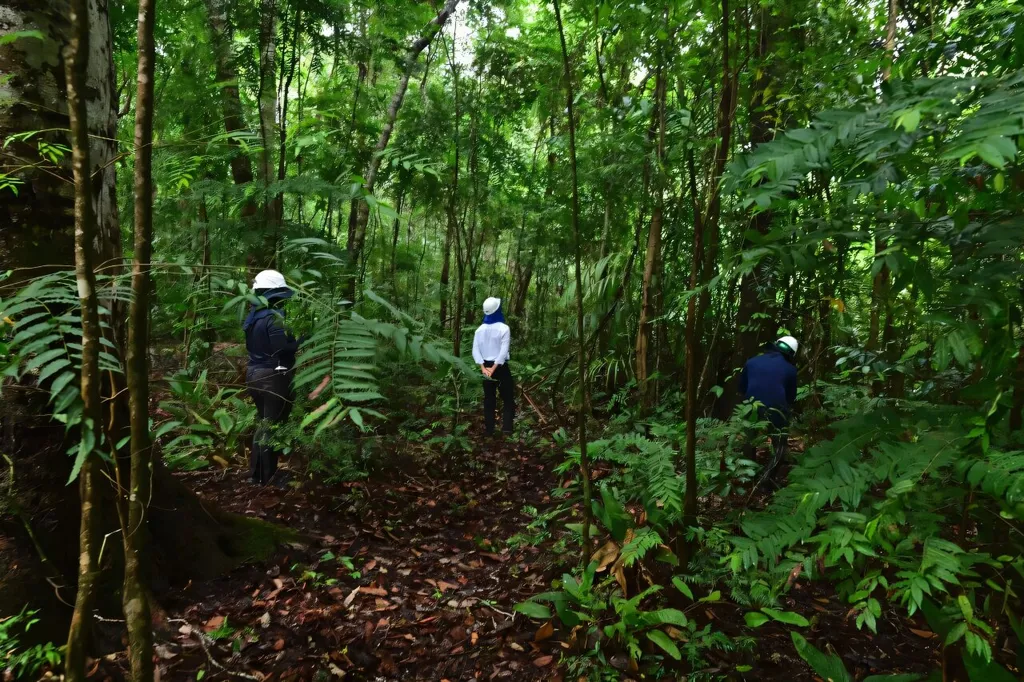
In the heart of the Brazilian Amazon, a groundbreaking study is reshaping our understanding of soil organic carbon (SOC) and its pivotal role in the global carbon cycle. Researchers have harnessed the power of geostatistical and machine learning techniques to model SOC content and stocks, offering a beacon of hope for climate-resilient land management and sustainable agriculture.
The study, led by Gizachew Ayalew Tiruneh from the Department of Natural Resource Management at Debre Tabor University and the Department of Forest Science at the University of São Paulo, analyzed 486 georeferenced soil samples from the Brazilian Amazon. The samples were evaluated for texture, pH, SOC, and bulk density at two depths: 0–30 cm and 30–60 cm.
The researchers employed a suite of methods, including inverse distance weighting (IDW) and machine learning algorithms like Random Forest, Support Vector Machine, Multiple Linear Regression, and Artificial Neural Network. The results were validated through 10-fold cross-validation, ensuring the robustness of the findings.
Random Forest emerged as the most accurate method for predicting SOC content, with an impressive R² value of 0.96. Meanwhile, IDW proved to be the best method for predicting SOC stock, achieving an R² value of 0.88. The study revealed that SOC content and stock followed a clear trend: forest > pasture > cropland. Forest soils exhibited SOC content ranging from 2.71–4.52% (103.89–261.95 Mg C ha−¹), while croplands showed lower values of 2.03–2.14% (80.05–86.06 Mg C ha−¹).
“Our findings highlight the significant impact of land use on soil organic carbon,” said Tiruneh. “By understanding these dynamics, we can better guide climate-resilient land management practices and improve soil carbon sequestration.”
The study also identified clay content, temperature, and land use as major factors influencing SOC variation. This insight is crucial for the agriculture sector, as it underscores the importance of sustainable land-use practices in maintaining and enhancing soil health.
One of the most exciting aspects of this research is its potential to bridge data gaps in regions where soil data is sparse. By combining IDW and machine learning approaches, the study paves the way for scalable and transferable modeling systems. This innovation could revolutionize global carbon accounting, sustainable agriculture, and land-use planning for climate mitigation.
As the world grapples with the challenges of climate change, this research offers a glimmer of hope. By delivering accurate and reliable estimates of soil carbon storage, it enables more informed decision-making and strategic planning. The agriculture sector, in particular, stands to benefit from these advancements, as they strive to balance productivity with sustainability.
Published in the journal ‘Trees, Forests and People’, this study not only advances our scientific understanding but also provides practical tools for addressing real-world challenges. As we look to the future, the integration of geostatistical and machine learning techniques holds immense promise for shaping climate-resilient landscapes and fostering a more sustainable world.
In the words of Tiruneh, “This research is just the beginning. The potential applications are vast, and we are excited to see how these methods will be applied in other tropical and subtropical regions.”