
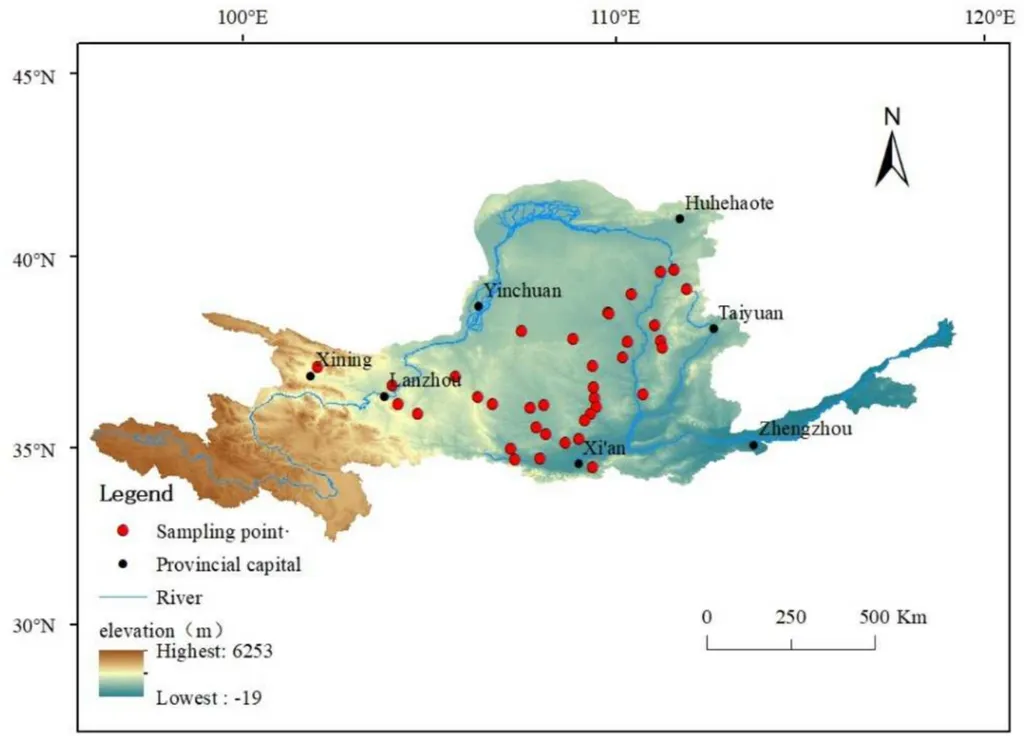
In the heart of China’s agricultural landscape, the Yellow River Basin, a pressing question looms: how will climate change reshape the future of crop yields and water use? A groundbreaking study published in *Agricultural Water Management* sheds light on this very issue, offering insights that could steer the course of agricultural water management and investment strategies.
The research, led by Linchao Li from the College of Agronomy at Inner Mongolia Agricultural University, employs a sophisticated ensemble of nine crop models and 38 global climate models to project the future of drought-driven yield losses. The findings are stark: as the planet warms, the yield gap between irrigated and rainfed crops is set to widen for maize, soybean, and rice, while wheat may see a slight decrease. This shift signals a potential increase in irrigation reliance, a development with significant commercial implications for the agriculture sector.
The study reveals that precipitation’s role in narrowing the yield gap is diminishing. “Rainfall is becoming less effective at bridging the gap as atmospheric demand rises,” explains Li. This trend is particularly pronounced for maize, with 69.8% to 77.8% of grid cells showing increasing sensitivity under different climate scenarios. In other words, farmers may need to rely more on irrigation to maintain yields, a shift that could drive up water usage and costs.
Evapotranspiration (ET), the process by which water is transferred from the land to the atmosphere, tells a different story. While ET generally shows an opposite spatial pattern to precipitation, the study found that in extremely arid upstream areas, the coupling between ET and yield gap weakens or even decouples due to high atmospheric demand. This decoupling could lead to unexpected challenges in water management, particularly in drought-prone regions.
The study also highlights the role of atmospheric CO2 in reducing the yield gap, a phenomenon linked to improved water-use efficiency. This effect is more pronounced in the arid upstream areas, offering a glimmer of hope amidst the challenges posed by climate change.
The research underscores the need for targeted irrigation investment and drought-time water-allocation prioritization. By identifying spatiotemporal hotspots of intensifying yield-gap sensitivities, the study provides a roadmap for climate-smart water management, a critical step towards stabilizing production and ensuring long-term sustainability.
As the agriculture sector grapples with the realities of climate change, this study serves as a wake-up call and a guide. It challenges farmers, policymakers, and investors to rethink water use strategies and prioritize investments that build resilience in the face of a changing climate. The future of agriculture in the Yellow River Basin, and indeed the world, depends on it.
The study, “Shifting climatic sensitivities of drought-related yield gaps signal potential increases in irrigation reliance in the Yellow River Basin,” was published in *Agricultural Water Management* and led by Linchao Li from the College of Agronomy at Inner Mongolia Agricultural University. The research also involved contributions from the State Key Laboratory of Soil and Water Conservation and Desertification Control at Northwest A&F University and the State Key Laboratory of Water Engineering Ecology and Environment in Arid Area at Inner Mongolia Agricultural University.