
In the quest for precise and efficient soil moisture measurement, a novel technique is emerging from the realm of cosmic rays, promising to revolutionize water management in agriculture and hydrology. Published in the journal *Geoderma*, a critical review led by Markus Köhli from Heidelberg University, delves into the potential of Cosmic-Ray Neutron Sensing (CRNS) to provide real-time, high-quality data crucial for optimizing water use and climate change mitigation.
Soil moisture is a critical factor in agricultural productivity and water resource management. Traditional methods of measuring soil moisture often lack the spatial and temporal consistency required for effective decision-making. Enter CRNS, a technique that leverages cosmic-ray induced neutrons to estimate soil moisture over large areas. “The beauty of this method lies in its non-invasive nature and the ability to provide spatially integrated measurements,” explains Köhli. This approach involves detecting the flux density of above-ground neutrons generated by cosmic-ray interactions, which correlates with the amount of water in the environment.
The CRNS method boasts a substantial footprint, covering several hectares and penetrating up to half a meter into the soil. This makes it particularly valuable for large-scale agricultural operations and hydrological studies. National and international monitoring networks, such as COSMOS, COSMOS-UK, ADAPTER, and TERENO sites, have already begun integrating CRNS into their programs, recognizing its potential to enhance water management strategies.
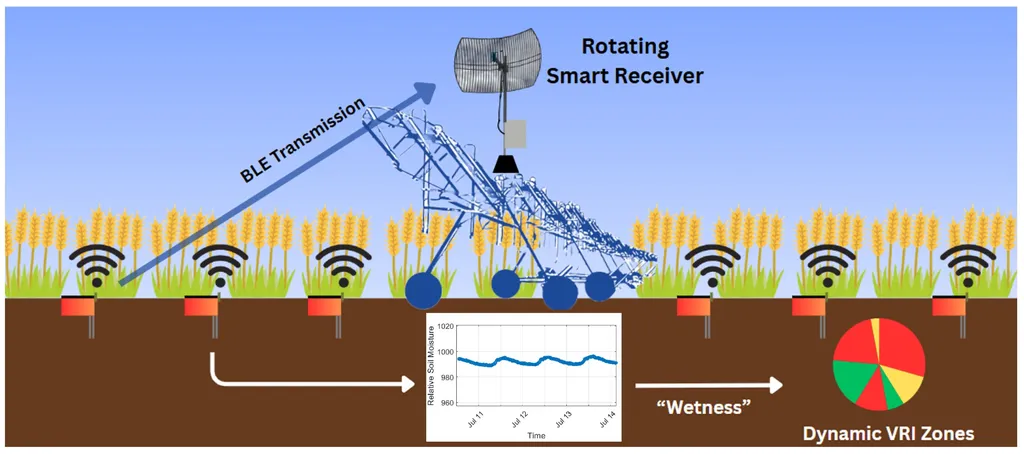
One of the significant advancements in CRNS technology has been the development of cost-efficient instruments using alternative technologies to the previously scarce helium-3. This shift has made the method more accessible and scalable, paving the way for its application in practical contexts such as irrigation management and soil moisture mapping. “With more cost-effective instrumentation, we can now focus on applied contexts like climate-resilient agriculture,” notes Köhli.
However, challenges remain. The technique’s large footprint can be a double-edged sword, particularly for smaller irrigated fields or areas with heterogeneous conditions. “Heterogeneous biomass distribution can complicate the interpretation of data,” Köhli acknowledges. Despite these hurdles, the potential benefits of CRNS are substantial, offering a more holistic understanding of soil moisture dynamics.
The ‘Soil Moisture Metrology’ (SoMMet) consortium is at the forefront of establishing the metrological basis for CRNS, ensuring the accuracy and traceability of measurements. This collaborative effort is crucial for harmonizing the methodology and integrating it into mainstream agricultural and hydrological practices.
As the agricultural sector faces increasing pressures from climate change and water scarcity, innovative technologies like CRNS offer a beacon of hope. By providing real-time, high-quality soil moisture data, farmers and water managers can make more informed decisions, optimizing water use and enhancing crop resilience. The research led by Markus Köhli from the Physikalisches Institut at Heidelberg University, published in *Geoderma*, underscores the transformative potential of CRNS, heralding a new era in precision agriculture and environmental monitoring.