
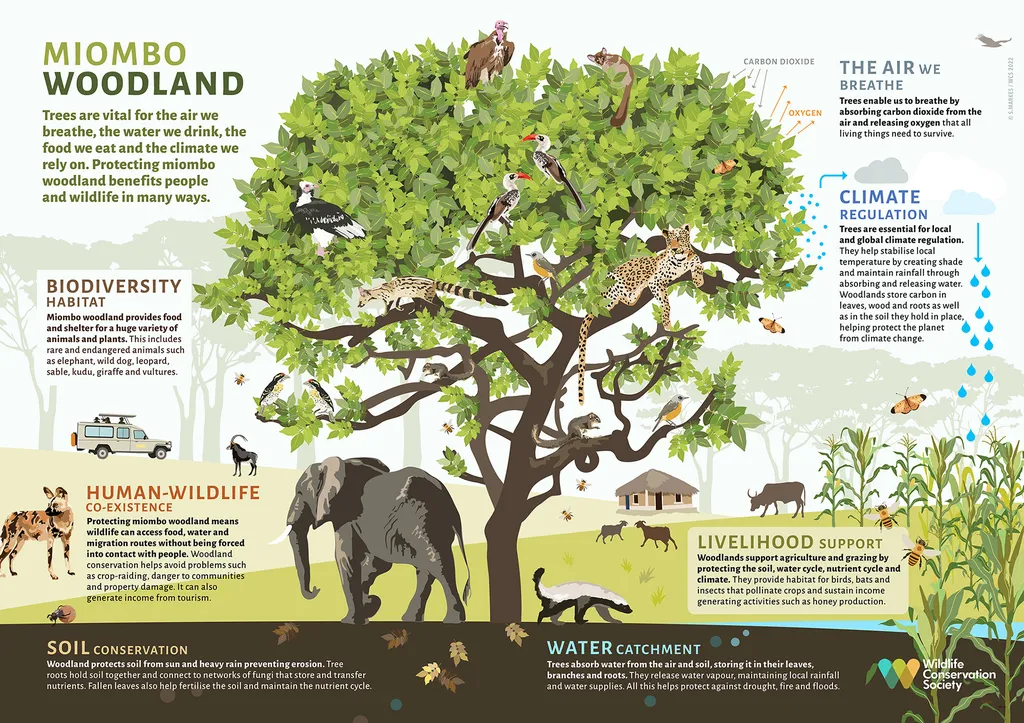
In the heart of Mozambique, two protected areas are revealing secrets about the miombo woodlands that could reshape how we understand and manage these vital ecosystems. A recent study published in *Forest Ecosystems* delves into the floristic diversity and forest structure of Gilé National Park (GNP) and Niassa Special Reserve (NSR), offering insights that could have significant implications for conservation and agriculture.
The research, led by Cremildo Dias of the Agricultural Research Institute of Mozambique (IIAM) and the University of Lisbon, utilized seven permanent sampling plots (PSPs) to assess the horizontal and vertical structure, species diversity, and spatial patterns of trees with a diameter at breast height (DBH) of at least 5 cm. The findings highlight the ecological distinctiveness of these two protected areas, each with its own unique characteristics and challenges.
“NSR exhibited slightly higher adult species richness and greater tree density for both adults and juveniles, reflecting active regeneration and structural maturity,” Dias explained. This suggests that NSR is in a more advanced stage of ecological development compared to GNP, which showed greater species evenness and localized floristic heterogeneity. The dominant species, such as *Brachystegia spiciformis*, *Julbernardia globiflora*, and *Pseudolachnostylis maprouneifolia*, play a crucial role in shaping the spatial organization and structural patterns of these woodlands.
The study also revealed that most species displayed moderate intraspecific aggregation, with conspecific individuals often clustered locally. However, overall tree spacing tended to be regular, indicating limited interspecific mixing and the coexistence of species-level aggregation with stand-level regularity. This complex interplay of species distribution and forest structure has significant implications for forest management and conservation strategies.
For the agriculture sector, these findings could be a game-changer. Understanding the spatial organization and structural attributes of miombo woodlands can help in developing more sustainable land-use practices. By identifying the dominant species and their roles in the ecosystem, farmers and foresters can make informed decisions about crop selection, agroforestry practices, and conservation efforts.
“The need to expand and establish more PSPs for long-term monitoring and adaptive forest management within the framework of REDD+ and national biodiversity strategies is crucial,” Dias emphasized. This long-term monitoring will provide valuable data that can guide policy decisions and ensure the sustainable management of these vital ecosystems.
As we look to the future, this research underscores the importance of integrating ecological insights into agricultural and conservation practices. By doing so, we can ensure the long-term health and productivity of miombo woodlands, benefiting both the environment and the communities that depend on them.
The study, published in *Forest Ecosystems*, was led by Cremildo Dias, affiliated with the Agricultural Research Institute of Mozambique (IIAM) and the University of Lisbon. This groundbreaking research not only sheds light on the ecological dynamics of miombo woodlands but also paves the way for more sustainable and informed land-use practices in the agriculture sector.