
In the heart of Germany’s Rhineland, a quiet revolution is taking place, one that could reshape the future of agriculture. Researchers at the University of Bonn have compiled a comprehensive dataset that promises to break through the so-called “phenotyping bottleneck,” a challenge that has long hindered crop research and development. This bottleneck, characterized by the expensive and labor-intensive nature of monitoring crop traits, has been a significant hurdle in the path of agricultural innovation.
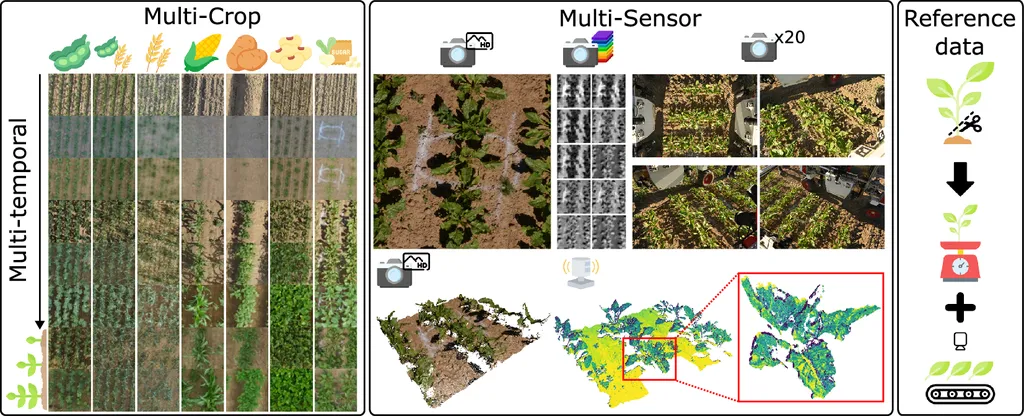
The MuST-C (Multi-Sensor, multi-Temporal, multiple Crops) dataset, published in the journal *Scientific Data*, is a testament to the power of automation and data-driven methods. Led by Yue Linn Chong from the Center for Robotics at the University of Bonn, the team has deployed aerial and ground robotic platforms equipped with RGB cameras, LiDARs, and multispectral cameras to capture a wide variety of modalities and observations from different viewpoints. The dataset includes field data from various sensors collected over a growing season, covering six crop species, all georeferenced for alignment across sensors and dates.
The significance of this dataset lies in its potential to enable the development of novel automatic phenotypic trait estimation methods. “Our dataset allows for comparisons across different sensors and generalizability across crop species,” Chong explains. This capability is crucial for advancing research in crop trait variation, which is essential for improving crop yields, resilience, and sustainability.
The commercial impacts of this research are substantial. By reducing the cost and labor involved in phenotypic trait monitoring, the MuST-C dataset could accelerate the development of new crop varieties that are better adapted to changing climates and resistant to pests and diseases. This, in turn, could lead to more efficient and sustainable agricultural practices, benefiting farmers and consumers alike.
Moreover, the dataset’s ability to facilitate comparisons across different sensors and crop species could pave the way for more integrated and holistic approaches to crop monitoring and management. This could lead to the development of more precise and effective agricultural technologies, further enhancing the productivity and sustainability of the agriculture sector.
As we look to the future, the MuST-C dataset represents a significant step forward in the field of agricultural research. By providing a valuable resource for the development of automatic phenotypic trait estimation methods, it promises to break through the phenotyping bottleneck and unlock new possibilities for crop improvement. The potential benefits for the agriculture sector are immense, and the impact of this research is likely to be felt for years to come.