
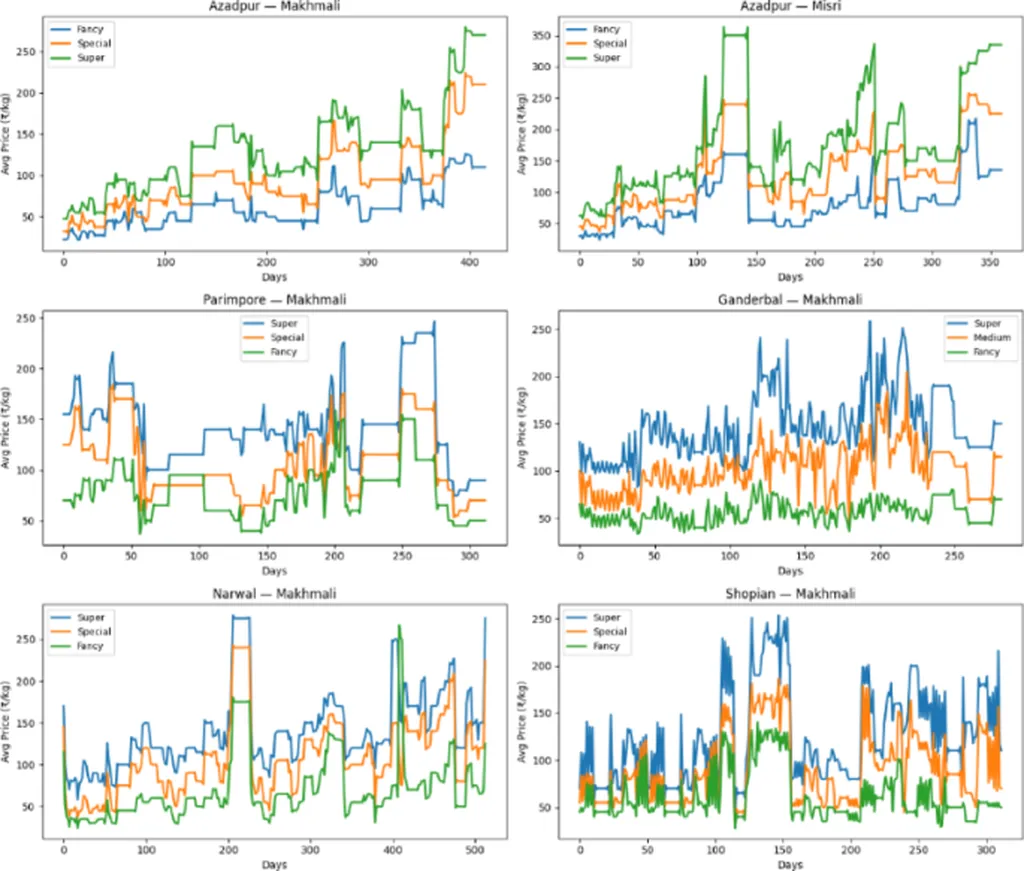
In the dynamic world of agriculture, where prices can fluctuate as rapidly as the weather, having an accurate crystal ball would be a game-changer. For cherry producers and traders in India, that crystal ball might just have arrived in the form of deep learning algorithms, according to a recent study published in *Scientific Reports*.
The research, led by F. A. Shaheen from the Institute of Business and Policy Research at Sher-e-Kashmir University of Agricultural Sciences and Technology of Kashmir, explores the potential of deep learning (DL) models to forecast cherry prices with remarkable accuracy. The study compared six different forecasting methods, including traditional statistical models like Seasonal Auto-regressive Integrated Moving Average (SARIMA) and machine learning models like Random Forest (RF) and Extreme Gradient Boosting (XGBoost), against deep learning architectures like Long Short-Term Memory (LSTM) and Transformer.
The results were striking. “Deep learning models, particularly LSTM and Transformer, consistently outperformed the other methods across all error metrics,” Shaheen explained. These models demonstrated a superior ability to capture the non-linear price changes that are typical in agricultural markets. The study found that the best-performing LSTM model could predict cherry prices with over 92% accuracy for market-variety-grade combinations, with error margins as low as 5-10% in major markets like Azadpur, Narwal, and Parimpora.
The implications for the agriculture sector are substantial. Accurate price forecasting can stabilize producer income, inform policy interventions, and provide real-time decision support for various stakeholders. Imagine a cherry farmer in Kashmir being able to access daily price predictions based on real-time market conditions. This information could guide decisions on harvesting, transportation, and sales, ultimately maximizing profits and minimizing waste.
The study didn’t stop at theoretical predictions. During the 2025 cherry season, the researchers deployed the LSTM model as a live, web-based forecasting system. Market officials could submit real-time data, and the system would generate daily predictions. The accuracy of these predictions was later verified against actual prices, confirming the model’s reliability.
This research could shape the future of agricultural market intelligence. As Shaheen noted, “The current study presents a novel and comprehensive operational methodology for advanced AI models in the agriculture and allied sectors of India.” The framework established here could be scaled up and adapted for other high-value perishable goods, creating a more stable and predictable market for producers and traders alike.
In an era where technology is transforming every sector, it’s heartening to see agriculture, often seen as a traditional industry, embracing innovation. The integration of deep learning models into agricultural market intelligence systems could herald a new era of data-driven decision-making, benefiting everyone from the small-scale farmer to the large-scale trader. As this technology continues to evolve, we can expect to see even more sophisticated models and applications, further revolutionizing the way we think about and interact with our food supply chains.