
In the heart of Europe, a groundbreaking study is reshaping how we monitor and manage ammonia emissions from cereal crops. Researchers have developed a novel IoT system that promises to bring real-time, data-driven decision-making to the agricultural sector. This innovation, published in *Scientific Reports*, could be a game-changer for sustainable farming practices.
The study, led by Nyéki Anikó from the Albert Kázmér Mosonmagyaróvár Faculty of Agricultural and Food Sciences at Széchenyi István University, introduces a LoRaWAN-based IoT system designed for real-time monitoring of ammonia (NH₃) emissions in cereal crop fields. This system integrates soil, crop, and microclimate sensors to observe a range of environmental variables, including NH₃⁺, air temperature, rainfall, humidity, soil temperature, and moisture content.
“Our goal was to create a system that could provide farmers with real-time data on ammonia emissions and environmental conditions,” Nyéki Anikó explained. “This information is crucial for making informed decisions that can enhance crop productivity while minimizing environmental impact.”
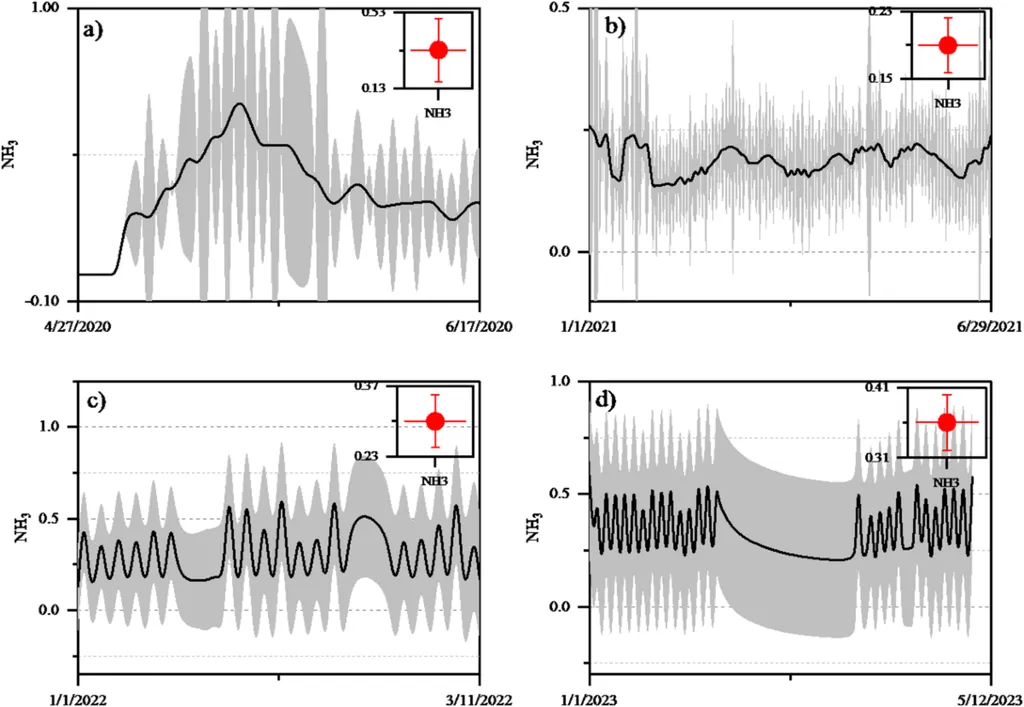
The system comprises a field lab, data server, and custom dashboard with analytics capabilities. Over three growing seasons (2020–2023), the researchers measured NH₃ fluxes in autumn-sown cereals. The data revealed significant variations in NH₃ emissions and environmental variables between years. For instance, the highest NH₃ emissions were recorded in 2020 (1.94 ppm) and 2021 (1.71 ppm), coinciding with elevated air (25–31°C) and soil (21–23°C) temperatures, as well as higher mean and peak rainfall (0.40–0.48 mm average; max 9–31.6 mm).
Principal Component Analysis showed that 65.8% of the variance was explained by the first two principal components, with high loadings from temperature and soil moisture. Spearman’s correlation indicated moderate positive associations between NH₃ and soil moisture at 20 cm and 40 cm depths, and a weak negative correlation with soil temperature at the same depths.
The implications of this research are far-reaching. By providing real-time monitoring of ammonia emissions and environmental variables, the IoT system can help farmers optimize their practices to reduce greenhouse gas emissions while maintaining crop yields. This is particularly important in the context of sustainable agriculture, where the need for on-farm greenhouse gas tracking is increasingly recognized.
“Our study underscores the potential of IoT technology using calibrated gas sensors and LoRaWAN for real-time NH₃ and environmental monitoring,” Nyéki Anikó noted. “This technology can enable informed decision-making in smart agriculture, ultimately contributing to more sustainable and efficient farming practices.”
The commercial impact of this research is significant. Farmers can use the data provided by the IoT system to make timely adjustments to their farming practices, such as optimizing fertilizer application and irrigation schedules. This can lead to cost savings and improved crop yields, while also reducing the environmental footprint of agriculture.
As the agricultural sector continues to evolve, the integration of IoT technology is likely to play a pivotal role. The research led by Nyéki Anikó and her team at the Albert Kázmér Mosonmagyaróvár Faculty of Agricultural and Food Sciences represents a significant step forward in this direction. By providing real-time, data-driven insights, this technology has the potential to shape the future of smart agriculture, making it more sustainable, efficient, and environmentally friendly.