
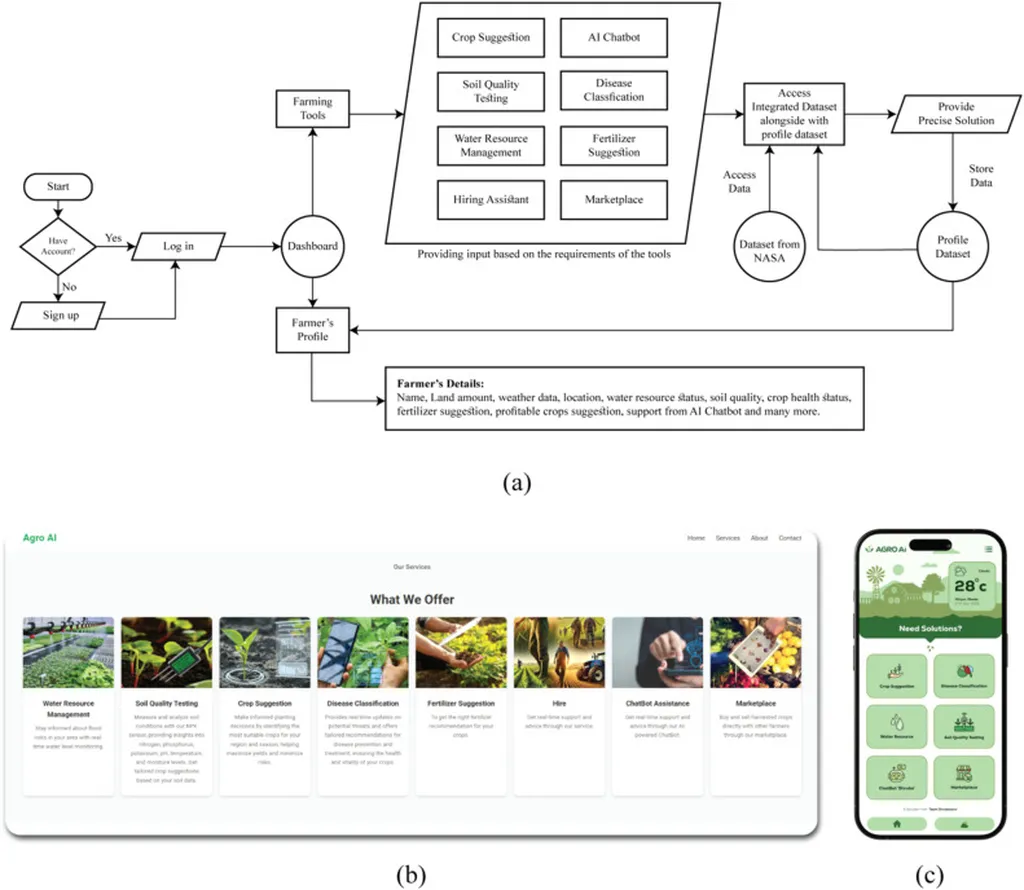
In the heart of Bangladesh, where agriculture is the lifeblood of the economy, farmers are often grappling with challenges that limit productivity and sustainability. From optimizing resources to managing soil health and detecting diseases, the hurdles are many. While machine learning has been employed in the past to tackle these issues, solutions have often been fragmented, relying on small datasets and lacking the integration of large-scale monitoring with field-level precision. Enter AGRO AI, a compact yet comprehensive web and mobile platform that promises to revolutionize agriculture in Bangladesh and beyond.
AGRO AI, developed by a team led by Md Shamsul Arefin from the Department of Electrical & Electronic Engineering at Bangladesh University of Business and Technology (BUBT), integrates NASA satellite data for large-scale agricultural monitoring with real-time IoT sensor inputs capturing localized land conditions. This fusion of macro- and micro-level insights enables the platform to generate personalized recommendations for water resource management, soil quality assessment, crop and fertilizer selection, and early detection of diseases and pests.
“The novelty of our research lies in its multi-source data fusion framework,” Arefin explains. “By unifying large-scale monitoring with field-level precision, we’ve created a scalable and integrated platform that improves recommendation accuracy beyond existing localized solutions.”
The commercial impacts of AGRO AI on the agriculture sector are substantial. By enhancing crop yields and reducing environmental impact, the platform contributes to food security and climate-resilient agriculture. The AI-powered chatbot feature ensures continuous farmer support, making the technology accessible and user-friendly.
AGRO AI’s unified approach not only improves recommendation accuracy but also offers a farmer-centric interface adaptable to diverse agricultural contexts. This adaptability is crucial in a country like Bangladesh, where agricultural practices vary widely from region to region.
The research, published in the journal Applied Food Research, is poised to shape future developments in the field. By demonstrating the potential of integrating satellite data with real-time IoT inputs, AGRO AI sets a new standard for agricultural technology. The platform’s success could inspire similar initiatives in other countries, fostering a global movement towards more sustainable and efficient farming practices.
As the world grapples with the challenges of climate change and food security, innovations like AGRO AI offer a beacon of hope. By leveraging the power of artificial intelligence and satellite data, we can transform agriculture into a more resilient and productive sector, ensuring a sustainable future for generations to come.