
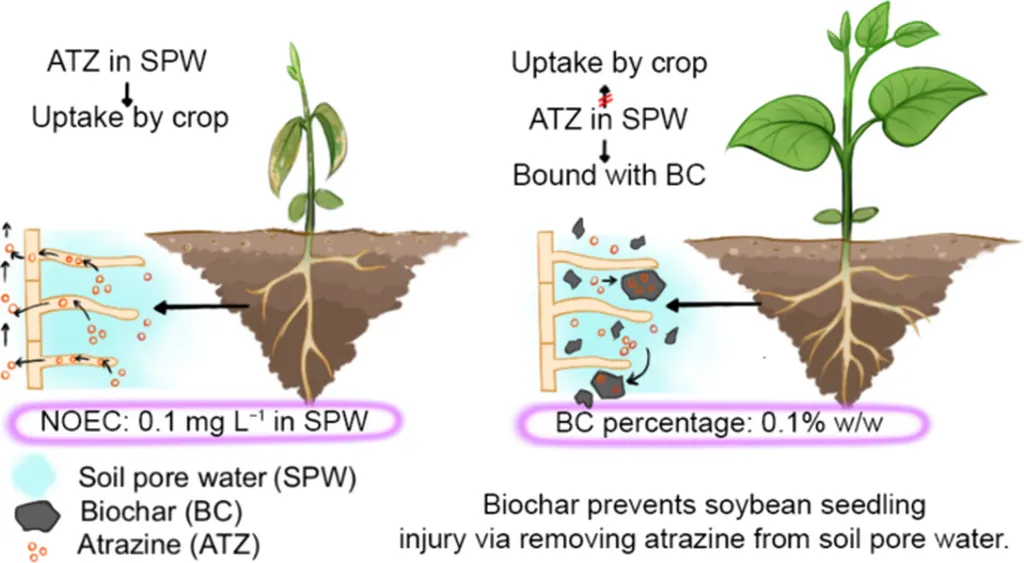
In the quest for sustainable and efficient agricultural practices, researchers have made a significant stride by exploring the potential of biochar-coated seeds to enhance soybean tolerance to herbicides. A recent study published in *Frontiers in Plant Science* reveals promising results that could revolutionize weed management and crop protection in soybean farming.
Soybean (Glycine max L.) is notoriously sensitive to herbicides, which often limits the effectiveness of chemical weed control and poses challenges to sustainable production. To address this issue, a two-year field study conducted at the Agronomic Farm, University of Agriculture Faisalabad, investigated the effectiveness of biochar-coated soybean seeds in enhancing herbicide tolerance and suppressing weeds. The study, led by Muhammad Awais Arshad from the Department of Agronomy at the University of Agriculture Faisalabad, offers insights that could have far-reaching implications for the agriculture sector.
The experiment employed a randomized complete block design with a factorial arrangement, comprising 12 treatments replicated three times. These treatments included biochar-coated seeds and normal seeds, combined with six weed control treatments: s-metolachlor + pendimethalin, s-metolachlor, fluazifop-p-butyl, haloxyfop-p-ethyl, weed-free, and a weedy check. The study recorded various growth, yield, quality, and weed-related indices throughout the two-year period.
The results were striking. Biochar-coated seeds combined with s-metolachlor + pendimethalin significantly reduced weed dry weight, lowered the susceptibility index, and improved seed yield, protein content, and oil content. “This treatment not only suppressed weeds effectively but also minimized crop injury, demonstrating the protective role of biochar against herbicide-induced stress,” said lead author Muhammad Awais Arshad.
In 2022 and 2023, the biochar-coated seeds treated with s-metolachlor + pendimethalin showed a remarkable reduction in weed dry weight (699.5 and 516.2 kg ha-1, respectively) and a lower susceptibility index (1.5 and 1.2, respectively). The seed yield increased to 1879.21 and 1933.77 kg ha-1, with protein content reaching 34.7% and 35.3%, and oil content at 19.3% and 19.8%, respectively. These findings highlight the potential of biochar-coated seeds to enhance crop resilience and productivity.
The study also revealed a 3.12% to 3.95% higher weed control percentage, a 9.93% to 12.55% increase in weed persistence index, and a 3.25% higher weed control efficiency. Weed indices were lower, and yield losses were limited to only 6.66% and 8.93% compared to normal seeds. “Overall, these findings confirm that biochar-coated seeds, combined with s-metolachlor and pendimethalin, effectively suppress weeds with minimal crop injury, while also improving protein, oil content, and yield,” Arshad explained.
The commercial implications of this research are substantial. Farmers could benefit from reduced herbicide use, lower production costs, and improved crop yields. The use of biochar-coated seeds could also contribute to more sustainable and eco-safe food systems, aligning with global efforts to promote environmentally friendly agricultural practices.
As the agriculture sector continues to seek innovative solutions to enhance productivity and sustainability, this research offers a promising avenue for exploration. The findings warrant further investigation across diverse agro-ecological conditions, potentially paving the way for widespread adoption of biochar-coated seeds in soybean farming and beyond. With continued research and development, biochar-based seed coatings could become a cornerstone of modern, climate-smart agriculture.